Asheville Stone Masonry

Services

Boulder Retaining Walls in Asheville, NCFire Pit Builders in Asheville, NCFlagstone Patios in Asheville, NCGas Fire Pit Installation in Asheville, NCHardscaping in Asheville, NCOutdoor Fireplace and Outdoor Kitchen Builders in Asheville, NCOutdoor Kitchen Builders in Asheville, NCPaver Driveways and Walkways in Asheville, NCPaver Patio Installers in Asheville, NCRetaining Wall Repair in Asheville, NCRetaining Wall Contractors in Asheville, NCStacked Stone Fireplaces in Asheville, NCStone Retaining Walls in Asheville, NC: Dry-Stack and MortaredStone Steps and Walkways in Asheville, NCStone Veneer Installation in Asheville, NCStone Waterfalls and Ponds in Asheville, NC

Cost & Rules

Backyard Waterfall and Pond Cost in NCBoulder Retaining Wall Cost in NCFire Pit Installation Cost in NCFlagstone Patio Cost per Square Foot in NCHow Much Does a Retaining Wall Cost in NC?Outdoor Fireplace Cost in NCOutdoor Kitchen Cost in NCPaver Patio Cost per Square Foot in NC

Areas

Fire Pit Builders in Arden, NCFire Pit Builders in Barnardsville, NCFire Pit Builders in Biltmore Forest, NCFire Pit Builders in Black Mountain, NCFire Pit Builders in Candler, NCFire Pit Builders in Canton, NCFire Pit Builders in Clyde, NCFire Pit Builders in Etowah, NC All pages → Get a free quote
Buncombe County, NC · Service

Flagstone Patios in Asheville, NC

Flagstone patio Asheville NC: what natural stone patios cost in Buncombe County, how site prep on slopes works, and why drainage beats thickness.

Free on-site estimateReal photos of our own workBased in Candler, west of AshevilleSe habla espanolWalls, patios, fire pits, veneer Free on-site estimateReal photos of our own workBased in Candler, west of AshevilleSe habla espanolWalls, patios, fire pits, veneer

Get a free quote

Fast reply — no obligation.

Goes straight to us. We never sell or share your info.

Quick answer
Flagstone Patios in Asheville, NC

A flagstone patio in Asheville, NC typically costs $18–$32 per square foot installed, with most projects landing between $8,000 and $25,000. What you're paying for isn't the stone — it's the compacted base, the drainage plan, and the installation that keeps the slabs from becoming a wobbly mosaic after a mountain winter. Get the base right and the stone is the easy part.

19
federal disaster declarations on record in Buncombe County
Hurricane Dorian
most notable event in the federal record
1973–2026
span of the declaration record
Asheville
Buncombe County hub

What flagstone patios actually are — and what they aren't

Flagstone is nature's paving: quarried sedimentary stone — usually mountain quartzite or bluestone in western North Carolina — split into flat slabs and laid on a prepared base to form a patio surface. The stone itself is the romance; the base is the marriage. A flagstone patio that fails does so because water moved the soil underneath, not because the stone wore out. In Buncombe County, where the clay is expansive and the slopes are real, that base is the whole ballgame.

Here's the honest part most quotes skip: flagstone is a surface. It does not solve a drainage problem, it does not terrace a slope by itself, and it will not stay flat on ground that's still moving. If your yard pitches toward the house or runoff from the hillside crosses your patio site, that water plan has to be solved before the stone goes down — often with the same excavation that prepares the base. Patios that get installed without this conversation are how paver patios (or flagstone, for that matter) end up needing re-leveling within a few years.

Installation — the order of operations that matters

A correctly built flagstone patio in Asheville follows a sequence that a lot of crews skip corners on. The standard steps:

  • Site evaluation and layout. Mapping the slope, locating the water table's influence, and marking the footprint — the cheapest hour of the whole project is the one spent looking at where water comes from and goes to.
  • Excavation to 6–8 inches. Removing the organic topsoil down to mineral soil or competent clay. Organic material under a patio is a slow-motion collapse.
  • Base stone and compaction. 4–6 inches of crushed stone — typically #57 stone or road base — compacted in lifts. This is the load-bearing layer.
  • Screening sand or stone dust. A leveling bed that gives the installer final control over each stone's plane.
  • Stone selection and fitting. The craft part — sorting for thickness, cutting to fit the gaps, and staggering joints so the patio reads as a unified surface.
  • Joint filling. Stone dust or polymeric sand swept into the gaps, then compacted again. The joints need to drain — flagstone patios are only as good as their ability to shed water.

On a slope, that sequence gains a retaining edge — often a header course or a stone step that holds the low side. That's where the structural thinking happens, and where a crew that only knows flat-lawn installation gets exposed.

What a flagstone patio costs in Buncombe County

Prices in this region run $18–$32 per square foot installed, with $22–$26 being the realistic middle for a straightforward job on reasonably flat ground. The table below shows how scope moves the number:

ScopePrice Range (per sq ft)What drives the cost
Simple flagstone patio, flat-ish yard, 200–300 sq ft$18–$24Pallet stone (irregular shapes), minimal cutting, no retaining edge
Custom-laid patio with cut stone, 300–500 sq ft$22–$28More cuts, specified color/gauge, better sorting time
Sloped yard patio with retaining edge or steps$26–$35Engineered edge, drainage behind the wall, fire pit integration if requested
Premium stone (bluestone, gauged quartzite), full hardscape$30–$40+Material cost alone can double; gauged stone means less waste and more consistent surface

Stone thickness matters less than the base — but it does matter. In this climate, with freeze-thaw cycles and the dramatic wet-dry swings that come with the mountain weather pattern, 1–1.5 inch minimum thickness for flagstone is the rule. Thin veneer stone is for walls, not for walking on. The International Code Council's standards for pedestrian paving and footings reflect that reality: the stone is a wearing surface, and the structure below it carries the load.

Buncombe County specifics: weather, soil, and the climate reality

Asheville sits in a rain shadow at the edge of the Blue Ridge, which means it gets real weather — heavy summer downpours, freezing winters, and the occasional ice event that tests anything installed at grade. The clay soils here are the real enemy: they hold water, they expand when wet and shrink when dry, and a patio base laid on unprepared clay is a patio that's heaving by year two. That's why excavation depth and base compaction are non-negotiable — and why the National Weather Service data on this region's storm patterns (19 federal disaster declarations since 1973-2026) matters for more than trivia: when the ground is saturated and the hillsides are moving, patios that were built without a drainage conversation are the ones that call us in the spring.

The other Buncombe County reality is slope. This is not flat terrain, and a "simple" patio on paper becomes a project with a retaining wall, a French drain, or a stepped layout the moment a transit level goes on it. Any local installer who quotes you a flat number without seeing your yard's grade is guessing — and the guess is usually low. The county itself doesn't typically require a permit for a ground-level patio under 200 square feet, but if you're adding a roof, a retaining wall over 4 feet, or tying into the house, the NC building code sets the threshold and any honest contractor will tell you to pull the permit.

The four questions that keep a flagstone bid honest

“How many inches of compacted base am I paying for, and is it in the bid?” If the answer isn't "4 to 6 inches of crushed stone, compacted in lifts," you're paying for a patio that won't last. “What happens to the water that runs off the hill before it hits my patio?” A swale, a curtain drain, or a redirect — any answer that starts with "we'll just grade it" is incomplete. “Is the stone gauged or ungauged, and does the price reflect that difference?” Gauged stone is uniformly thick and costs more; ungauged varies and takes more skill to set level. “Can I see three recent local installations?” Not photos — actual yards you can walk on after a rain. The best reference is a patio that's weathered two winters. If a contractor can't produce that, ask yourself why.

One more honest note: with the regional building patterns tightening around storm resilience, the smart money is on building the base as if the next big rain is coming this spring — because in the mountains, it is.
Buncombe County, NC: the storm record

Federally declared disaster events19
Named storms in the recordHurricane Dorian, Hurricane Florence, Hurricane Fran, Hurricane Helene, Hurricane Ian, Hurricane Isaias
Incident typesFire, Flood, Hurricane, Severe Storm, Snowstorm
Record span (fiscal years)1973–2026
Source: FEMA OpenFEMA disaster declarations. County-level federal declarations, not individual claims.
Questions people ask

Straight answers

How much does a flagstone patio cost in Asheville, NC?
Expect $18–$32 per square foot installed in Buncombe County. A 300 sq ft patio typically lands $6,500–$9,000 with standard stone; custom stone or slope work pushes it toward the top of that range or beyond.
Is flagstone or pavers better for Asheville's climate?
Both work when the base is right. Flagstone gives a natural, irregular look and stays cool in summer; concrete pavers are more uniform, often more slip-resistant when wet, and can be easier to replace individually. The deciding factor is usually aesthetics and how the stone's character fits your house — not durability.
Does a flagstone patio need a permit in Buncombe County?
Ground-level patios under 200 square feet typically don't require a permit. If you're adding a permanent roof structure, a retaining wall over 4 feet, or altering drainage that affects your neighbor, the NC building code applies and a permit is required. Your installer should tell you which side of the line you're on.
Why do flagstone patios sink or heave after a few years?
Almost always because the base was too thin, the soil wasn't compacted, or water was allowed to wash the base material away. Clay soils in Asheville move with moisture; a proper 6-inch+ compacted stone base with drainage solved at the surface is the only thing that stops that movement.
What thickness flagstone do I need for a patio?
A minimum of 1 inch, with 1.25–1.5 inches preferred for walk-on surfaces in a freeze-thaw climate. Thinner stone breaks, cracks under point loads, and shifts more. The extra cost of slightly thicker stone is trivial compared to the long-term difference.
Can you install a flagstone patio on a sloped yard?
Yes — a slope is a feature, not a bug, when handled right. It typically requires a retaining edge on the low side, possibly a stone step or walkway transition, and always a drainage plan at the top of the slope. Expect that work to add 15–30% to the project cost.
Do flagstone patios need sealing or maintenance?
Flagstone is natural and requires very little — sweep it, occasionally rinse it. Sealing is optional; it can enrich color but can also trap moisture and cause spalling in freeze-thaw. We generally recommend leaving natural stone unsealed in this climate unless you have specific staining concerns.
Our work

Our work

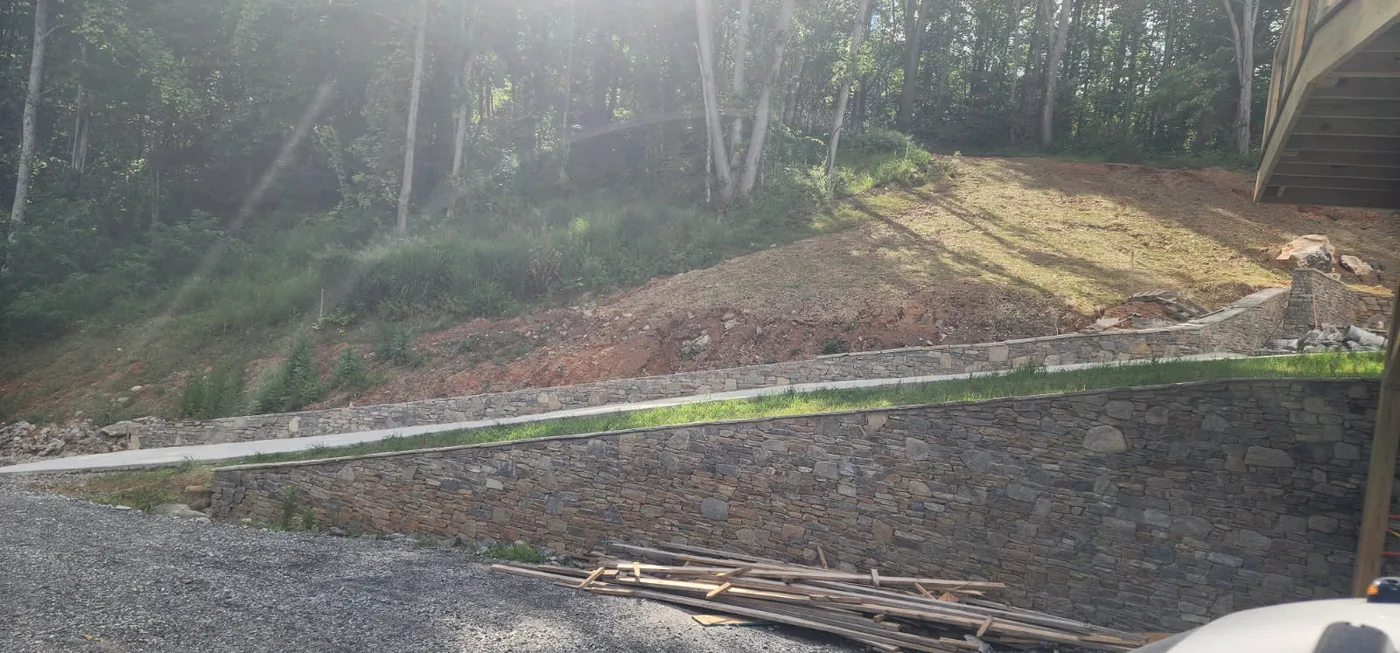
Mortared fieldstone retaining walls stepping up a mountain driveway, with fresh concrete poured between them. Built by Asheville Stone Masonry.
Mortared fieldstone retaining walls stepping up a mountain driveway, with fresh concrete poured between them.
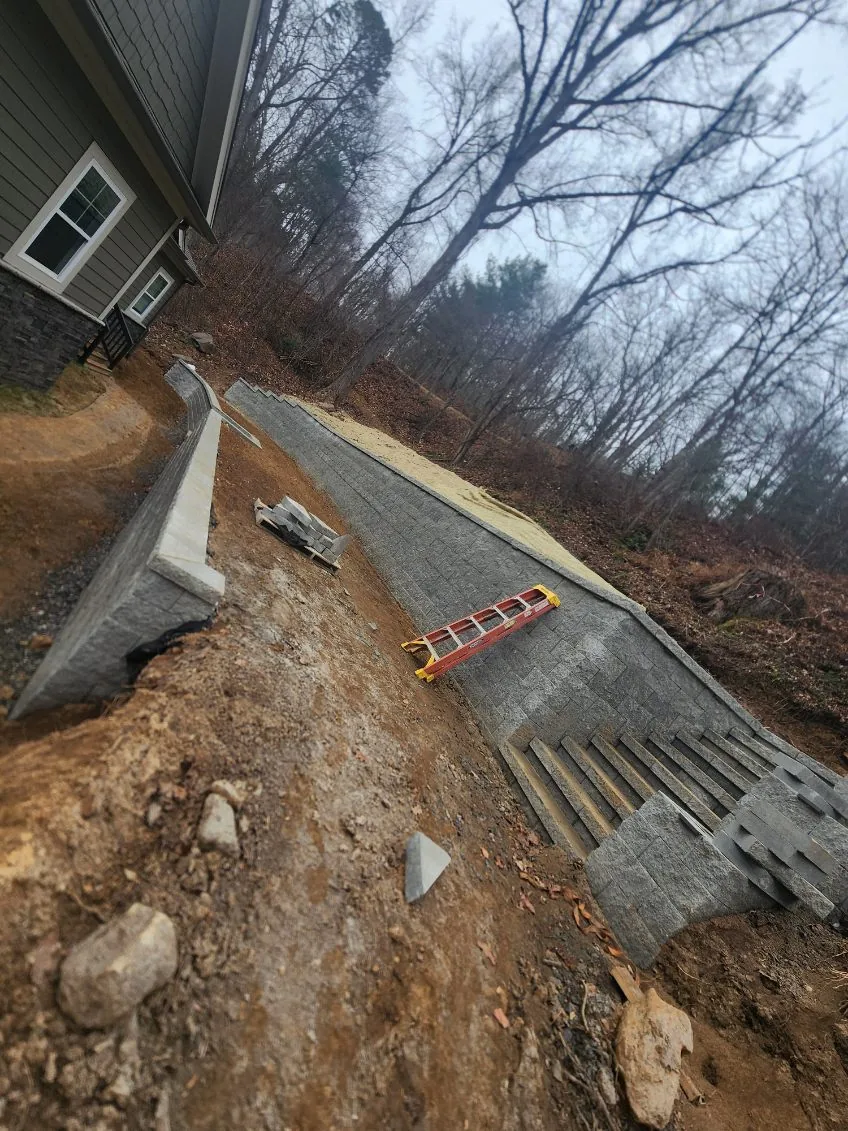
Segmental block retaining wall with a built-in stair run, holding the grade beside a new home. Built by Asheville Stone Masonry.
Segmental block retaining wall with a built-in stair run, holding the grade beside a new home.
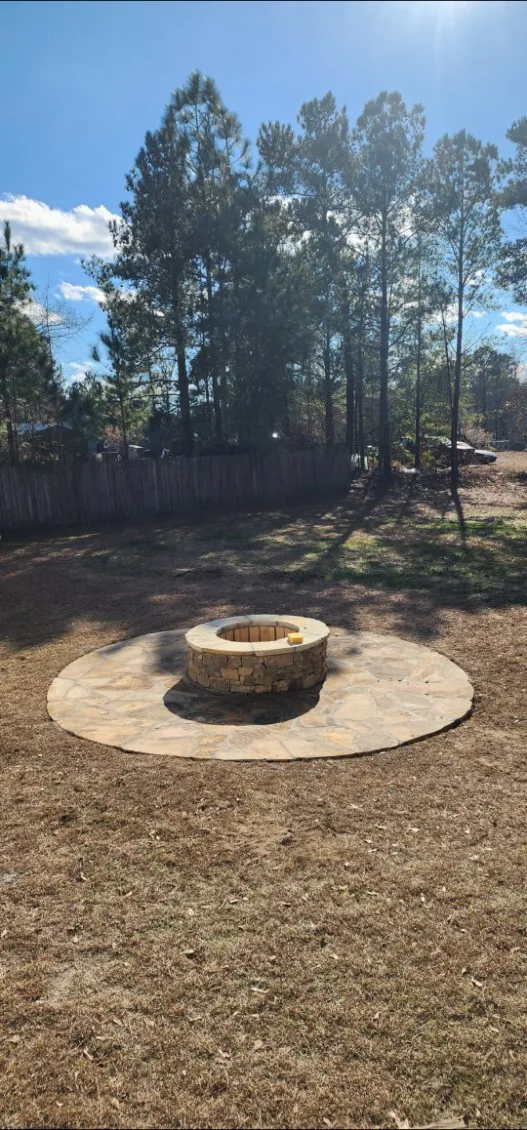
Finished fire-pit patio: a stacked-stone ring with a cut-stone cap inside a full circle of flagstone. Built by Asheville Stone Masonry.
Finished fire-pit patio: a stacked-stone ring with a cut-stone cap inside a full circle of flagstone.
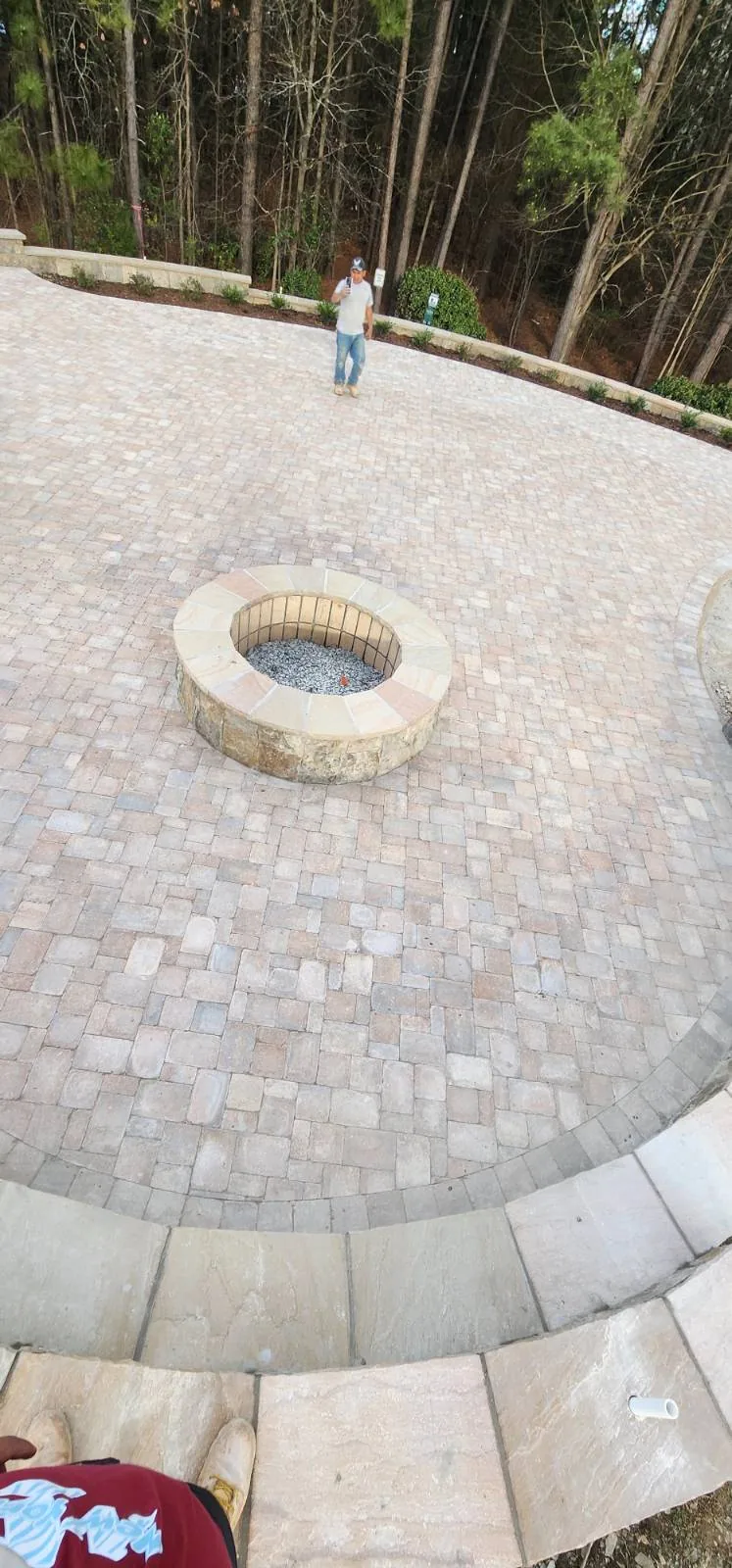
Circular paver patio with a stone fire pit and a curved seat wall at the tree line. Built by Asheville Stone Masonry.
Circular paver patio with a stone fire pit and a curved seat wall at the tree line.
Get a quote

Tell us about your project. We price it straight.

Where it is and what you need — that's all it takes to start. You get a clear scope and an honest number, and your info never gets sold to a list.

Or call — (828) 424-8873

Fast, free quote

Call now Text us