How a Fairview water feature gets built, start to finish
Fairview sits southeast of Asheville in Buncombe County, up against however the ground happens to fall on your particular ridge or hollow. That is why nearly every waterfall and pond project here is a sequence problem before it is a design problem. A crew's first day on site is not digging. It is walking the grade and asking where the water will actually go when the pump shuts off, because a Fairview slope will route overflow somewhere whether you planned for it or not.
The order that works: Day 1 is layout and level checks — marking the pond edge, the falls drop, the header pool, and the gravel overflow path. Days 2–5 are excavation and hauling, which in this ground means rock, clay, or both, and the spoil has to go somewhere on a mountain lot. Days 5–8 are the underlayment and plumbing: liner or concrete shell, skimmer, pump vault, and the flexible or rigid line run up to the falls head. Days 8–14 are the part you actually hired the trade for — setting stone so the falls read as one continuous sheet instead of stacked rocks. Days 14–20 are water tuning, edge concealment, and planting. A small recirculating waterfall on an easy grade can finish in under two weeks; a large pond with a long stream run on difficult ground can run five weeks or more. Any quote that promises the whole thing in three days is selling you a liner and a pump, not a built feature.
The Fairview version of that sequence has a few local wrinkles that are worth knowing before a shovel hits the ground. The first is spoil. On a lot with any grade at all, you are not just moving dirt, you are deciding where a pile of it lives while the job is open — on a narrow ridge, that often means the spoil sits on the driveway apron or gets hauled off-site, and hauling adds days and dollars. The second is water. Fairview draws from a mix of wells and municipal lines, and if a fill line is part of the plan, that connection changes who is on site and when. The third is access. A machine that fits through a gate opening is different from one that fits down a switchback, and on some Fairview lots the equipment choice is made before the design is finalized.
That is also why weather windows matter here. This side of Buncombe County gets the same wet season that feeds the rest of the region, and an open excavation that fills with rain is not just an inconvenience — it is a re-dig. Builders who know the terrain tend to schedule excavation tight against the liner or shell work rather than leaving a pit open for a week, because a storm during that gap costs more than the original dig.
What the Fairview price bands actually pay for
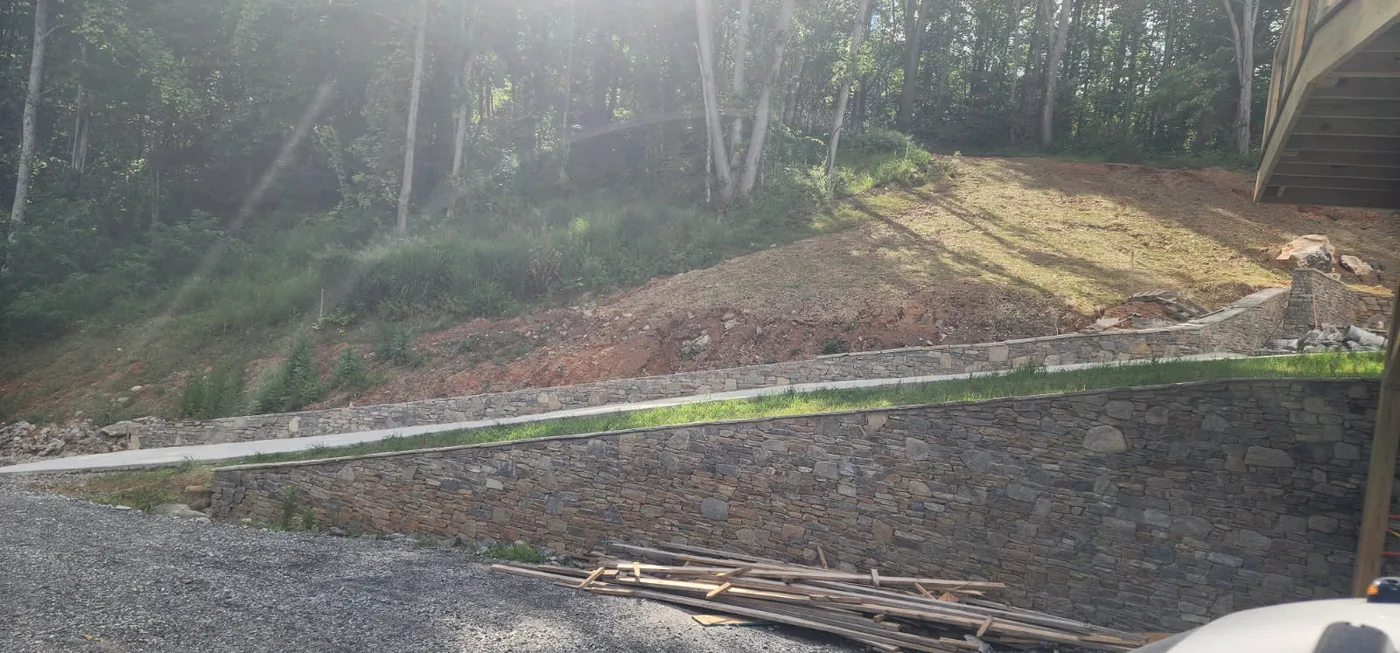
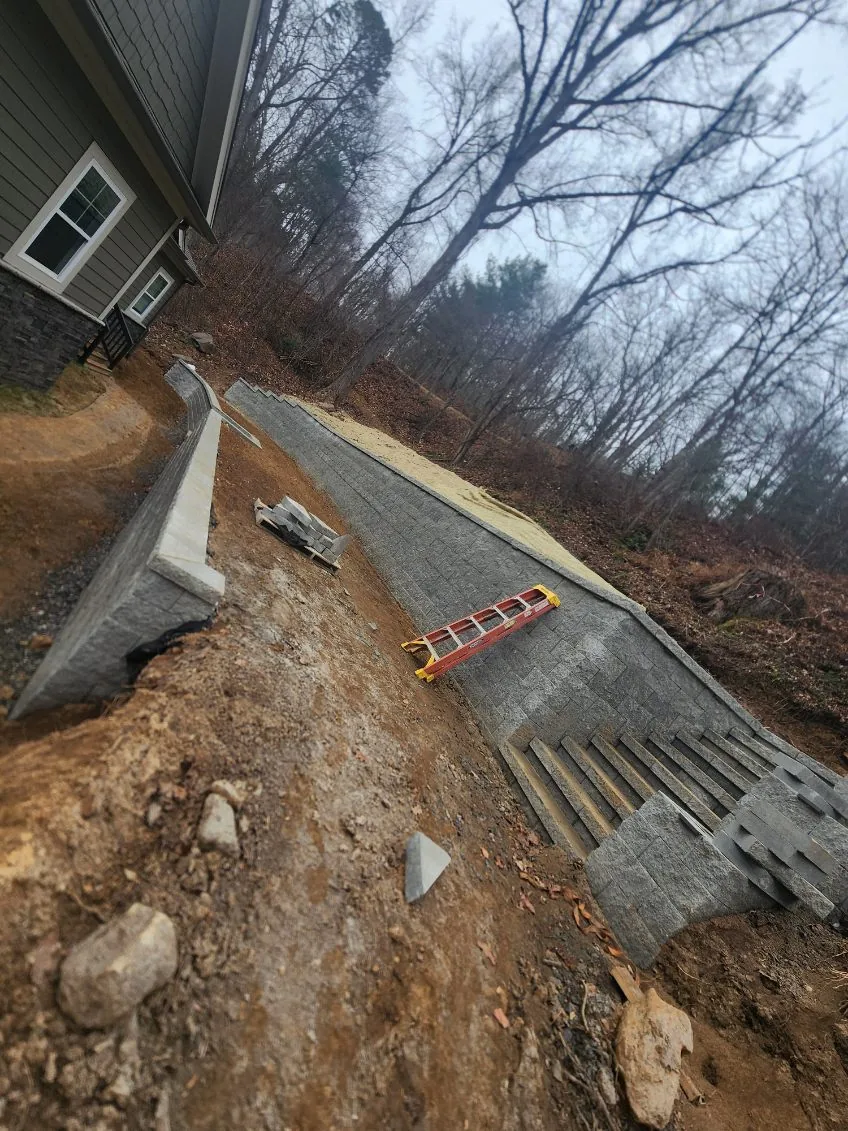
Pricing here is driven by four things and almost nothing else: total drop and run length, liner versus concrete, whether rock has to be imported, and how hard the ground is to dig. Buncombe County rock is not a hypothetical — excavation that needs a breaker instead of a bucket changes the labor line fast. Site work and retaining for a pond that sits into a slope overlaps the same trades covered in the retaining wall cost breakdown for Buncombe County, and if your project needs grade correction before any water goes in, read that table alongside this one.
| Scope | Typical Fairview range |
|---|---|
| Small recirculating waterfall, existing grade, 3–5 ft drop | $6,500–$11,000 |
| Medium waterfall with header pool and short stream run | $11,000–$18,000 |
| Lined pond, 8x11 ft class, with falls and skimmer | $14,000–$22,000 |
| Concrete shell pond with integrated waterfall | $22,000–$28,000+ |
| Pump, plumbing, and liner replacement on existing feature | $1,800–$6,500 |
These are regional bands, not quotes. Stone selection moves the number more than most homeowners expect — a locally sourced fieldstone build and an imported slab build of the same footprint can differ by thousands.
It helps to see where the money physically goes on a Fairview job. Excavation and hauling is usually the least glamorous line and often the second-largest one after the stone itself, because moving rock and clay off a sloped lot is slow work. Plumbing is smaller than people assume but unforgiving: a pump vault sized for the head height and run length, a skimmer that can actually be serviced, and a check valve that keeps water from draining back when the pump cycles off. The liner or shell is a defined cost once the dimensions are set. Stone is the wildcard. A builder who quotes by the ton and shows you the haul allowance is being honest; one who quotes a single number for "stone" without a quantity is guessing.
There is also a maintenance band homeowners should budget for separate from the build. Pumps and liners do not last forever on any feature, and on a Fairview pond that sees leaves every fall and freeze-thaw every winter, the replacement cycle can feel shorter than expected. Keeping a few hundred dollars a year set aside for pump service, liner inspection, and edge re-seating is realistic, and it is a better plan than waiting for a failure in the middle of a dry summer when the water level drops.
Water, slopes, and why the order matters on this terrain
Fairview's federal disaster record is the reason a good builder talks about overflow before aesthetics: 19 declared events touch this county across 1973-2026, and the dominant family is storm and flood. A pond that is beautiful in July and a mud pit in September was designed for the wrong month. The fix is sequencing — overflow engineering gets decided at layout, not added after the liner is in. The North Carolina Building Code Council publishes the state codes that govern grading and drainage on residential sites, and the EPA maintains the stormwater guidance that explains why directing a pond overflow at a neighbor's slope is a problem you inherit, not just a courtesy issue.
On a Fairview slope, the design question is not "where does the waterfall go" — the grade usually answers that for you. The real question is where the water goes when the feature is full and the rain keeps coming. A feature built into a hillside has two water sources: the recirculating loop and the storm runoff that crosses the slope. If the overflow path is sized for a gentle rain and the lot actually sheds like a small watershed, the pond becomes a settling basin and the stone disappears under sediment. Builders who work this terrain routinely design the overflow before they finalize the stone layout, because the overflow weir and the spillway have to coexist with the falls without looking like an afterthought.
Freeze-thaw is the other Fairview-specific factor. Water features in this climate cycle through freeze and thaw repeatedly across winter, which is hard on liner seams, stone bedding, and pump housings. A build that drains partway down for winter, with a bypass or a removable pump, will survive better than one designed to stay full year-round. Ask how the feature is winterized before you sign off on the design, because retrofitting a drain-down path after the shell is in is far more expensive than building it in from the start.
The Fairview retaining wall contractors page covers the structural side of holding a slope in place where a pond or falls cuts into it. On a lot where the pond excavation removes the toe of a slope, retaining and water work are not two projects — they are one sequence, and separating them across two crews is how walls end up leaning into a pond that is already full.
Where the licensing line falls on feature work
Most waterfall and pond installations do not cross the general contracting threshold, but the sequence often does. If your project includes a retaining structure over the height limit, a structural grade change, or a pump circuit that a licensed electrician must wire, the job splits across licensed trades. The North Carolina Licensing Board for General Contractors sets the dollar threshold and scope rules; the State Board of Examiners of Plumbing, Heating and Fire Sprinkler Contractors governs plumbing-side connections where a potable water line or fill line is involved. Ask a builder how they sequence licensed subs, because on a Fairview build those subs usually arrive between excavation and stone setting — the exact window where a scheduling mistake costs a week. If your project also needs site retaining, the Fairview retaining wall contractors page covers who does that piece and how it interlocks with the water work.
Electrical deserves its own pause. A pump is a motor sitting near water, and the circuit that feeds it needs a GFCI-protected outlet, a weather-rated box, and a disconnect that a homeowner can actually reach. On a Fairview lot where the pump vault sits far from the house, that can mean a buried conduit run and a subpanel, and that is licensed electrician work in North Carolina, not something a landscaping crew should improvise. Builders who sequence this correctly have the electrical rough-in done while the trench is still open, rather than hand-digging a second trench after the stone is set.
Permitting on the water feature itself is often minimal, but the adjacent pieces trigger review: retaining walls over a certain height, structural grade changes, and any electrical or plumbing connection. The safe move is to have the builder list every licensed trade that will touch the job and confirm which permits apply before excavation. On a Fairview build, that conversation is cheap; discovering it mid-project is not.
What the crew is actually doing, week by week
The weekly rhythm on a Fairview water feature is fairly consistent once you strip away the marketing. Week one is almost entirely dirt and logistics: marking the layout, protecting trees and driveways, excavating the pond basin and the stream course up the slope, and hauling or staging spoil. If the job includes a concrete shell instead of a liner, week one also includes forming and pouring, which means the shell has to cure before any stone goes in. That cure time is real and non-negotiable, and it is one of the reasons a concrete build runs longer than a liner build of similar size.
Week two is the plumbing and the hidden work you will never see again: setting the skimmer and pump vault, running the supply line up to the falls head, installing check valves and unions so the pump can be serviced without cutting pipe, and laying underlayment if the pond is lined. This is the week where a rushed job shows its seams later, because undersized pipe or a pump with too little head capacity will run hot and loud for years. Ask what pump curve the builder sized the feature for and how many gallons per hour the falls need to look right; if the answer is vague, the feature will look thin.
Week three is stone. This is the slow, hand-heavy part, and it is where a Fairview build either reads as natural or as a pile of rocks. Setting stone so a waterfall looks continuous means selecting each piece for how water will sheet over it, bedding it so it does not rock under the pump's vibration, and hiding the liner edges under stone rather than letting liner show at the waterline. On a slope, the stone also has to lock into the grade so the whole assembly does not migrate downhill after a wet winter. That is why the stone phase often takes as long as excavation, even though it looks simpler.
Week four and beyond is tuning and finish. The pump runs, the water finds its channels, and small adjustments get made: raising a stone a quarter-inch here, adding a gravel overflow path there, planting the edges so the liner disappears. Edge concealment is the difference between a feature that looks built and one that looks installed, and on a Fairview lot with native vegetation, the planting is usually done with species that handle the same wet-dry swing the feature does. Any job that skips this phase and calls itself done at water-on is a job you will be calling someone back to finish.
What to settle before anyone digs
Three questions decide whether a Fairview feature turns out well. First: liner or concrete, and the builder must be able to explain the tradeoff for your ground, not in general. Second: where does overflow go during a multi-inch rain, and can they show you on the grade. Third: is the stone local and is the quantity estimated by the ton with a haul allowance written in. The general stone waterfalls and ponds guide walks through the materials and build types in more detail. Get all three answers in writing and the timeline discussion becomes simple.
There are a few more items worth locking down before excavation begins. Ask for a written sequence with names attached: who excavates, who plumbs, who wires, who sets stone, and who tunes the water at the end. On a Fairview build those may be three or four different crews, and knowing the handoff points prevents the classic failure where excavation finishes and the site sits open for a week waiting on a plumber. Ask, too, how the builder handles a rain event during the open-excavation window — whether they cover, pump, or reschedule — because that answer tells you how much they have actually worked this terrain. And ask what the feature will look like in February, not July. A design that accounts for winter draw-down, leaf load, and freeze protection is a design that will still be working in year five.