Why Mars Hill yards refuse a flat-stone plan
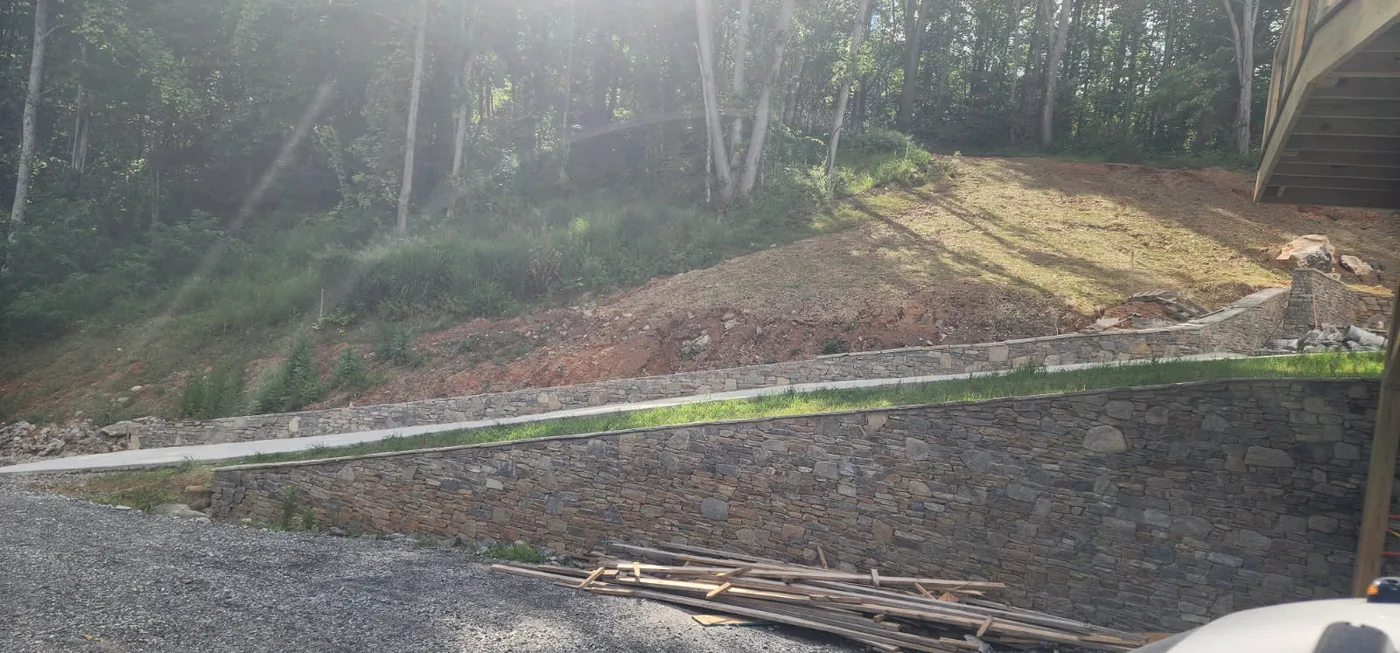
Drive through Mars Hill and you notice the same thing a mason does: almost nothing here is level. Lots step down from the road, sidle along ridges, or perch on the shoulder of a hill with a creek somewhere below. The town grew along the crossroads of Route 19 and NC 213 near the university campus, and its houses followed the terrain rather than fighting it. That means a front walk in Mars Hill is less a path than a graded transition, and a set of stone steps is usually a drainage structure wearing a flat cap.
The subsoil is the other half of the story. Madison County's hillside ground is often red clay over decomposed rock, which drains slowly and swells when it is wet. Winter here is colder than Asheville proper, so the freeze-thaw cycle is longer, and a base that would feel solid in July can heave by February. Every real question about stone steps in Mars Hill starts with those two facts: grade and clay.
Around the college side of town, lots tend to be tighter and the walk from street to door is short but steep, sometimes only eight or ten feet of run for three or four feet of rise. On the ridge roads out toward the county line, parcels open up and the same house may sit two hundred feet back from the pavement, with the driveway taking the easy grade and the walkway forced to climb straight up. Those are different jobs even when the stone looks identical, because the long walk needs more drainage breaks and the short steep one needs more careful riser geometry. A mason who has only worked flat lots in Asheville will misread both.
What the work actually costs in this market
Pricing depends on rise, run, and how much base you have to build, not on how pretty the stone is. The table below reflects realistic regional bands for Mars Hill and the surrounding Madison County hills. Treat any quote far below these as a sign the base or drainage was left out.
| Scope | Typical range | What moves the number |
|---|---|---|
| Replace or reset 1-3 existing stone steps | $650-$1,800 | Whether the base stays or is rebuilt; hauling old stone |
| New cut-stone stoop, 2-4 risers | $1,900-$4,600 | Stone thickness, tread depth, grade at the door |
| Flagstone or fieldstone walkway, 30-60 ft | $2,400-$6,500 | Excavation depth, base stone, joints, pitch for runoff |
| Steps plus walkway, sloped lot | $4,800-$9,800 | Grade change, retaining at edges, drainage line |
| Hand-set natural stone treads on a steep run | $850-$1,700 per step | Access for equipment, tread size, rigging |
| Repointing or resetting a failing joint line | $400-$1,400 | Linear feet, mortar match, how deep the failure runs |
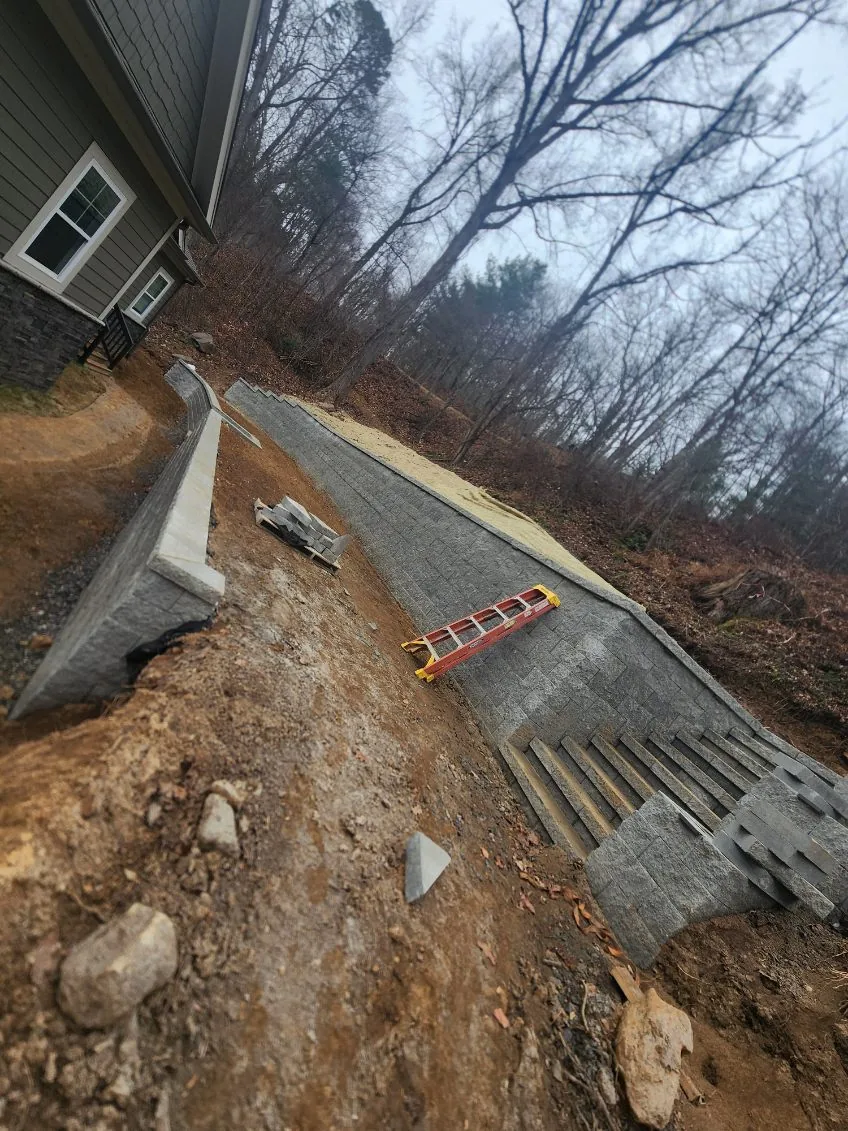
Those bands assume the stone is on site or locally sourced. Quarried stone hauled in from off the mountain adds freight, and steep lots add labor for hand-carrying material where a machine cannot reach. For the structural cousin of this work, see the Madison County retaining wall cost breakdown, since a walkway that cuts into a slope almost always includes some retaining.
Two cost drivers that surprise homeowners here. First, matching existing stone: if the house already has a particular fieldstone on its foundation or chimney, finding enough of a compatible look can take time and a second quarry trip, and that shows up in the labor line, not the material line. Second, access: a walkway that runs down a slope with no machine path means every bucket of base gravel and every tread is carried by hand, which can add days on a job that would otherwise be quick.
Base, drainage, then stone — in that order
The failure I see most in Mars Hill walkways is not bad stone. It is stone set on clay with no path for water to leave. When the ground saturates, the treads tilt, joints open, and the next freeze widens them. The International Code Council's residential provisions treat site drainage as a structural expectation rather than a finishing touch, which is the right frame: iccsafe.org is the reference crews should be working from.
A proper Mars Hill build usually means excavating below frost influence, placing compacted crushed base in lifts, and giving the walk a slight pitch so water runs off the treads instead of pooling on them. On hillside lots, that often means a French drain or a swale above the steps to catch water coming down the slope. If a contractor proposes steps without a plan for where uphill water goes, the steps are a temporary installation.
There is a reason this matters more on the north-facing slopes common above town, where the sun does not hit the treads until mid-morning and the last snowmelt lingers. Those steps stay wet longer, which means more freeze cycles per winter, not fewer. A walk that sheds water quickly survives those cycles. One that cups water on the tread surface will not, no matter how thick the stone is. When a joint starts to open in year three, that is usually the diagnosis, and repointing alone will not hold if the water still has nowhere to go.
Local rules, licensure, and what to verify
Much of this work falls under general contracting rather than a specialty license, and North Carolina draws its threshold at project value. The NC Licensing Board for General Contractors publishes the current figure, and it is worth checking before you sign anything on a large hardscape job, because a walkway project with significant grading or retaining can cross it. Small repairs usually sit below the threshold, but a rebuild on a steep lot rarely does.
Two more things to verify. First, insurance: ask for a certificate and confirm it is current, since hillside access means real risk to the crew and your property. Second, disposal and sourcing: where the spoil goes and where the stone comes from both affect price and both should appear in the written scope.
For projects near a stream or in a drainageway, it is also worth checking with the county before you start moving earth, because water that leaves your lot is a shared concern. The U.S. Environmental Protection Agency publishes plain-language guidance on managing runoff from residential sites at epa.gov, which can help you ask the right questions before a crew starts digging. That is especially relevant in Madison County, where a wet hollow can carry water from several properties through one yard, and a set of steps built without thinking about that shared flow becomes someone else's problem downstream.
Reading a Mars Hill bid without getting burned
A good bid for stone steps and walkways names the base depth, the drainage approach, the stone type, and the joint method. A weak bid says "stone steps" and a number. On hillside work, ask specifically how they will handle water arriving from above the project, and ask what happens to the grade at the bottom of the run. If the answer is vague, the quote is incomplete regardless of size.
Crews who work these slopes regularly tend to walk the site before pricing. If someone quotes from a photo of a Mars Hill yard, they are guessing at grade and access, and the change orders will show up later. When you are ready to compare local crews, the Mars Hill retaining and hardscape contractors page is the place to start.
One more question worth asking: how the work will be sequenced around the rest of the property. A walk that ties into a gravel drive or meets a porch foundation needs a clean transition, and a mason who has worked this town will already be thinking about how the new stone meets what is already there. That kind of planning is often the difference between a walkway that looks native to the hillside and one that looks dropped onto it.