The five-day build, and why Mills River grades stretch it to three weeks
A simple tier wall on flat ground near the French Broad bottomland goes up in about five working days. The order is fixed and rarely varies: utility locate and layout on day one, machine excavation on days two and three, compacted base plus drainage stone on day four, then block or stone facing on days five through seven, with cap and backfill the following week. Compress any one of those steps and you get the bowed walls still visible along older stretches of Boylston Highway — the ones that leaned after a wet March and never came back.
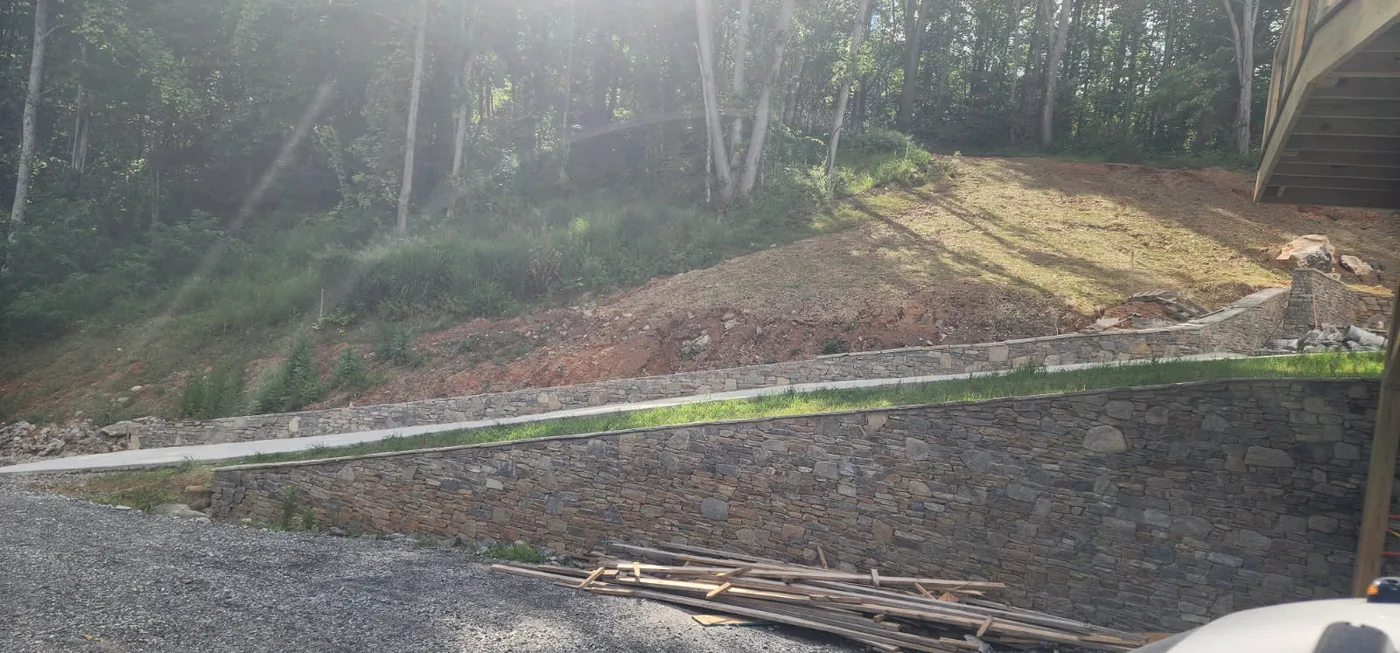
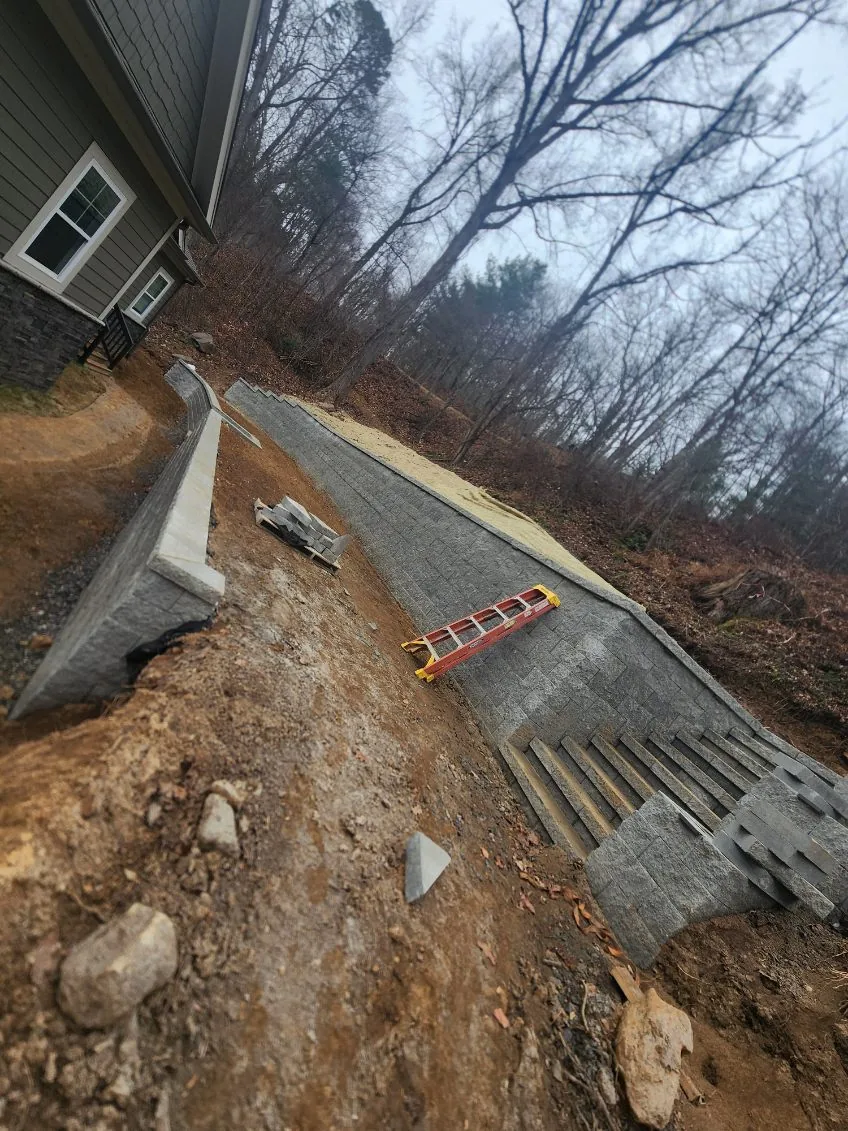
The reason the same job stretches to two or three weeks five miles up the ridge is the cut itself. Bottomland is flat and wet; the grade above it is clay that holds water into spring. Excavating a height-of-wall bench into that clay, hauling spoils off a driveway you can't block, and setting a footing that drains means more machine hours, more stone, and more compaction passes. A wheelbarrow-served garden wall and a wall against a steep Mills River driveway are the same square footage and not the same job.
What the scope-to-price table looks like on Henderson County grade
Ranges below reflect typical residential work in the Mills River corridor. Residential walls under four feet of retained height are usually excluded from local permit review, but anything above that gets engineered drawings. The full Henderson County cost breakdown shows the line-item math behind these bands.
| Scope | Typical range |
|---|---|
| Garden wall, under 2 ft, dry-stack stone | $2,500-$6,000 |
| Segmental block wall, 2-4 ft face, standard footing | $6,000-$14,000 |
| Engineered wall, 4-6 ft face with drainage system | $14,000-$28,000 |
| Tiered walls on steep slope, engineered | $25,000-$60,000+ |
| Wall repair (bulge, crack, footing failure) | $1,800-$9,500 |
Per-face-foot pricing sits around $35 to $75 depending on stone type, drainage complexity, and access. Two walls of the same height on the same road can price a third apart if one needs a machine to reach the back side and the other doesn't. Ask for the drainage line item separately and compare that number, not the total.
Water is the client here, not the wall
Henderson County has been touched by 16 federal disaster declarations spanning 1978-2026, most of them flood and storm events. Every one of those loaded walls that had been built assuming drier ground. When a retaining wall fails in Mills River, the visible tip is the wall; the cause is almost always the water behind it. Drainage stone, perforated pipe, and a properly graded filter fabric are not add-ons — they are the wall's structural life support. The NC Department of Insurance Engineering & Codes Division treats retained-soil walls as structural systems for exactly this reason, and the EPA's stormwater guidance explains why uphill runoff timing matters on slopes this steep. A wall that sheds a wet-season storm in February behaves differently from one that catches a summer cloudburst over saturated clay. If a bid lists wall face, cap, and labor but no drainage line item, it is not a cheaper bid — it is an incomplete one.
The practical check for any homeowner is uphill, not at the wall. Where does the water from the ridge above your property historically go? If the answer is 'through where the wall is now,' the drainage design has to intercept that flow before it reaches the backfill, or the wall is fighting the property's own grade. That is a site-specific conversation, and it is the one worth having before excavation, not after.
Who can legally and practically take the job
North Carolina does not license masonry or hardscape contractors specifically, but wall work tied to a driveway, foundation, or site plan on a permitted build usually falls under a general contractor. The NC Licensing Board for General Contractors sets the thresholds — a wall above a certain dollar figure or retained height pulls the project into licensed territory. Ask any contractor you consider whether their last three walls were engineered, and ask to see the drainage detail on those drawings. The retaining walls overview walks through the residential specifics for this region.
Insurance and workers' comp matter more on grade work than on most residential trades, because the exposure is excavation, not carpentry. Ask for the certificate before a machine shows up. A crew that can't produce it is a crew whose accident becomes your property's problem.
Repair or rebuild on older Mills River walls
Timber walls built more than fifteen years ago are reaching end of life across the county; a leaning timber wall usually goes to segmental block rather than timber replacement, because the footing and drainage are already half the cost of a new wall. A bowed block wall can sometimes be rebuilt in place without new excavation, but once the footing has heaved, you are looking at a rebuild — resetting the top course on a bad base just delays the same failure another season. The retaining wall repair guide covers what can be saved versus replaced, and it is worth reading before any crew quotes a rebuild you may not need.
The tell for a footing failure is horizontal movement, not vertical. A wall that has crept out at the base and rotated will show a gap at the top courses before it shows a crack at the bottom. Photograph it from the same spot each month; the rate of movement is what tells you whether this is a spring project or an emergency.
Scheduling around Henderson County's working seasons
Late spring and early summer are the busiest stretch — the ground is workable, the summer rain has not yet saturated the clay, and homeowners are correcting winter movement. Fall work is second choice and often a better value because crews have room in the calendar. Mid-winter excavation into saturated Henderson County clay is possible but slow, and compaction verification is harder to guarantee in freezing night temperatures, so a wall scheduled in January and a wall scheduled in May are not the same quality risk even when they carry the same price.
Plan a wall between April and October if you can. If the wall is failing now — bulging, leaning, or dumping soil into a driveway — treat it as emergency work and expect a shorter lead time with a smaller set of crews, because the good ones are booked and the ones with open capacity earned it. Either way, get the drainage detail in writing before the machine arrives; that detail is what determines whether you are paying for a wall or renting one.