What Canton walls are up against
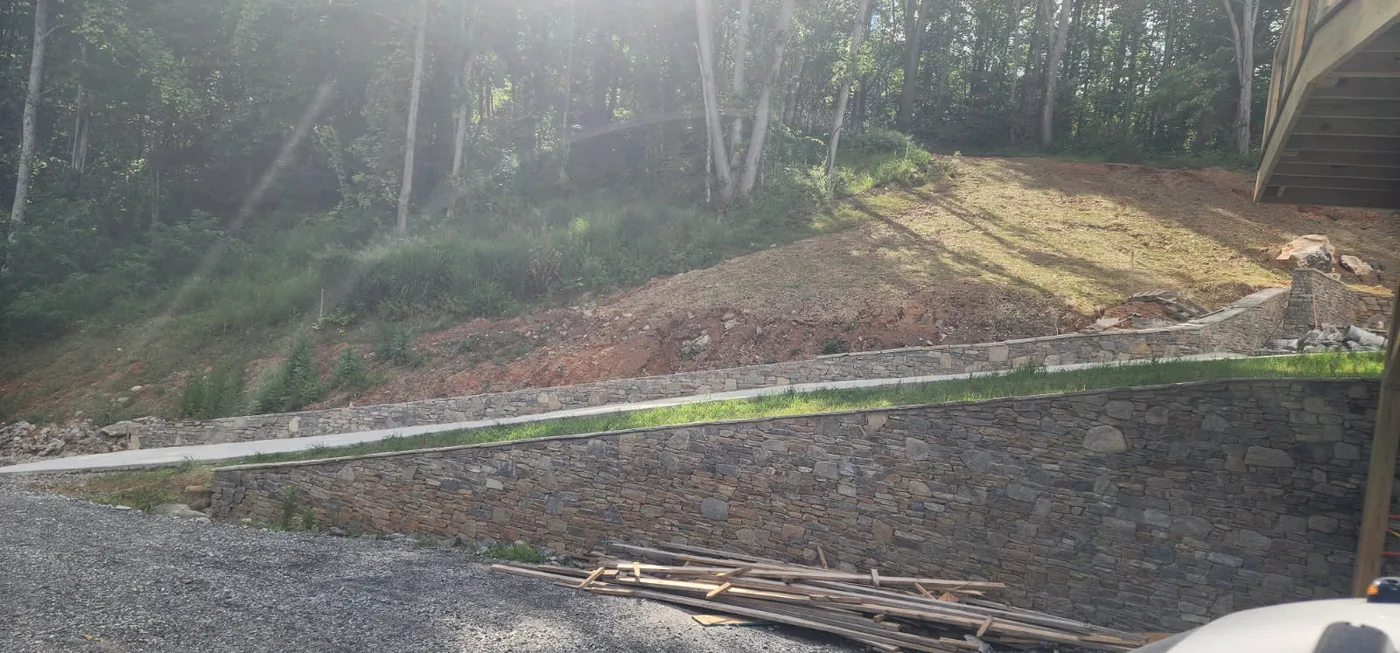
Canton sits in the Pigeon River valley, where the Blue Ridge escarpment turns every residential lot into a grade problem. A 1950s brick rancher off New Clyde Highway has a failing concrete block wall holding back a driveway that was cut into a hillside. A newer spec home in the Sorrells Cove area needs a terraced system to manage a backyard that drops fifteen feet in forty. The old mill housing near the river has retaining walls built from whatever was on hand in the 1920s. All three share one vulnerability: water moving downhill through clay-heavy soil that expands when wet and contracts when dry.
The NWS watches this region closely for a reason—the Greenville-Spartanburg office issues the flash flood warnings that matter here. When soil saturates, hydrostatic pressure builds behind any wall without proper drainage stone and pipe. The failure is rarely the block itself; it is the water that was never given a way out. Bowed walls, leaning sections, and bulges at the base are all water problems first, material problems second.
Drive up Boyd Avenue toward the former paper mill and you will see what decades of mountain weather do to masonry. The south-facing slopes dry out quickly in the summer sun, but the north-facing cuts behind the old mill village stay damp for weeks after a rain. That constant moisture cycle is what breaks mortar joints and spalls concrete. A wall built for a flat Piedmont lot in Charlotte will not survive two winters here without the drainage and reinforcement that Haywood County soils demand.
The Haywood County pricing picture
Costs here track slope access, excavation difficulty, and what the soil does when it rains. See the full Haywood County retaining wall cost breakdown for the working table. The short version:
| Scope | Typical Range (Canton area) |
|---|---|
| Gravity block wall (3–4 ft, straight run) | $55–$75 per sq ft |
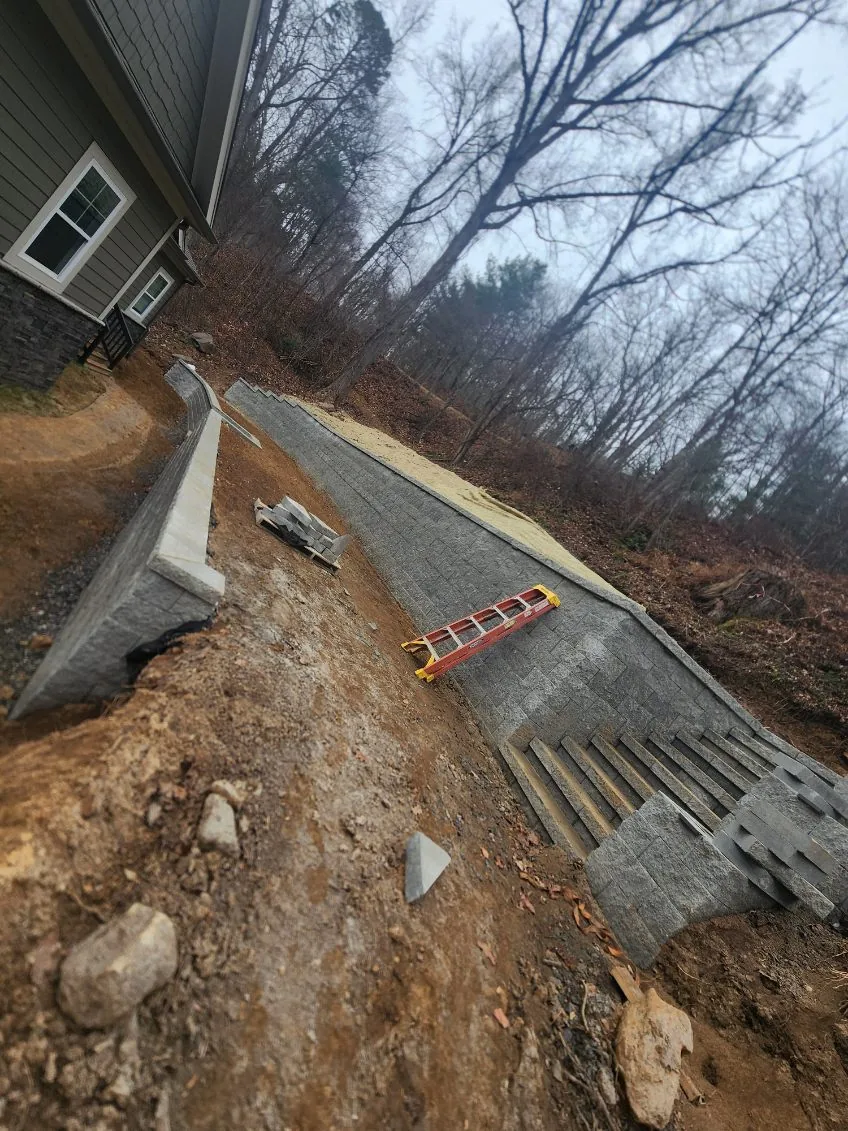
| Engineered segmental wall (4–8 ft, curved or terraced) | $75–$110 per sq ft |
| Natural stone or boulder wall | $90–$130 per sq ft |
| Drainage retrofit (existing failing wall) | $1,800–$5,000 |
| Structural engineer review & stamped plan | $500–$1,500 |
Any wall over 4 feet vertical—or any wall that supports a driveway or structure—needs a stamped engineered design under North Carolina building code adopted by Haywood County. Treat a bid without that line item as shopping, not bidding.
The price difference between a gravity wall and an engineered system is not markup—it is geogrid reinforcement, proper footing depth, and drainage stone that meets specification. A 3-foot garden wall at the flat end of Rhododendron Drive can be a straightforward gravity block job. The same 3-foot wall on a 2:1 slope off Beaverdam Road suddenly needs to resist lateral pressure from a hillside that has been saturated by a week of mountain rain. The excavation alone can double when your access is a switchback driveway that a dump truck cannot turn around on.
Drainage is the design, not an add-on
Haywood County has been through 19 federal disaster declarations spanning 1973-2026—a record dominated by the flood and storm events that define mountain living. Every one of those events tested retaining walls that were built without proper drainage stone, perforated pipe, or a clean outlet. The International Code Council structural provisions treat retained soil as water-logged weight precisely because it is the real-world condition.
A wall that looks fine after three dry months can move six inches in one hard storm. The fix is boring on purpose: 12 inches of washed stone behind the wall, a 4-inch perforated drain at the base pitched to daylight, and compaction of the backfill in lifts. When a contractor tells you drainage is extra, you are hearing what the project will cost without surviving the next declared event.
On the ridge lines above Canton, where the new development is pushing into former forest, the soil profile is shallow over bedrock. That sounds stable, but water runs off the rock face and concentrates at the bottom of the cut. A retaining wall there has to intercept that water before it reaches the wall, then move it out through a toe drain that daylights below the frost line. In the valley bottom near the Pigeon River, the water table sits higher and the clay is deep and plastic. The same drainage pipe that works on the ridge may need a larger diameter and a longer outlet run down near the floodplain. Site-specific design is not a luxury, it is the difference between a twenty-year wall and a five-year repair.
Canton-specific hiring checks
Three local filters before you take a bid: First, ask how many walls they have built in the Clyde-to-Canton corridor—soil here is not what it is on the Buncombe side of the ridge. Second, verify they carry active general contractor licensing through the NC Licensing Board for structural work over the threshold, and ask for the engineer's name on any wall above 4 feet. Third, ask how they sequence drainage versus wall construction. The crews that build walls for the long term will show you a drain detail before they show you a color chart.
Neighbors who have built here will tell you the same thing: the best wall in Canton is the one you cannot see fail because the water never accumulated. For smaller landscape walls under 3 feet, the retaining wall guide covers what a properly built system includes. And if you are on the east side toward Clyde, the Clyde-specific page covers that service area's access and grading realities.
Also worth asking: do they have a relationship with a local geotechnical engineer who has already logged borings in this valley? Haywood County clay behaves differently depending on whether it came from the mica-rich schist up on the ridges or the alluvial deposits closer to the river. A contractor who has worked with the local soils will know which backfill to specify and where the water table sits in a wet spring. They will also know which county inspectors are strict about compaction testing and which are more concerned with setback lines. That institutional knowledge saves you weeks of back-and-forth.
Importing this article for regional projects
We serve the entire Haywood County market including Waynesville, the county seat, and the smaller communities that line the Pigeon River valley. The same mountain drainage logic applies anywhere above 2,000 feet, but the local soil maps and rain history get specific fast. Mention your road and your slope direction when you call—south-facing slopes dry faster, north-facing walls live in shade and moisture year-round, and both change what the drainage design needs to do.
If you are outside Canton proper—say on a ridge off Interstate 40 toward the Blue Ridge Parkway or down closer to Lake Junaluska—the wall rules change again. Higher elevations mean deeper frost penetration and more freeze-thaw cycles. A footer that passes inspection in Waynesville's 2,800-foot elevation might heave in Canton's 2,600-foot zone, but only if the drainage fails to keep water away from the base. The EPA's stormwater guidance for sediment control applies when you are disturbing enough ground for a large wall system; the county enforces those rules at the zoning stage. We can talk through what your specific parcel will require during a site visit.