Why this town's walkways aren't Asheville walkways
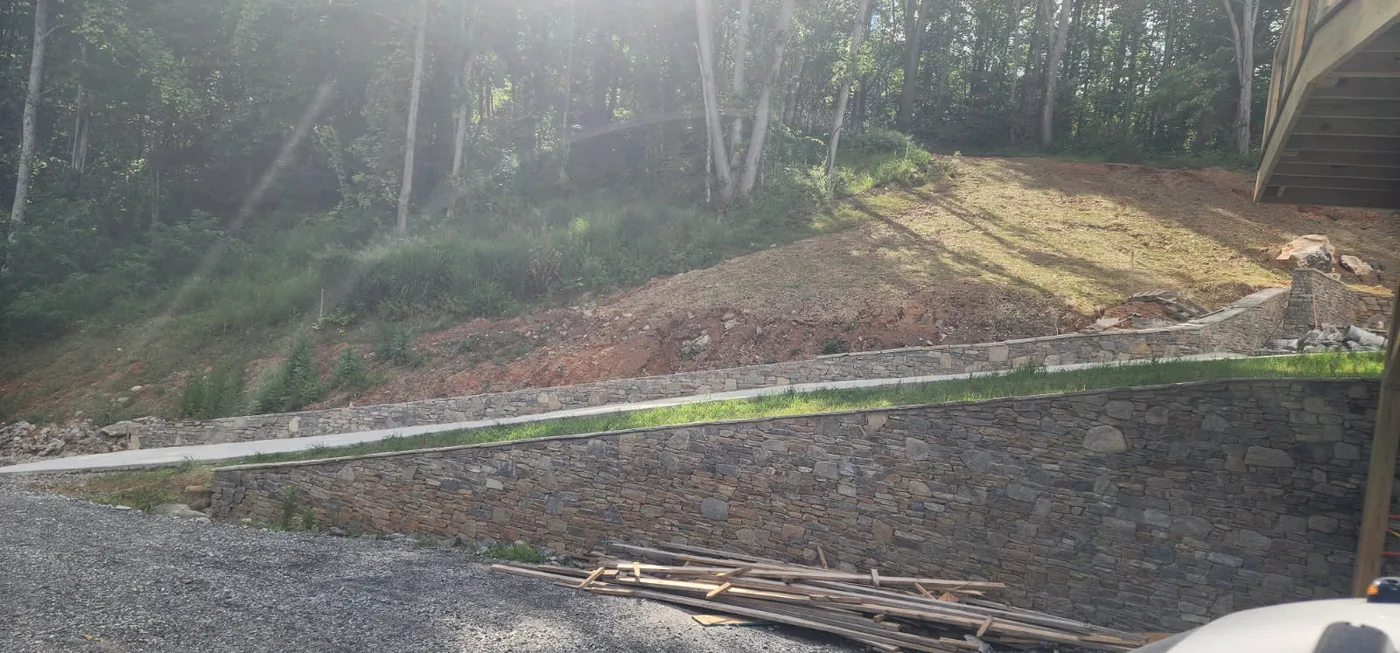
Biltmore Forest lots rarely look like the grid streets ten minutes east. Parcels are large and heavily wooded, driveways run long, and the grade from curb to front door is often a gentle but relentless slope — a pitch that lets water travel forty feet before it ever touches a foundation. Stone steps and walkways here are not decoration on a flat pad; they're the transition between an engineered approach and the house itself, and they inherit every drainage decision made above them.
That means the first useful conversation is not about stone style. It's about where the water goes, how the path is crowned and pitched, and whether the steps are holding a grade or bridging a short, steep rise. Get those right and the masonry will sit for decades. Get them wrong and the prettiest flagstone walk in the county heaves after two winters.
What sets this town apart from Asheville proper is the combination of lot shape, soil, and canopy. Many parcels were laid out along the original Olmsted-influenced estate plan, so boundaries follow ridge lines and creeks rather than a surveyor's grid. That produces irregular building envelopes, side yards that drop away faster than the front, and mature oak, tulip poplar, and white pine whose roots run under every proposed path. The soils tend toward clay-heavy upland with pockets of decomposed granite and the occasional seep where a hillside spring surfaces. A walkway that would be simple on a flat West Asheville lot becomes a root-and-slope negotiation here, and the honest bid reflects it.
The cost picture for stone steps and walkways
Local pricing tracks scope more than square footage: how much base prep, how much grade change, how much stone has to be carried by hand to the work area. The range below reflects typical residential work in this part of Buncombe County. For the deeper retained-structure numbers, see the Buncombe County retaining wall cost breakdown, since steps and terraces overlap constantly.
| Scope | Typical price range |
|---|---|
| Short flagstone walk, low slope, easy access | $3,500–$6,500 |
| Garden path with 3–5 stone steps | $5,500–$9,500 |
| Full front-entry stair, cut stone or bluestone | $8,000–$16,000 |
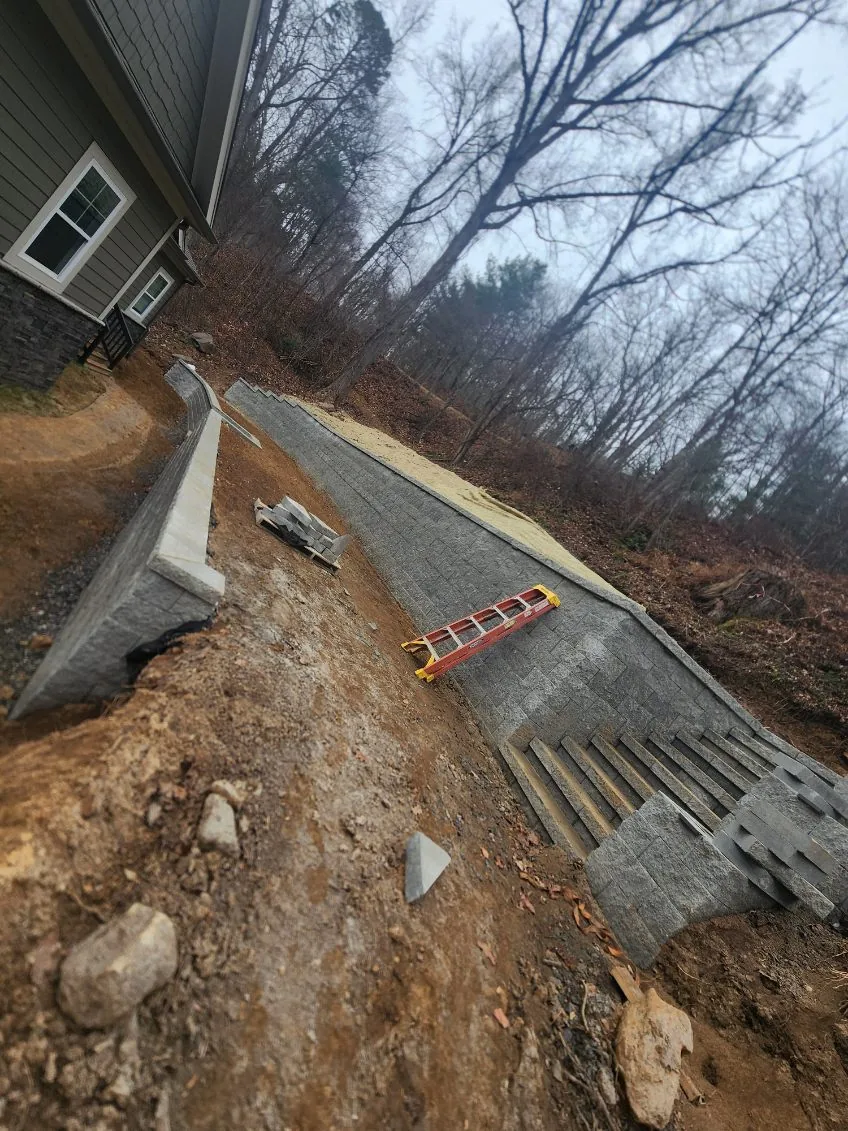
| Segmented steps on steep grade, hand-carry material | $12,000–$25,000+ |
| Repointing or resetting existing steps (per step) | $200–$600 |
Steep-lot work above the estate's wooded ridges routinely adds line items for hauling, base stabilization, and drainage — treat a bid that skips them as incomplete, not cheap.
Two scope details move the number more than anything else on a Biltmore Forest job. First, access: if a tracked machine can't reach the work zone without damaging roots or turf, stone and base material get moved by wheelbarrow and hand, and that labor shows up in the bid. Second, disposal: excavated clay and broken concrete have to leave the site, and hauling off a wooded lot with a narrow drive costs more than a curbside dump. A bid that lists these plainly is easier to trust than one that folds them into a single lump.
Matching the material to the house
Biltmore Forest has a distinct architectural character: brick and stone homes from the early and mid-twentieth century, many of them designed to sit quietly in the landscape rather than announce themselves. New hardscape has to respect that. Bluestone, Tennessee fieldstone, and dimensional limestone tend to read best against this housing stock; poured concrete steps and paver walkways can look out of place on a wooded lot with mature planting.
The International Code Council publishes the stair geometry standards that keep steps safe and code-compliant — riser height, tread depth, handrail rules. Those numbers matter whether the step is a grand front entry or a small transition at a side door, and they're the sort of detail that separates a mason who builds to last from one who builds to look right on day one.
Material choice also interacts with shade. Under heavy canopy, north-facing walks stay damp longer, and some sedimentary stones darken or grow a fine biological film that can get slick. A mason who knows these lots will often spec a slightly rougher tread finish or a subtle thermal treatment on shaded runs so the surface keeps grip through a wet Carolina winter. That's a small decision with real safety consequences, and it's the kind of thing worth asking about specifically when you get quotes.
Finding a mason who works these lots
Three questions worth asking before anyone touches the ground. First, what's the base spec — how deep is the compacted crushed stone, and how is it separated from the native soil? Two inches of sand over clay is a guarantee of frost heave. Second, how is drainage handled at the top and bottom of the run, and where does the water actually go? Third, if the job is meaningful in scope, is the contractor licensed? The North Carolina Licensing Board for General Contractors sets the thresholds, and for hardscape combined with retaining structures those thresholds are often crossed.
Repointing and resetting existing steps is a different skill from new construction, and the trades don't always overlap. If your work is repair-oriented, mention it up front and ask for that kind of reference specifically. The stone steps and walkways overview walks through what each kind of job involves.
It also helps to ask how the mason handles tree roots. On these lots, cutting a major root can destabilize a mature hardwood, and paving over one guarantees the walk will heave within a few seasons. A good answer involves routing the path around the root zone, bridging with a properly supported span, or adjusting the grade so the root stays outside the base. A vague answer is a warning sign, because root conflicts are the single most common surprise on wooded Biltmore Forest properties.
What actually wears out first
The federal disaster record here explains a lot: 19 declared events have touched this county over 1973-2026, and the dominant family is storm and flood. On a wooded Biltmore Forest lot, that translates into saturated soil pushing against step foundations, leaf litter clogging drain lines, and freeze-thaw cycling opening joints in any stone set on a weak base. The National Weather Service tracks the local pattern, and the pattern is familiar to anyone who has watched a path fail after a winter.
The repairs worth prioritizing: a step that has dropped more than a quarter inch from its neighbor (base failure), joints that stay wet long after rain stops (drainage), and any stair that has started moving laterally (structural). See the Biltmore Forest retaining wall contractor guide if the grade above the walk is failing too.
Leaf litter deserves its own mention here, because it is a maintenance reality that shapes long-term performance. Heavy fall drop from mature hardwoods fills step joints and swales, holding moisture against mortar and stone through the winter. A walk built with slightly open joints and a clean pitch sheds that debris better than one with tight joints and a flat run, and homeowners who clear the runs each fall get noticeably longer service life from the same masonry.