Why the driveway, not the wall, sets the price here
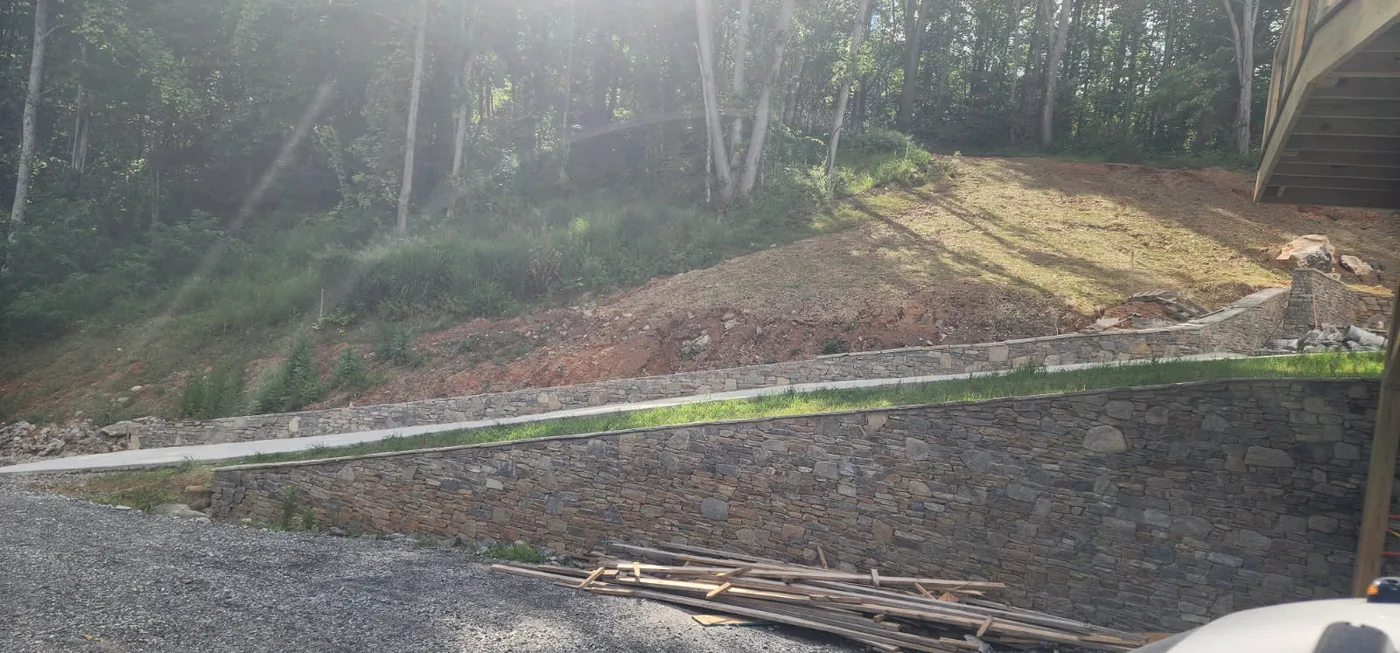
Biltmore Forest is a wooded, low-density town tucked into the slope south of Asheville, and most of its lots were laid out for privacy rather than for trucks. A wall that could cost a flat per-face-foot figure on a flat, open lot costs meaningfully more when the only way to the back yard is a curving gravel drive under a canopy of mature oak and white pine, or a side grade that a skid steer can climb but a dump truck cannot. Long before anyone talks about block color or cap style, the real question on a Biltmore Forest job is how a delivery gets from the street to the work zone, and whether the excavated spoils can leave without being carried by machine or by hand.
Three access costs show up on nearly every job: how close a stone or block delivery can get, whether excavated soil can be hauled out in one pass or shuttled by machine, and how much hand work the crew does because there is no room to swing a bucket. A short wall at the top of a tight driveway can outprice a longer wall on an open corner lot closer to Hendersonville Highway. Read the general scope options on the retaining walls page before you compare numbers.
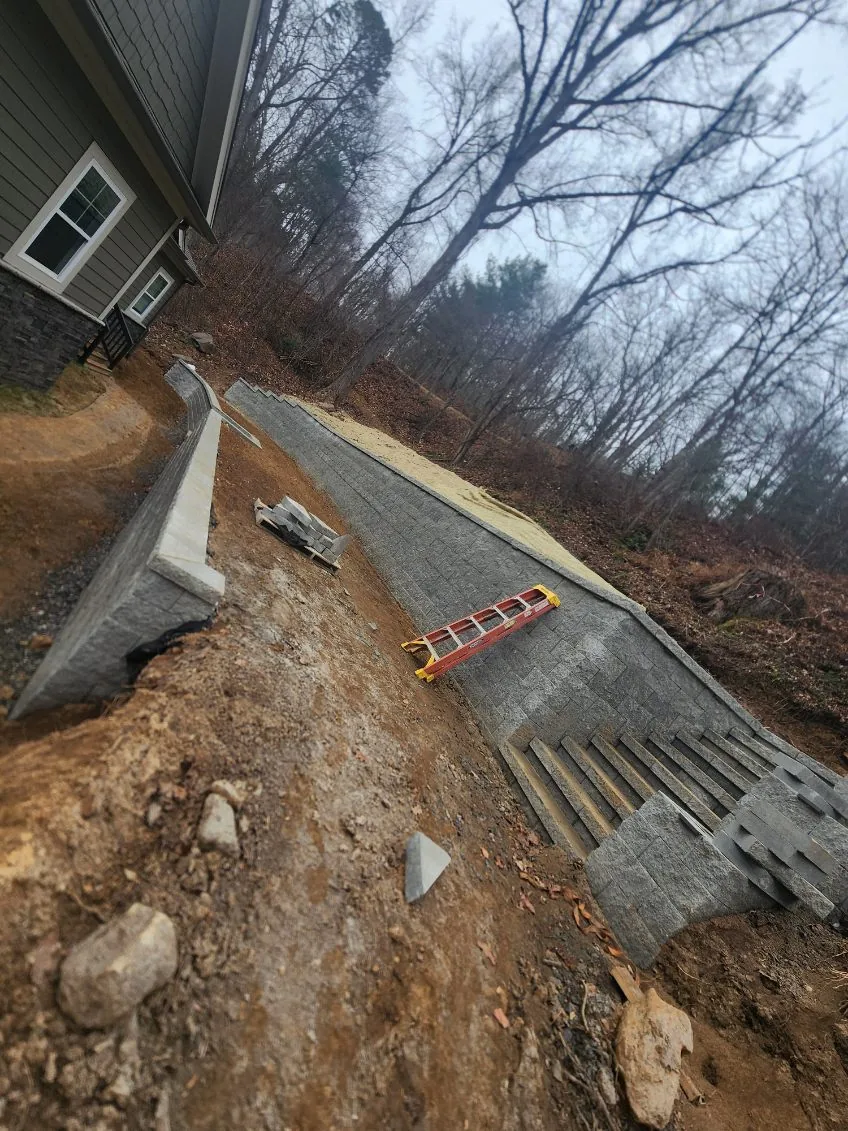
Terrain compounds it. Many lots here sit on a grade that falls away from the house, so the wall is doing real earth-retention work rather than edging a flat patio. When a wall holds a slope that supports a driveway, a pool deck, or any part of a structure, the engineering and permitting conversation changes, and the price follows. It is also why two neighbors with visually similar walls can be thousands of dollars apart.
The material and haul math behind every bid
Most Biltmore Forest walls are built from either segmental block, natural stone (often regional granite or fieldstone), or timber where a low garden terrace is all that is needed. Material cost per square foot of wall face is only part of it — the rest is haul. Buncombe County has local quarries and block yards, but a delivery truck that cannot enter a narrow drive means the material is offloaded at the street and moved by machine or by hand, and that labor is real. On the steepest wooded lots, the crew may stage block on a temporary pad and shuttle it down slope a pallet at a time.
Excavation haul-out works the same way. Behind-wall drainage gravel, filter fabric, and perforated pipe are not optional on these slopes; the soil a wall displaces has to go somewhere, and if there is no room to stockpile it on site, it leaves by truck. A yard of native soil weighs more than most homeowners expect, and depending on how far the disposal or reuse site is, that haul can add hours to a job that a flat lot would never see. The county-level line items are broken out on the Buncombe County cost breakdown, and the short version is below.
Natural stone deserves its own note. It looks right on the older wooded lots and ages well, but every piece is placed by hand, and the wall takes longer to lay than a modular block system of the same height. That labor, plus the pallet weight and the number of trips to move it, is why natural stone carries a higher per-face-foot range even when the quarry is not far away.
What Biltmore Forest walls actually cost
Treat these as working ranges for the Asheville metro, not quotes. Slope, access, and finish move the number.
| Scope | Typical range | Notes |
|---|---|---|
| Low garden wall, timber or block, under 2 ft | $45–$90 per face ft | Minimal excavation, often DIY-adjacent |
| Block wall, 2–4 ft, engineered base | $65–$130 per face ft | Proper footing, drainage stone, fabric |
| Natural stone wall, 2–4 ft | $95–$180 per face ft | Material and labor intensive |
| Tall or terraced wall, over 4 ft | $150–$300+ per face ft | Often needs engineering and permits |
| Tight-access or steep-grade surcharge | +15%–40% | Hand carry, shuttle haul, cribbing |
A wall that is failing rather than being built is a different scope; see retaining wall repair in Biltmore Forest for that path. And if a bid seems far below these bands, ask what it leaves out — base depth, drainage stone, and haul-off are the three most common omissions.
When a wall crosses into a licensed job
North Carolina draws a line between routine landscape work and construction that needs a licensed general contractor. Height, whether the wall retains a slope that supports a structure or a driveway, and whether it is tied to a permit all matter. If a wall is structural or over the residential exemption threshold, the crew should be licensed, and you can verify status through the NC Licensing Board for General Contractors. Taller walls in Buncombe County frequently require an engineered design and a building permit, and the design standard for segmental and gravity walls traces to the International Code Council family of codes that North Carolina has adopted.
Ask any contractor two questions before you sign: who engineers the wall if it is over four feet, and who pulls the permit. A crew that answers both cleanly is the crew you want. A crew that waves off the question, or says permits are not needed on private property, is usually the crew that leaves you holding the problem if the wall moves.
If the project also touches plumbing or drainage that ties into a sprinkler or irrigation system, separate state licensing can apply, and the NC State Board of Examiners of Plumbing, Heating and Fire Sprinkler Contractors is the place to confirm who is authorized for that portion of the work.
Drainage and the storm record
Retaining walls fail from water far more often than from stone. Buncombe County has seen 19 federal disaster declarations over 1973-2026, overwhelmingly storm and flood related, and every heavy event loads the soil behind a wall with water it was not designed to hold. That is why behind-wall drainage — gravel, filter fabric, and a perforated pipe that actually daylight — matters more here than the face material.
If a wall is bulging, leaning, or showing cracked mortar and separated blocks, the drainage is usually the cause. Repair scope, not a cosmetic patch, is the fix. Homeowners dealing with moisture around a foundation or a wet crawl space should also look at how the EPA frames grading and drainage around structures at epa.gov, since the same water that kills a wall is often moving toward the house. On a wooded Biltmore Forest lot, the fix usually starts with where the roof and driveway runoff go before it ever reaches the wall.