Why the driveway, not the wall, sets your price here
The first question a stone crew asks on a Buncombe County job isn't how tall the wall is — it's whether a loaded dump truck can back up to it. Half the walls we look at sit at the top of a 20%+ grade driveway in places like Haw Creek or off Town Mountain Road, where the truck parks at the bottom and every boulder rides to the footer in a skid-steer bucket. That's not a discount line. It's usually the single biggest cost driver on the whole job, and it's invisible in the per-foot quotes you see online.
Couple that with where the rock comes from. There are local quarries around the greater Asheville area, but boulder availability swings by the month, and specialty stone — large granite fieldstone, engineered riprap sized for a real wall — often gets trucked in from well outside the county. Haul distance is billed by the load, and on a tight mountain driveway a large dump truck may not get in at all, which means a smaller truck making more trips. Same rock, same wall, double the delivery cost.
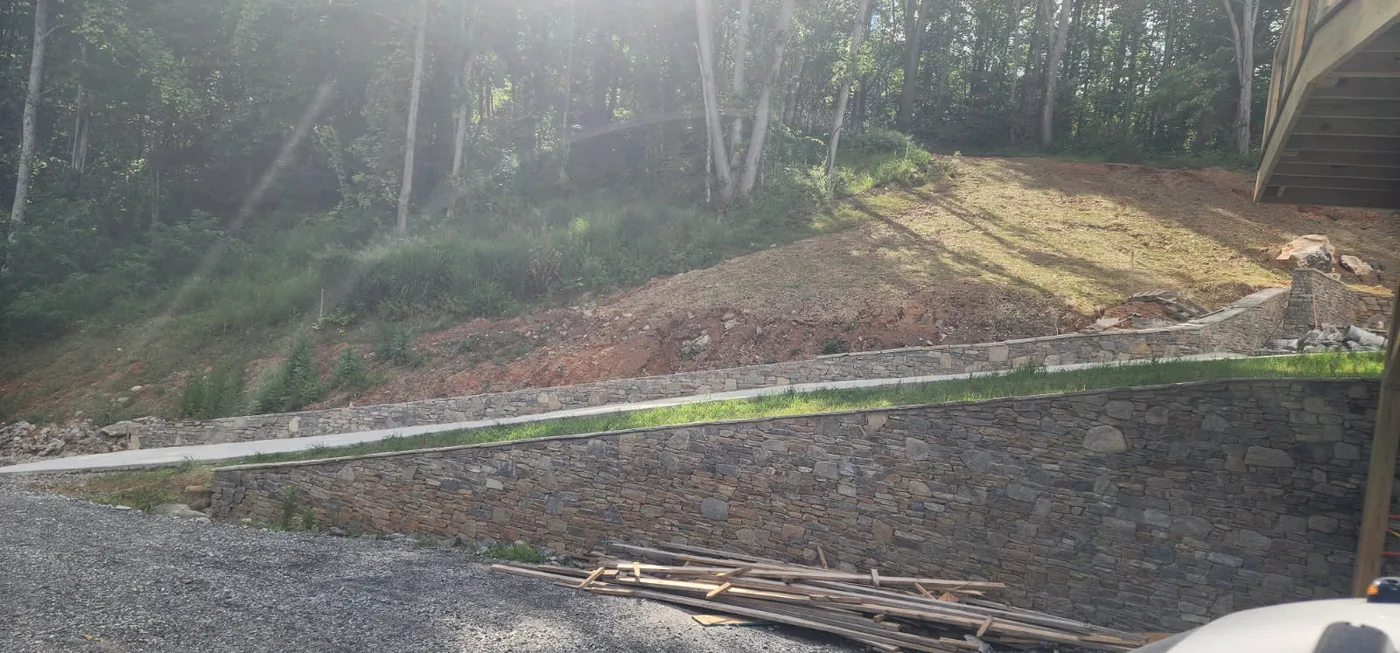
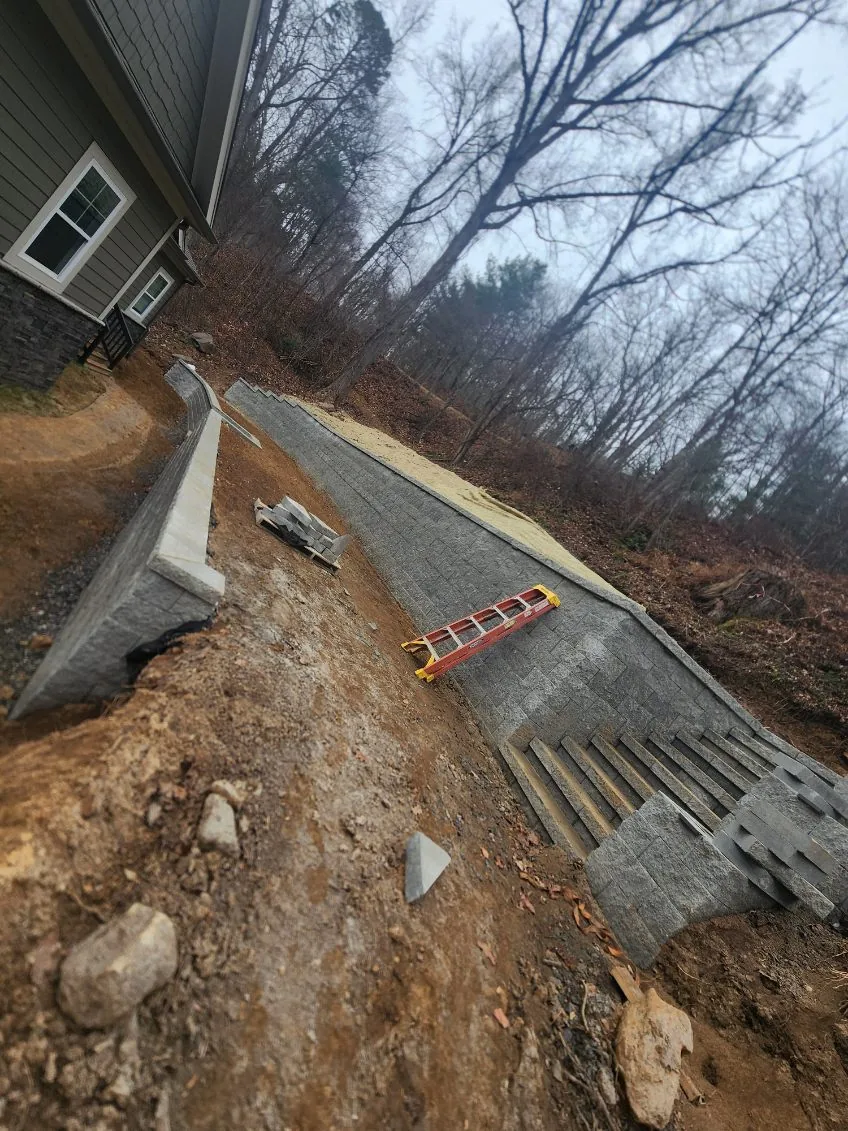
This is a terrain-driven market in the most literal sense. Buncombe County's housing stock spreads across valley floors, ridge lines, and everything in between, and the lots reflect it: narrow switchback driveways in Riceville and Weaverville, near-vertical cut banks in Black Mountain and Swannanoa, and plenty of homes in West Asheville or Oakley where the wall is holding back a slope the builder created in the first place. A dry-stacked garden wall on a flat lot is a three-day job. The same wall face on a 25% slope in Fairview could take two weeks, and the labor line shows it.
| Scope of work | Typical Buncombe range | What drives it |
|---|---|---|
| Low garden wall, 18–24 inches, flat access | $45 – $60 / sq ft of face | boulder size, cap course, how level the dig is |
| Structural wall, 3–4 feet, truck-accessible | $55 – $75 / sq ft | footer depth, drainage gravel, geogrid |
| Tall or terraced wall, 5 feet plus | $75 – $110+ / sq ft | engineering, tier setbacks, machine reach |
| Steep-lot surcharge (long carry, no truck access) | adds $8 – $20 / sq ft | labor hours, small-machine trips, staging area |
| Drainage and backfill tie-in | $900 – $3,500 | drain line length, outlet, how wet the slope runs |
Those are working ranges, not bids. Anyone who quotes a firm number before walking the grade is guessing with your money.
One more place-specific wrinkle: staging. In a county where a lot may have a single-car-wide gravel drive and no turnaround, the crew has to stage stone somewhere and feed it uphill. That means more machine hours and more hand work, and it's the reason two bids on the same wall can differ by thousands. Ask any bidder where they plan to stage material. If they haven't thought about it, they haven't priced your job.
How slope and water history change the build
Buncombe County sits in a wet, steep corner of the state, and the federal record backs that up: 19 federally declared disaster events have touched the county across 1973-2026, most of them storm and flood family. On a retaining wall, that history is not abstract. A wall built to hold back a hillside is also holding back the water that hillside collects, and when a storm stalls over the Blue Ridge, that pressure has to go somewhere. It goes into your drainage detail or it goes into the wall.
The terrain makes it worse in specific ways. Western North Carolina soils vary wildly over short distances — clay pockets that hold water, weathered saprolite that drains fast, and rock ledges that force a footer up or down. A wall footer that hits rock near the surface may need a different footing detail than the same wall 200 feet away. That's why a real quote on a Buncombe hillside involves digging a test hole or two, not just eyeballing the slope. The National Weather Service tracks the rainfall patterns that drive this; the pattern for the southern Appalachians is intense bursts on already-saturated ground, which is exactly the condition a wall's drainage has to survive.
Practical consequence: in this county, a retaining wall quote that doesn't include a drainage plan is a quote for doing the job twice. That usually means perforated drain line behind the wall, washed gravel backfill, and a filter fabric to keep the fines out — plus a real outlet, not just a pipe that dumps onto the neighbor's slope. On a slope where water already sheets down the driveway after a storm, that outlet run can be as much work as the wall itself. For more on how that changes the engineering, our boulder retaining walls guide walks through the build sequence.
Permits, codes, and where licensure kicks in
Retaining walls occupy a gray zone in most of North Carolina: a low garden wall usually needs no permit, but once a wall becomes a structural earth-retention structure — generally taller than about four feet, or carrying a surcharge like a driveway or a building above it — the county treats it as construction and expects a permit and often an engineered design. Buncombe County enforces the residential code's provisions for retaining structures under the NC State Building Code, and on steep-lot walls near a slope or a structure, plan review is the norm rather than the exception.
The building code itself traces back to the model codes maintained by the International Code Council, which governs footing, drainage, and backfill standards that a structural wall has to meet. In practice, that means a plan reviewer will look at footer depth, wall batter, and how water gets out from behind the wall — the same three things a good stone mason obsesses over anyway. It's not bureaucracy for its own sake; a failed wall on a steep lot in this county can move a lot of earth downhill, fast.
On the contractor side, North Carolina's licensing threshold rules from the NC Licensing Board for General Contractors require a licensed general contractor once a project crosses $40,000. Plenty of retaining walls clear that number without trying, which means the person you hire should be able to show a license and pull the permit in their own name. If a contractor waves the permit off as optional on a structural wall, that tells you what their engineering looks like too.
A local note on scope: Buncombe County includes both the city of Asheville and unincorporated areas like Arden, Leicester, and Fairview, and while the state code applies countywide, plan review and inspection scheduling can differ between jurisdictions inside and outside city limits. A contractor who works these slopes regularly knows which office to call. If you're comparing bids, ask each one who pulls the permit and whether they've done it in your specific jurisdiction — the answers will separate the regulars from the drive-bys.
How to keep the number honest
Three moves protect you in this market:
- Price access up front. Ask every bidder to walk the driveway with you and say out loud where the truck stops and how the rock reaches the footer. If they skip that, they haven't priced the job.
- Price per square foot of wall face, and list the extras. Boulder size, cap course, drainage, and haul are the change orders that blow up budgets. Get them itemized, not bundled.
- Compare against the county range. If a bid lands far outside the table above, make them explain why. Sometimes there's a real reason — depth to rock, a load of stone that has to be trucked in from out of county — and how they explain it tells you everything.
It also helps to understand what you're actually buying. A boulder wall in this region is typically dry-stacked or lightly pinned, built from stone heavy enough that each piece is set with equipment, not by hand. The wall's strength comes from how the stones interlock and how the base course bears on undisturbed soil or compacted gravel, not from mortar. That's why an experienced mason spends most of the job on the part you'll never see — the excavation and the footer — and why a cheaper bid often means a shallower dig.
Wondering how your town compares? See retaining wall cost in Buncombe County for the full county picture, or the national cost guide for a baseline to compare against.
What actually moves a boulder wall quote
Beyond access and haul, four things separate a $6,000 wall from a $30,000 one on the same footprint. First, height: cost grows faster than height because taller walls need deeper footers, geogrid reinforcement, and often engineering. Second, boulder size and availability — the right stone for a structural wall is not the same as the decorative rock at the landscape yard, and the structural stuff is heavier, harder to source, and harder to set. Third, drainage: a wall on a wet slope needs more gravel, more fabric, and a longer outlet run than a wall on a dry one. Fourth, how long the wall is expected to last. A dry-stacked garden wall and a structurally pinned wall look similar in photos and price nothing alike to build.
There's also the question of what the wall is holding. A terrace wall that retains a planting bed is doing light duty. A wall that retains a driveway, or that sits below a house foundation on a cut slope, is doing structural work and has to be built like it. In the Asheville area, with its mix of older hillside homes and newer builds on lots that were graded hard, both situations are common. Be upfront with your contractor about what's above the wall. It changes the footer, the stone size, and sometimes whether you need an engineer's stamp at all.
One honest note on timing: stone work in western North Carolina is seasonal. A wet fall or a frozen January can push a wall weeks, and a crew juggling mountain jobs will tell you that up front. If a bidder promises a specific date in the middle of winter with no weather caveat, ask why.
If you're weighing a boulder wall against a block or timber wall, the trade-off is usually aesthetic and lifespan versus upfront cost — boulder and natural stone sit at the top of both, and the county cost page breaks down how the alternatives compare in this market.