Asheville Stone Masonry

Services

Boulder Retaining Walls in Asheville, NCFire Pit Builders in Asheville, NCFlagstone Patios in Asheville, NCGas Fire Pit Installation in Asheville, NCHardscaping in Asheville, NCOutdoor Fireplace and Outdoor Kitchen Builders in Asheville, NCOutdoor Kitchen Builders in Asheville, NCPaver Driveways and Walkways in Asheville, NCPaver Patio Installers in Asheville, NCRetaining Wall Repair in Asheville, NCRetaining Wall Contractors in Asheville, NCStacked Stone Fireplaces in Asheville, NCStone Retaining Walls in Asheville, NC: Dry-Stack and MortaredStone Steps and Walkways in Asheville, NCStone Veneer Installation in Asheville, NCStone Waterfalls and Ponds in Asheville, NC

Cost & Rules

Backyard Waterfall and Pond Cost in NCBoulder Retaining Wall Cost in NCFire Pit Installation Cost in NCFlagstone Patio Cost per Square Foot in NCHow Much Does a Retaining Wall Cost in NC?Outdoor Fireplace Cost in NCOutdoor Kitchen Cost in NCPaver Patio Cost per Square Foot in NC

Areas

Fire Pit Builders in Arden, NCFire Pit Builders in Barnardsville, NCFire Pit Builders in Biltmore Forest, NCFire Pit Builders in Black Mountain, NCFire Pit Builders in Candler, NCFire Pit Builders in Canton, NCFire Pit Builders in Clyde, NCFire Pit Builders in Etowah, NC All pages → Get a free quote
Henderson County, NC · Service Area

Stone Steps and Walkways in Laurel Park, NC

Stone steps Laurel Park NC: most walks and stoops land $3,200–$11,500. How a job actually runs, week by week, on Henderson County slopes.

Free on-site estimateReal photos of our own workBased in Candler, west of AshevilleSe habla espanolWalls, patios, fire pits, veneer Free on-site estimateReal photos of our own workBased in Candler, west of AshevilleSe habla espanolWalls, patios, fire pits, veneer

Get a free quote

Fast reply — no obligation.

Goes straight to us. We never sell or share your info.

Quick answer
Stone Steps and Walkways in Laurel Park, NC

For stone steps and walkways in Laurel Park NC, most residential jobs land between $3,200 and $11,500 depending on grade, stone choice, and rail requirements. Because Laurel Park lots climb, a typical build runs 4–10 working days: layout and digs first, base and compaction second, stone setting third, drainage and rails last.

16
federal disaster declarations on record in Henderson County
Hurricane Dorian
most notable event in the federal record
1978–2026
span of the declaration record
Asheville
Henderson County hub

How a Laurel Park stone job actually runs, start to finish

Most Laurel Park properties sit on a grade that makes a straight run of steps impossible. The town grew up as a summer estate community, and its best-known streets follow ridgelines above Hendersonville, so front walks routinely drop eight to twenty feet from the road to a door. That shape drives the whole schedule of a stone steps and walkways project in Laurel Park NC: nothing gets ordered until the rise has been measured twice.

Here is the honest sequence a competent crew follows. Days 1–2: layout and demolition. A builder's level or rotary laser establishes total rise, run, and landing locations. Old concrete stoops, railroad-tie timbers, and failed pavers come out and haul off. Days 2–3: excavation and base. Treads get dug to depth, typically six to ten inches of compacted base for a walkway and deeper under step footings, with geotextile fabric over Henderson County's red clay so the base does not pump silt. Days 3–5: stone setting. Treads are set bottom-up so each course is checked against the one below it. Days 5–8: drainage and finishing. French drains, gravel curtains, and gutter extensions get tied in before backfill, not after. Final day: rails, lighting, and clean-up — handrails where the code requires them, low-voltage path lights if the customer wants them, and a wash-down.

A short set of four or five treads with a small landing is a two-to-three-day job. A full hillside walk with switchbacks, a stoop rebuild, and a retaining transition can run two to three weeks. Weather moves everything: wet clay will not compact, and setting stone on saturated base is how a walk fails in year two.

What drives the price on a graded lot

Two Laurel Park jobs with identical square footage can differ by thousands of dollars, and grade is almost always the reason. Rise per run, the number of landings, whether footings have to be dug into slope, and whether railings are triggered by the drop all change the labor picture before a single stone is picked. Stone selection matters too: a regional granite or fieldstone tread costs more per piece than a manufactured concrete paver but outlives it by decades.

For the structural retaining components that often bracket a walk, the Henderson County retaining wall cost table shows how wall height and engineering drives the number separately from the step work itself. If a wall is part of your project, budget it as its own line.

ScopeTypical price rangeTypical duration
Short stone stoop (3–4 treads, reset existing landing)$1,800–$3,6001–2 days
Sloped front walk, 30–60 linear feet, stone treads and landings$3,200–$7,5003–6 days
Full hillside walk with switchbacks and drainage$7,000–$11,5001–2 weeks
Walk plus retaining transition and drainage corrections$9,500–$18,000+2–3 weeks
Railings, lighting, and finish details$600–$2,500added to schedule

Any of those brackets can move. A bid that lands far below the band for your scope is usually missing the base depth, the drainage, or both.

Base, water, and the freeze line

Henderson County gets real winter. Ground here freezes, thaws, and moves, and stone that sits on a shallow base will heave and go out of level within a season or two. The drainage half of the job is what keeps the steps where the crew put them: surface water has to be intercepted above the top tread, carried around the walk, and released below it. On Laurel Park's estate lots the uphill neighbor's runoff is often the actual culprit behind a failed walk, and no amount of new stone fixes it.

Compaction is not optional. Base material gets placed in lifts and compacted with a plate or jumping jack, and the crew should be able to tell you the depth and the compaction method in the bid. Handrail rules follow the residential building code, which the International Code Council publishes and North Carolina adopts with amendments — if your walk drops more than the threshold, plan on a rail whether or not you want one.

Checking a crew before you sign

North Carolina draws a licensing line at project value, and hardscape work can cross it fast once walls, drainage, and structural components are in the same scope as the steps. The NC Licensing Board for General Contractors is the place to confirm whether your contractor is required to hold a license and does. Ask for it directly, and check the number yourself rather than taking a photo of a card at face value.

Beyond licensing, two questions separate experienced hillside crews from generalists. First: how do they handle the base under the bottom tread, where water collects? Second: what happens at the top, where the walk meets the grade? A crew that has built on Laurel Park's slopes will answer both without hesitating. When you are ready to compare scope items side by side, the Laurel Park retaining and hardscape contractors page covers what to look for, and the stone steps and walkways overview explains the scope options before anyone comes out.

Storm history and why it shows up in bids

The federal disaster record for this county — 16 declared events across 1978-2026 — is dominated by storm and flood family events, and that history is written into the fine print of a good Laurel Park estimate. Heavy rain on a graded lot does not just run across a walk; it gets under it, and once the base is compromised the treads follow. That is why a serious bid includes gutter extensions, surface grading, and a drainage line item even when the walk itself looks structurally fine. If the storm history in your part of the county has already rearranged your yard once, that line item is not upsell — it is the reason the steps will still be level in five years.
Henderson County, NC: the storm record

Federally declared disaster events16
Named storms in the recordHurricane Dorian, Hurricane Florence, Hurricane Fran, Hurricane Helene, Hurricane Ian, Hurricane Isaias
Incident typesFire, Flood, Hurricane, Snowstorm, Tropical Storm
Record span (fiscal years)1978–2026
Source: FEMA OpenFEMA disaster declarations. County-level federal declarations, not individual claims.
Questions people ask

Straight answers

How much do stone steps and walkways cost in Laurel Park NC?
Most residential projects run $3,200–$11,500, with short stoops starting around $1,800 and full hillside walks with drainage climbing past $11,000. Grade, stone choice, and rail requirements are the biggest movers.
How long does a stone walkway project take?
A small stoop is a 1–2 day job. A typical sloped front walk runs 3–6 working days, and a full hillside walk with switchbacks and drainage takes 1–2 weeks. Wet weather on clay can add days, because base cannot be compacted when saturated.
Do I need a handrail on my stone steps?
It depends on the drop and the number of risers — North Carolina adopts the residential code published by the ICC, and the threshold is specific. A contractor should be able to tell you before you order stone, since rails affect the tread layout.
Why did my last stone walk fail so fast?
Almost always base depth or drainage. Stone set on a shallow, uncompacted base over Henderson County clay will heave and shift within a season or two, and uphill runoff that was never intercepted will undermine it from below.
Does my contractor need a North Carolina license for this work?
The state sets a project-value threshold, and a scope that includes retaining walls and drainage can cross it. Verify with the NC Licensing Board for General Contractors before signing.
Can you build on a very steep lot?
Yes — that is most of what Laurel Park's terrain requires. Steep lots mean switchbacks, landings, and footings dug into slope, and they may involve a retaining transition, which is priced as its own line item.
What stone holds up best here?
Regional granite and dense fieldstone outlast most manufactured options, especially where freeze-thaw movement is a factor. Natural stone also accepts a rougher finish, which matters on shaded, damp treads.
Our work

Our work

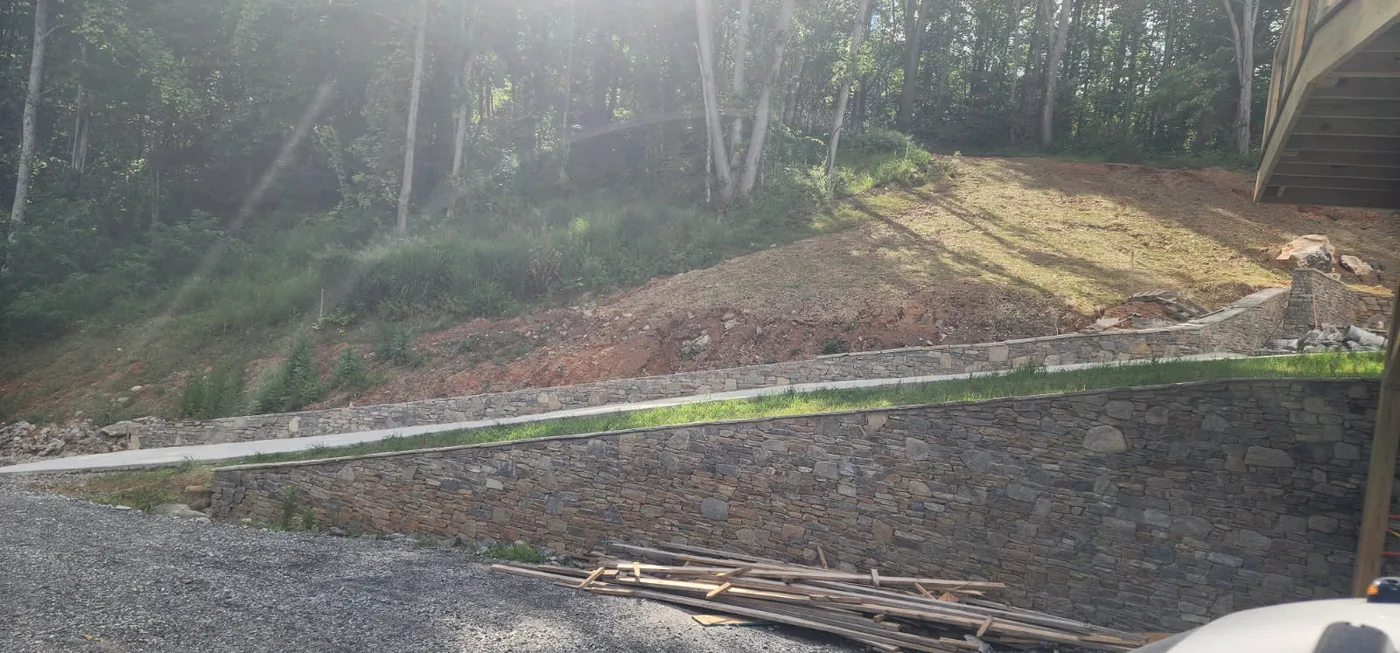
Mortared fieldstone retaining walls stepping up a mountain driveway, with fresh concrete poured between them. Built by Asheville Stone Masonry.
Mortared fieldstone retaining walls stepping up a mountain driveway, with fresh concrete poured between them.
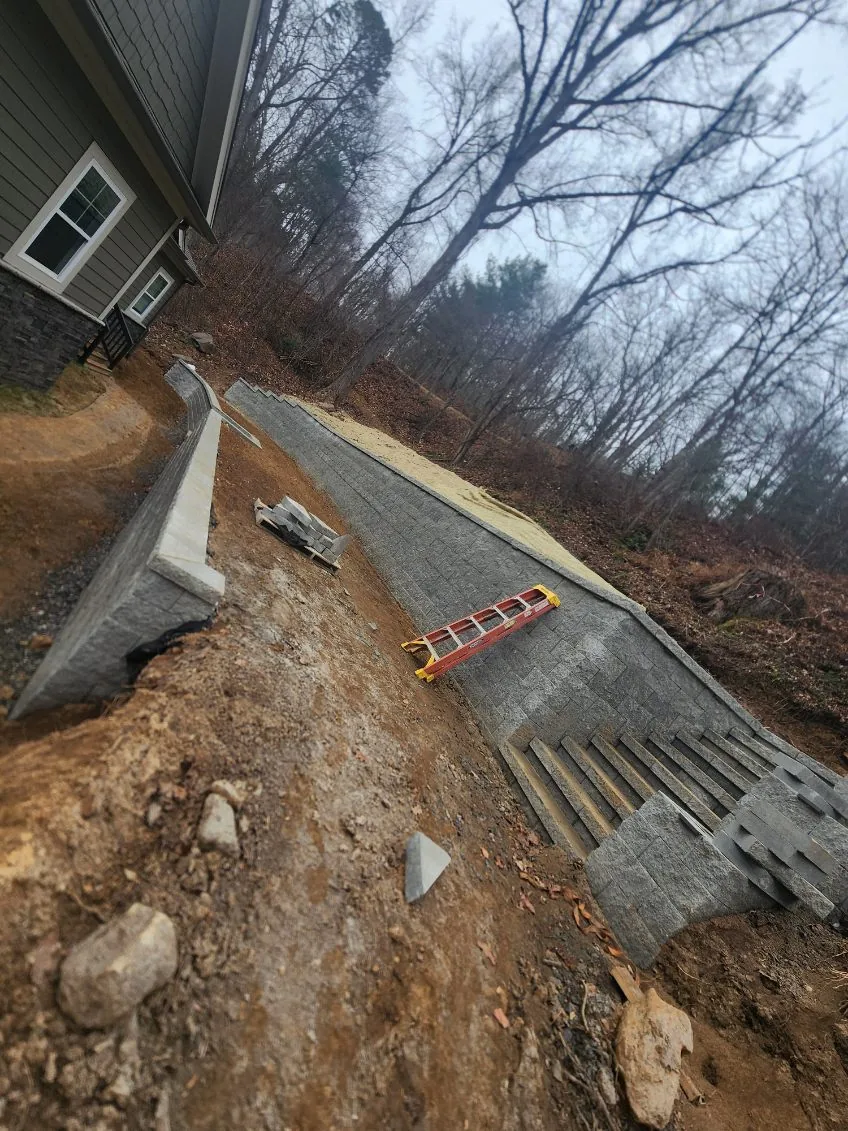
Segmental block retaining wall with a built-in stair run, holding the grade beside a new home. Built by Asheville Stone Masonry.
Segmental block retaining wall with a built-in stair run, holding the grade beside a new home.
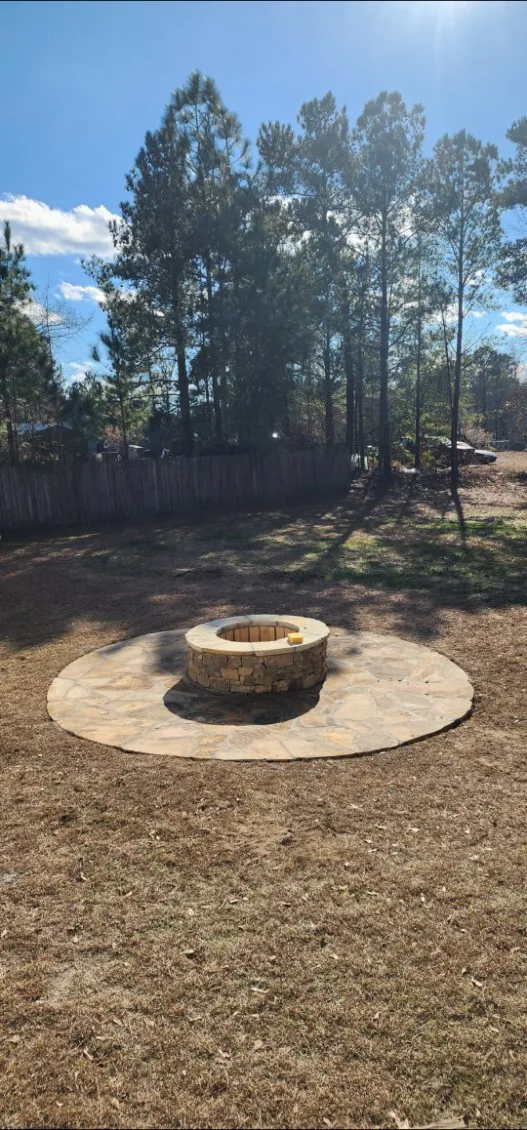
Finished fire-pit patio: a stacked-stone ring with a cut-stone cap inside a full circle of flagstone. Built by Asheville Stone Masonry.
Finished fire-pit patio: a stacked-stone ring with a cut-stone cap inside a full circle of flagstone.
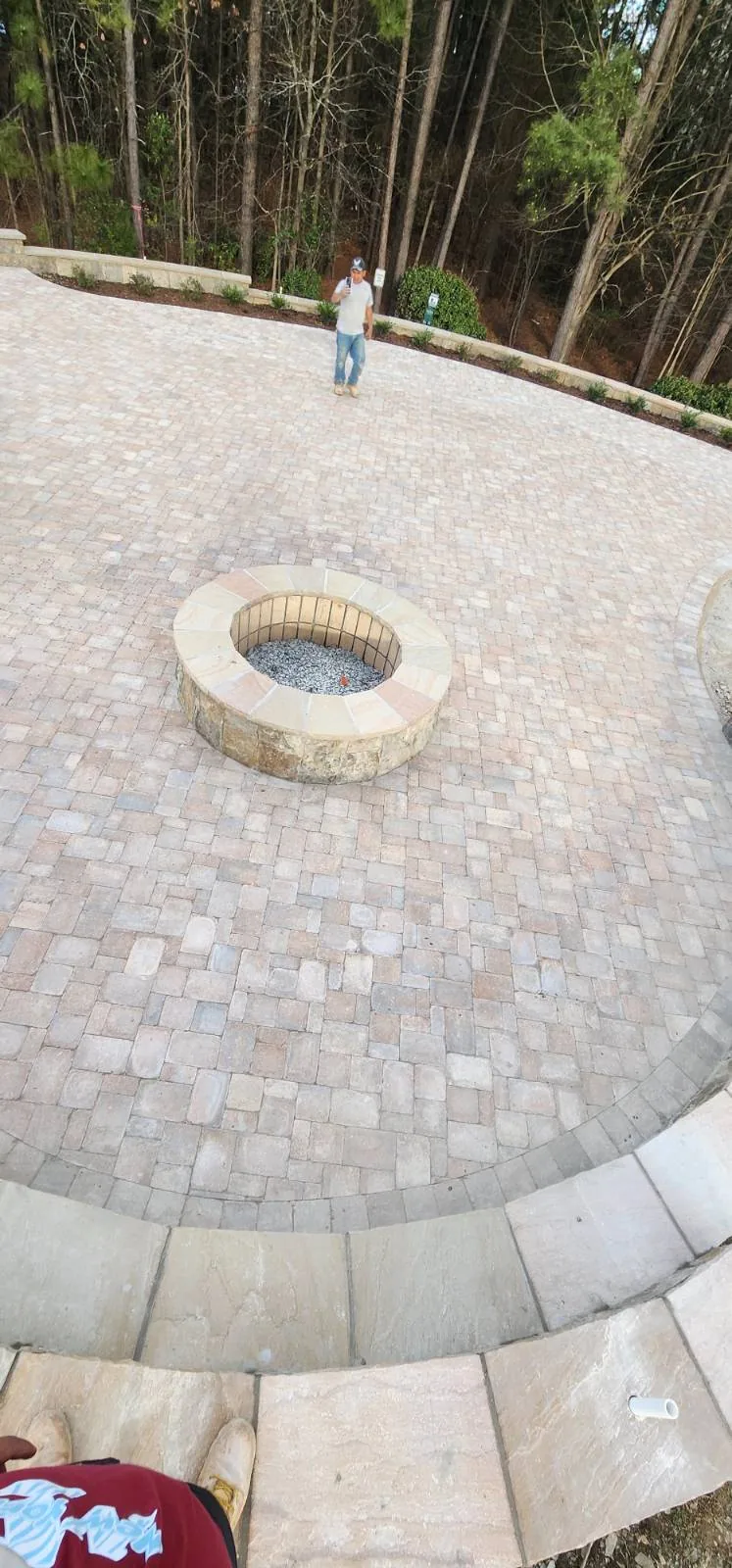
Circular paver patio with a stone fire pit and a curved seat wall at the tree line. Built by Asheville Stone Masonry.
Circular paver patio with a stone fire pit and a curved seat wall at the tree line.
Get a quote

Tell us about your project. We price it straight.

Where it is and what you need — that's all it takes to start. You get a clear scope and an honest number, and your info never gets sold to a list.

Or call — (828) 424-8873

Fast, free quote

Call now Text us