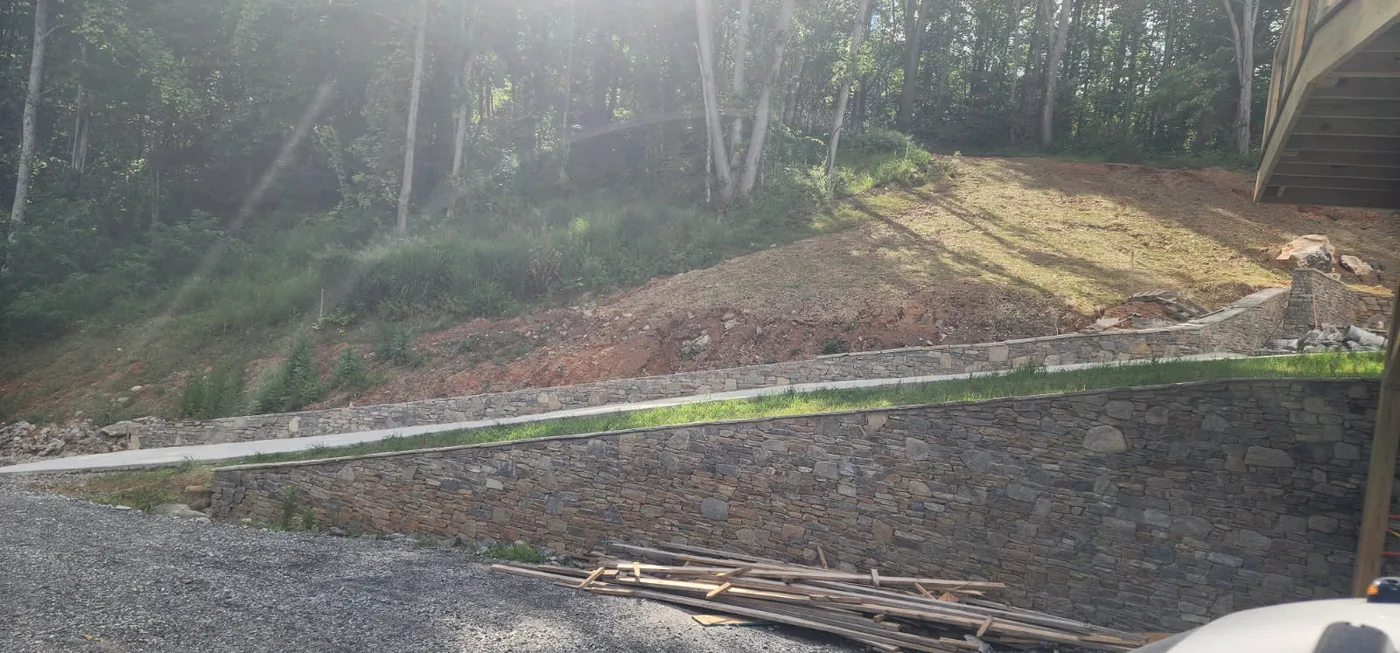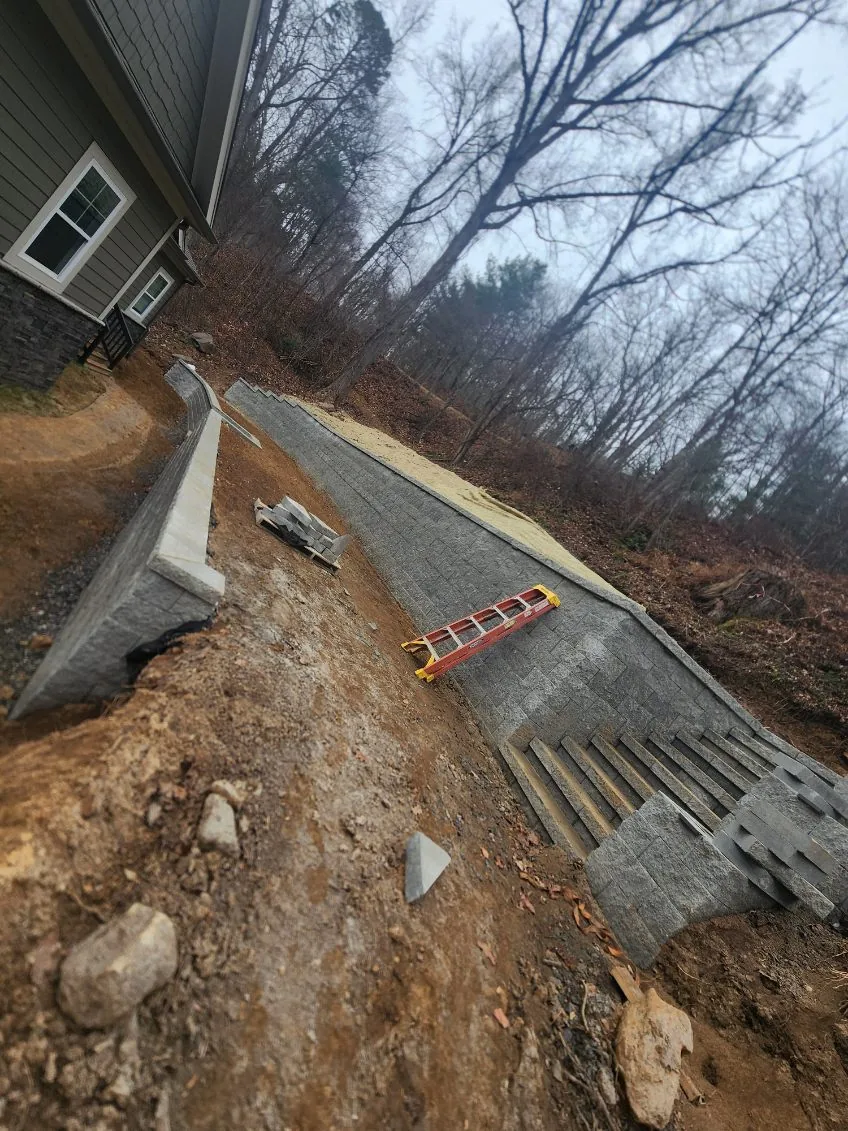
What retaining wall repair actually fixes
A retaining wall in Asheville is holding back more than dirt—it's holding back the mountainside. When it leans, cracks, or bulges, the question isn't how to patch it, but why it moved. Repair means addressing the cause: inadequate drainage, missing or shallow footings, frost heave, or a wall built without proper backfill compaction. In Buncombe County's red clay and steep lots, water is almost always the first mover—saturated soil doubles its weight and pushes laterally with hydrostatic pressure your wall was never designed to resist.
The honest version: some walls are repairable with soil anchors, drainage retrofits, or targeted rebuilding of a failing section. Others are past it—when a wall leans more than an inch per foot of height or has a continuous crack running through the block, the leaning wall guide explains why replacement is often the cheaper path than repeated repairs. Start with an overview of wall systems to understand what you're actually dealing with, then get someone who reads soil, not just block.
The real causes of wall failure in Buncombe County
Asheville's terrain is beautiful and brutal on retaining walls. Steep grades mean taller walls, taller walls mean more load, and more load means everything has to be done right. The causes we see most:
- No drainage behind the wall. Missing or clogged weep holes and gravel backfill turn your wall into a dam. When clay saturates, it expands and pushes—this is the #1 cause of failure here.
- Footings too shallow for frost. Frost heave lifts and settles walls unevenly. In the mountains, that movement is amplified by freeze-thaw cycles that can crack a wall in a single winter.
- Under-engineered for the load. A 4-foot wall holding back a 20-foot slope is a different structure than one holding back a flat yard. Without an engineering calc, you're guessing.
- Poor compaction behind the wall. Loose backfill settles, creating voids and pressure points that shift blocks over time.
This is why railroad tie walls—common on older Asheville properties—fail so predictably: they rot, the soil behind them saturates, and the whole system gives way. The National Weather Service tracks our region's rainfall patterns, and the data makes the point: repeated saturation events are the norm, not the exception, which means drainage isn't optional—it's the whole game.
Repair vs. replacement: how to decide
Every wall tells you what it needs. The decision comes down to three factors:
1. Cause. If the problem is clogged drainage or a missing footer drain, adding drainage and rebuilding the affected section can buy decades. If the footing is undersized or the wall is reinforced with nothing but gravity, replacement is the honest answer.
2. Movement. A wall leaning less than 1 inch per foot of height can often be stabilized with helical soil anchors drilled through the wall into competent soil. Beyond that, the structural integrity is compromised—see the leaning wall assessment for the numbers.
3. Material condition. Cracks that follow block joints are often cosmetic. Cracks through the block itself mean the wall is under load it wasn't designed for. Rotting timbers, rusted reinforcement, or spalling concrete mean the material has reached end-of-life.
For walls over 4 feet tall, North Carolina law requires an engineer's design—this isn't a suggestion, it's a licensed professional's responsibility. The NC Licensing Board for General Contractors sets the standards for who can legally build or repair these structures, and any contractor proposing structural work without addressing code compliance is cutting a corner you'll pay for later.
What repair costs in Asheville, NC
Pricing in Buncombe County varies dramatically based on access, height, and depth of the failure. Here's an honest scope-by-scope table—not flat rates, but real ranges from the territory:
| Scope of work | Typical price range | What's included |
|---|---|---|
| Drainage retrofit only (weep holes, gravel, footer drain) | $800–$2,500 | Unearthing the base, installing perforated pipe, adding drainage stone, restoring grade |
| Targeted repair / rebuilding a failed section | $2,500–$7,000 | Taking down the compromised area, recompacting backfill, rebuilding with proper drainage |
| Helical soil anchors to stabilize a leaning wall | $3,500–$9,000 | Anchors driven to competent soil, plate attachment, cosmetic patching |
| Full wall replacement (30–60 feet, 3–6 feet tall) | $12,000–$35,000 | Demo, engineered design, new footing, proper drainage, new wall system |
Municipalities across the county—Asheville, Woodfin, Black Mountain, and the unincorporated areas—each have their own permitting requirements, and the cost of an engineered design ($800–$1,500) is often folded into these figures on taller walls. County flood history matters too: with 19 federal disaster declarations in 1973-2026, this region has seen enough water events that insurance adjusters and engineers both look at drainage history first when a wall fails.
The questions that keep a repair bid honest
“Can I see the drainage plan?” If a contractor talks about wall repair without mentioning drainage, they're planning to fix the symptom, not the problem. “What's the compaction spec for backfill?” You want a real number—95% standard proctor is the norm—not a shrug. “Who does the engineering for walls over 4 feet?” Under NC law, a licensed engineer's seal is required; the General Contractor's licensing board can tell you if your contractor is even licensed to pull the permit. “What happens to the water after it hits the footer drain?” It needs somewhere to go—daylighting to a low spot or tying into a proper outfall, not just pooling at the downhill end.
Environmental considerations matter too: if the failed wall sits near a creek or drainage easement, sediment control isn't optional. The EPA's construction stormwater rules apply even on residential lots when disturbed soil can reach waterways—another reason to work with someone who knows Buncombe County's topography, not someone who builds flatland walls.