What retaining walls do in Black Mountain
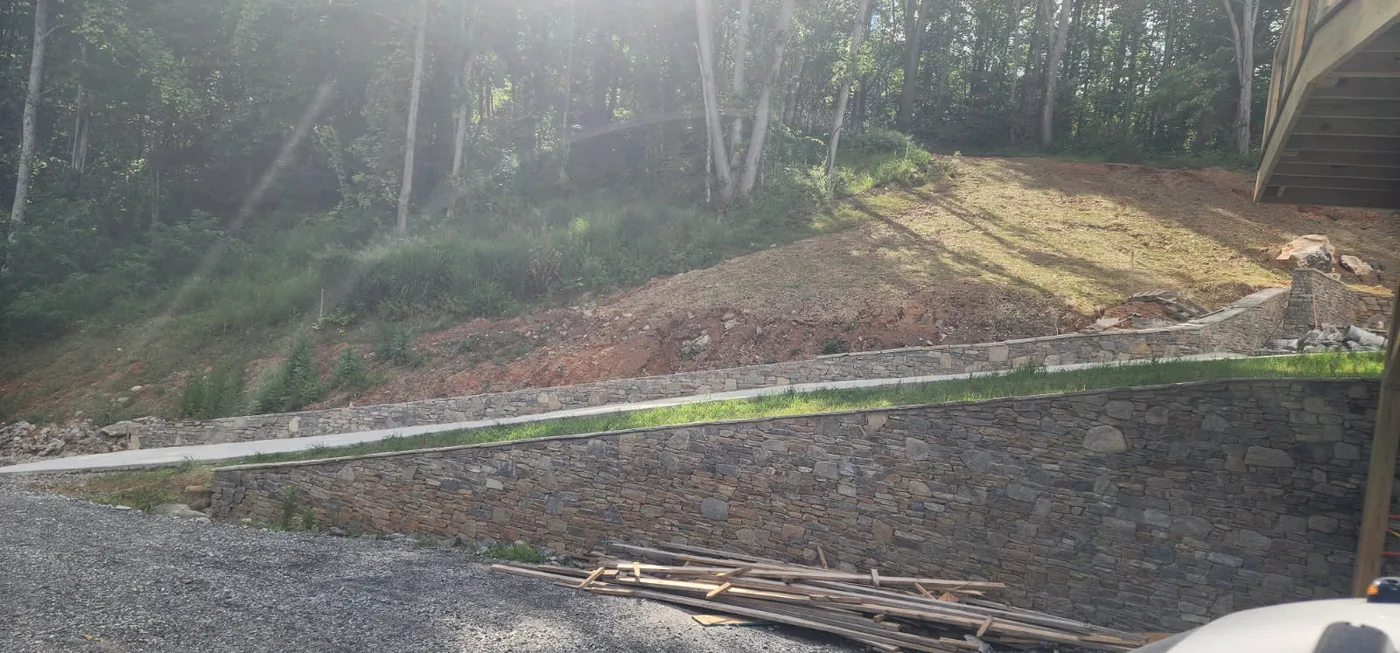
Black Mountain sits in a valley that collects water and a mountain fringe that moves it. The homes here — 1940s mill houses on Cragmont Road, newer craftsman-style builds on Bee Tree Road, and ridge-line cabins above Lake Tomahawk — all have one thing in common: a slope that needs holding. Retaining walls in this town aren't decorative. They stop driveway washouts, protect footers, and keep terrace gardens from becoming landslides.
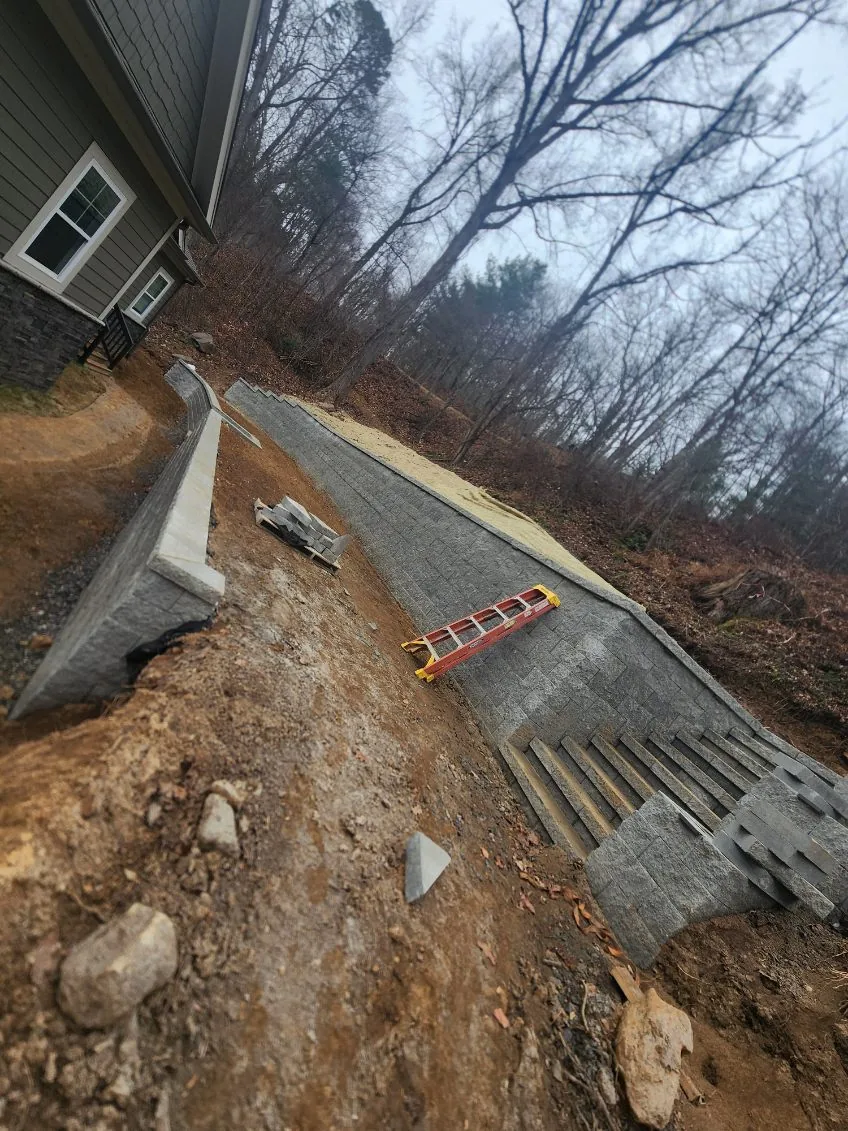
Knowing what you're asking for matters before you call. A gravity wall (stacked stone or large block) leans on its own weight. A segmental retaining wall (SRW) uses geogrid reinforcement to hold soil mass. And a cantilevered wall — usually poured concrete or engineered block — resists pressure with a footing buried below frost line. If a contractor quotes you one system without asking about your slope angle, drainage, or setback from structures, that's a red flag. Our retaining wall guide walks through which type fits which Black Mountain lot.
Black Mountain's ground and water reality
Buncombe County's disaster record tells a story your wall has to survive: 19 federal declarations since 1973-2026, most of them storm and flood events. Those events are why Black Mountain's clay-heavy soils get saturated fast — and saturated soil weighs roughly 50% more than dry soil, which is the number that actually crushes walls. The town's steep pitches off the Swannanoa River and toward the Blue Ridge escarpment mean water doesn't sit; it runs, and it runs fast.
National Weather Service data for the region shows why drainage is non-negotiable: intense short-duration storms hit this valley regularly, overwhelming any wall without a gravel backfill and perforated pipe behind it. The International Code Council's standards require that drainage for walls over four feet tall — and any wall retaining a slope that drains toward a structure. A wall without a drainage layer isn't a wall; it's a dam with a delayed failure date.
The Black Mountain price picture
Pricing in Black Mountain runs above the national average because of access and material hauling — narrow driveways, steep grades, and the distance from the aggregate yards in Asheville. The full cost breakdown has the working details, but the short version lives in this table:
| Wall Scope | Typical Height | Price Range (Installed) |
|---|---|---|
| Timber or landscape tie wall (repair or low garden edge) | Under 2 ft | $25–$45 per sq ft |
| Segmental block (SRW) — single terrace | 2–4 ft | $45–$65 per sq ft |
| Natural stone or full-height block with geogrid | 4–6 ft | $60–$90 per sq ft |
| Engineered cantilever wall (poured or block, engineer-stamped) | Over 6 ft | $95–$135 per sq ft |
Most homeowner-scale projects in town — a 40-foot driveway wall at 3 feet tall — land between $6,000 and $25,000. The big price movers: whether the wall needs a geotechnical engineer (walls over 4 feet, or any wall holding a structure's foundation), whether the old wall has to come out, and how far the crew carries materials from the truck to the trench.
Permits, codes, and who can build what
Black Mountain enforces the North Carolina State Building Code, and that code draws a clear line at four feet. Any retaining wall over 4 feet tall — measured from the bottom of the footing to the top of the wall — requires a permit from the town, an engineer's stamp on the plans if the wall is over 4 feet or retains a slope that supports a structure, and an inspection before backfill. The NC Licensing Board for General Contractors regulates who can take on these projects; retaining wall construction is general contracting, not a specialty license in North Carolina.
The licensing picture is simpler than most homeowners expect. For walls over 4 feet or any commercial work, your contractor should hold a valid general contractor's license — ask for it, and use the board's online database to verify it before you sign. For homeowner-built walls under 4 feet, no license is required, but the permit rule still stands. According to HUD guidance on slope stability, drainage behind any wall — regardless of height — is the single most important factor in preventing structural failure over time.
Hiring the right crew for this valley
Three checks separate a Black Mountain wall crew from a truck-and-shovel operation. First, ask about their experience with this soil — Buncombe County's residual clay and decomposed granite behave differently from the sandy loam on the other side of the state, and a crew that learned retaining walls in Charlotte will fight your ground. Second, ask how they sequence drainage: a proper wall has gravel and a drain pipe behind it before the wall face goes up, not as an afterthought. Third, ask if they pull the permit or if you have to — a crew that wants you to pull it is a crew that knows the inspector will wave off their work.
Also worth asking: have they worked with the engineer that Black Mountain requires for tall walls? A local wall contractor should have a working relationship with a geotechnical firm in the area, not a list of excuses for skipping the stamp. The EPA notes that poorly managed stormwater runoff from slopes is a leading contributor to sedimentation in waterways like the Swannanoa River — a well-built wall with proper drainage protects your property and the watershed. For nearby projects, our Swannanoa contractor page covers the same ground just up the valley — the crews we recommend there work Black Mountain too.