The Flat Rock price driver nobody mentions: haul and access
Ask three builders in Henderson County what a waterfall costs and you will get three answers, none of them about the waterfall. The difference is the driveway. Flat Rock sits on a shelf of rolling clay and granite shelf-country between Hendersonville and the Greenville watershed, and the lots that want water features most — the wooded, sloping ones off Little River Road and up toward the Carl Sandburg home side — are exactly the lots where a mini excavator cannot reach the backyard and a dump truck cannot turn around. When every boulder has to come down a hand-built path on a power buggy, the labor line doubles before the first stone is set.
Haul distance matters too. Most of the granite and fieldstone for local features comes out of quarries in the Henderson and Transylvania county area, so a few extra miles per load is real money on a job that can take five to fifteen tons of stone. A builder who walks the property before quoting — grade, gate width, turnaround, and where the spoils will go — is the one whose number will survive contact with the job.
Driveways here often climb at ten to fifteen percent, and many were laid out for horses or a Model A, not a tandem-axle dump. A loaded stone truck that cannot make the grade means a shuttle operation: park the big truck at the road, run a smaller machine up and down, and pay for the extra hours. That is not a design flaw; it is the terrain. On the wooded ridge lots above Bonclarken and around the Flat Rock Brook, a single boulder can cost two or three times what the same rock costs on a flat lot off Spartanburg Highway. Homeowners who understand that before the quote lands are rarely surprised by it.
There is also the question of where the spoils go. Excavating a pond or a fall basin produces yards of red clay and weathered rock, and on a tight lot there may be no place to lose it. If the only option is hauling it out, that is another trucking cost. A builder who plans to bench the spoils into the uphill slope, or use them to build up a planting berm, is saving you money without changing the look of the feature.
What a Flat Rock water feature actually costs
The table below reflects typical scopes and regional bands for Henderson County, not a single company's rate card. Steep-lot excavation, rock haul, and drainage corrections sit on top of what you see here.
| Scope | Typical range |
|---|---|
| Small boulder fall into a pre-formed or lined basin | $4,500–$8,000 |
| Pondless waterfall, 3–6 tons stone, single drop | $6,000–$12,000 |
| Lined pond with waterfall and edging, 8x11 typical | $10,000–$18,000 |
| Multi-drop feature with retaining and planting | $15,000–$28,000+ |
| Pump, liner, and filtration replacement only | $1,200–$4,000 |
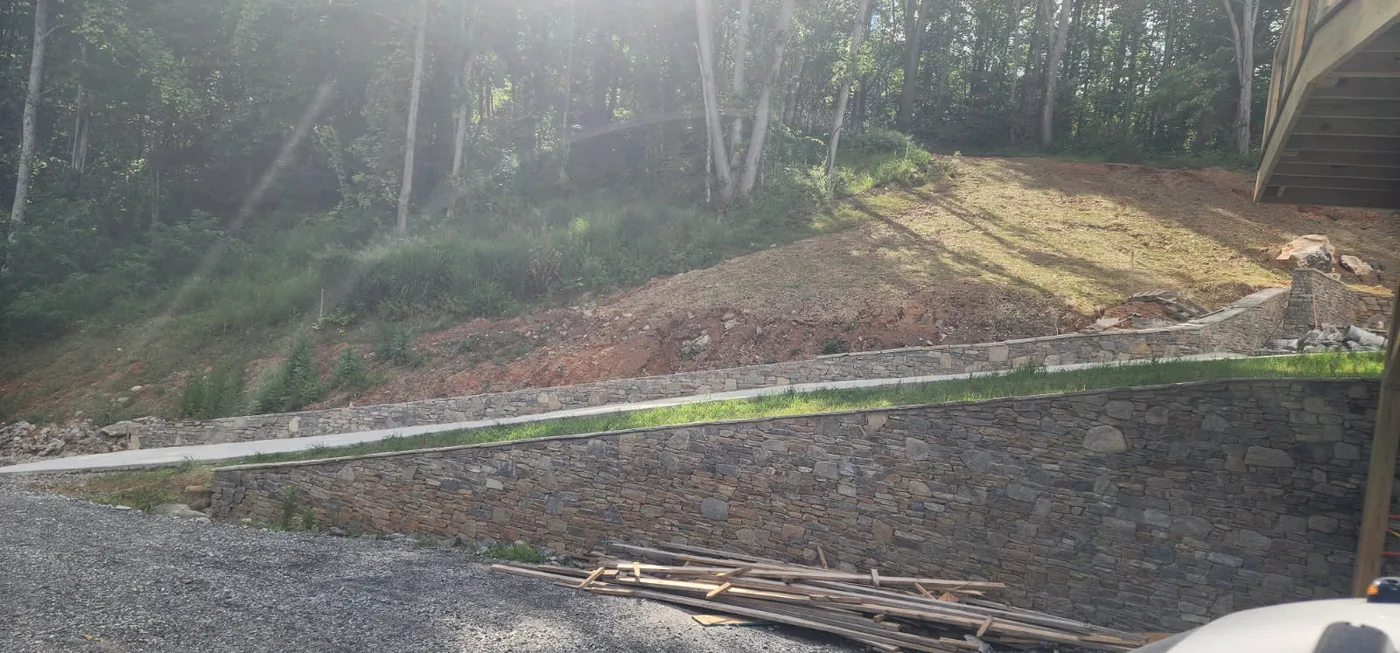
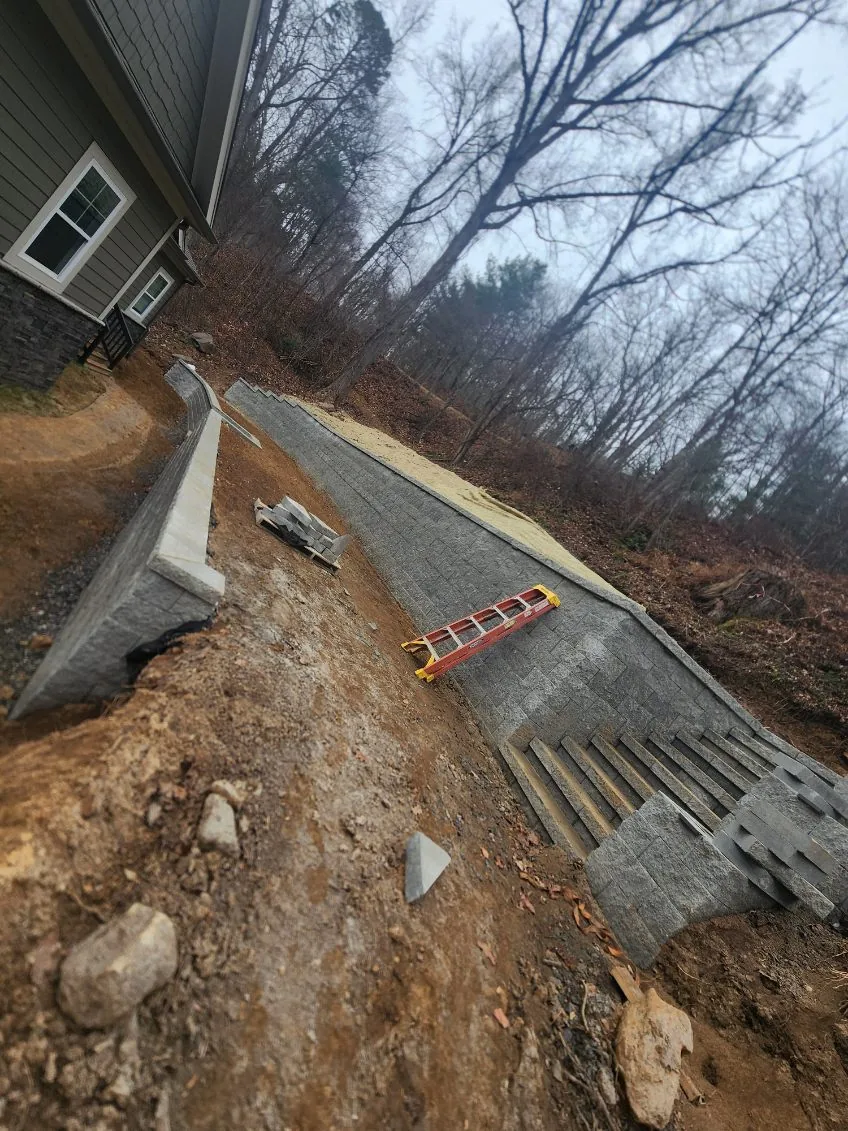
Structural retaining that the feature depends on is priced separately and often overlaps the same ground a wall crew is already working — see the Henderson County retaining wall cost breakdown before approving either scope.
Two line items explain most of the spread within each row. The first is liner and underlayment: a cheaper liner under a heavy boulder field is a callback waiting to happen, and the labor to redo it later is nearly the same as building the feature the first time. The second is the pump and electrical run. A feature sited far from the house may need a dedicated circuit and a weatherproof disconnect, and trenching that line through established landscaping is its own scope. Neither item is glamorous, and both are where a low bid tends to hide. Ask to see them broken out.
Permits, setbacks, and the water rules that surprise homeowners
A decorative recirculating feature is not a stream, and treating it like one creates problems. Anything that disturbs a creek, a mapped floodplain, or a protected riparian buffer can pull in state review through the NC Department of Environmental Quality, and the federal layer applies if the work touches a wetland — the EPA maintains the program that governs that. For a closed-loop waterfall, the practical questions are local: setback from the property line, HOA architectural review if you have one, and whether the excavation crosses a utility easement. A builder who has worked in this county will know where the line usually sits and will tell you when an engineer should look first.
Flat Rock's historic district adds a layer that many homeowners do not expect. Properties near the Carl Sandburg home and the old village core can carry design-review expectations that reach landscaping and hardscape, not just the house. A water feature visible from the street may need to be reviewed before excavation, and the review calendar can add weeks to a schedule. That is not a reason to skip the feature; it is a reason to start the conversation early and to choose a builder who has navigated the process before rather than one learning it on your dime.
On the county side, the trigger questions are usually about grading and stormwater rather than the water feature itself. If the excavation changes how stormwater leaves the property, or if the feature sits in a drainage swale that serves uphill neighbors, expect the county to want a closer look. A builder who understands the local drainage patterns can often design around the issue rather than fight it. Bring the county into the conversation before the dirt moves, not after.
Where Flat Rock water features fail first
Two failure modes dominate this terrain. The first is water finding the wrong path — a fall that looks right in June migrates under the liner by October and pulls the surrounding grade down with it. The second is settling on clay. Henderson County's red clay holds water beautifully right up until it does not, and a pond base or wall footer that skipped compaction will move in the first wet season. Ask any builder what they do about both, and listen for specifics: underlayment, geotextile, footer depth, and how they handle the uphill side of the grade.
This is the same reason storm history matters here. The county's record shows 16 declared federal events over 1978-2026, and the family that dominates is storm and flood — which means the standard is not the average year, it is the event. Size spillways and overflow paths for the worst week, not the nicest one, and reference the National Weather Service rainfall data for your part of the county when a builder proposes a design.
Watch for the quiet failures too. A pump buried in a gravel pit without a cleanout access is a service call the day it clogs. A liner trimmed too close to the edging stone leaves no slack when the ground shifts, and the first freeze-thaw cycle pulls it out from under the rock. A waterfall that dumps directly onto bare clay instead of into a splash basin will erode a hole behind the first boulder within a season. These are not exotic problems; they are the ordinary reasons a feature that looked fine at handoff starts looking tired by the second spring. A builder who talks about them before you ask is a builder who has been back to fix them.
Choosing a builder in a small market
Flat Rock is a small town inside a small county, and the crews who do this work are a short list. That makes reference-checking easy and gatekeeping important. Ask to see a feature they built two or three seasons ago and go look at it in person — a water feature is judged after the first winter, not the week it was finished. Ask who handles the pump and liner warranty and for how long. And ask how the quote treats the retaining scope, because on this terrain the wall is often half the job, and the Flat Rock retaining wall contractors page covers how to vet that side of the work. The NC Licensing Board for General Contractors sets the threshold where a project needs a licensed general contractor, and a large waterfall with structural retaining can cross it. For feature styles and construction detail, start with the stone waterfalls and ponds guide.
Because the market is small, schedules slip when one crew is busy. A builder who gives you a start date and a stone delivery window in writing is worth more than one who quotes a lower number and then disappears for a month. Ask how many active jobs they run at once, and ask what happens if the quarry is short on the stone size you want — a good builder has a second source or a plan to substitute a similar stone without changing the price.
Finally, consider the maintenance conversation. A water feature is a living system, and the homeowner who understands the seasonal rhythm — cleaning the pump intake, checking the water level through a dry August, clearing leaves before winter — gets years more out of the same build. A builder who walks you through that at handoff, rather than handing you a bill, is the one to call. It is a small county, and the crews that last are the ones whose phone still gets answered three years later.