Where the water comes from on a Hendersonville lot
Stand on almost any lawn between the Historic Courthouse and the foot of Jump Off Rock and you can trace the water that will eventually sit on your new patio. Hendersonville sits high, around 2,200 feet, and it gets more rain than most of the Southeast. On the county's rolling terrain, runoff arrives from three directions at once: sheet flow down your own slope, concentrated flow from the uphill neighbor, and spring water that pushes up through the clay that underlies most of these lots. A hardscape that ignores any one of those three is a hardscape that will heave within two winters.
That is why the first design decision on a Henderson County project is not paver color or wall block — it is where the water leaves. On a slope that falls toward the house, the answer is usually a swale or a buried drain that carries roof and surface water to a daylight point at the property edge. On flatter lots near Mud Creek or the French Broad bottoms, the answer is often a raised base and an infiltration bed. The local International Code Council residential provisions treat drainage and footing depth as structural requirements for a reason, and the dry-stacked walls that worked in the Piedmont fail here.
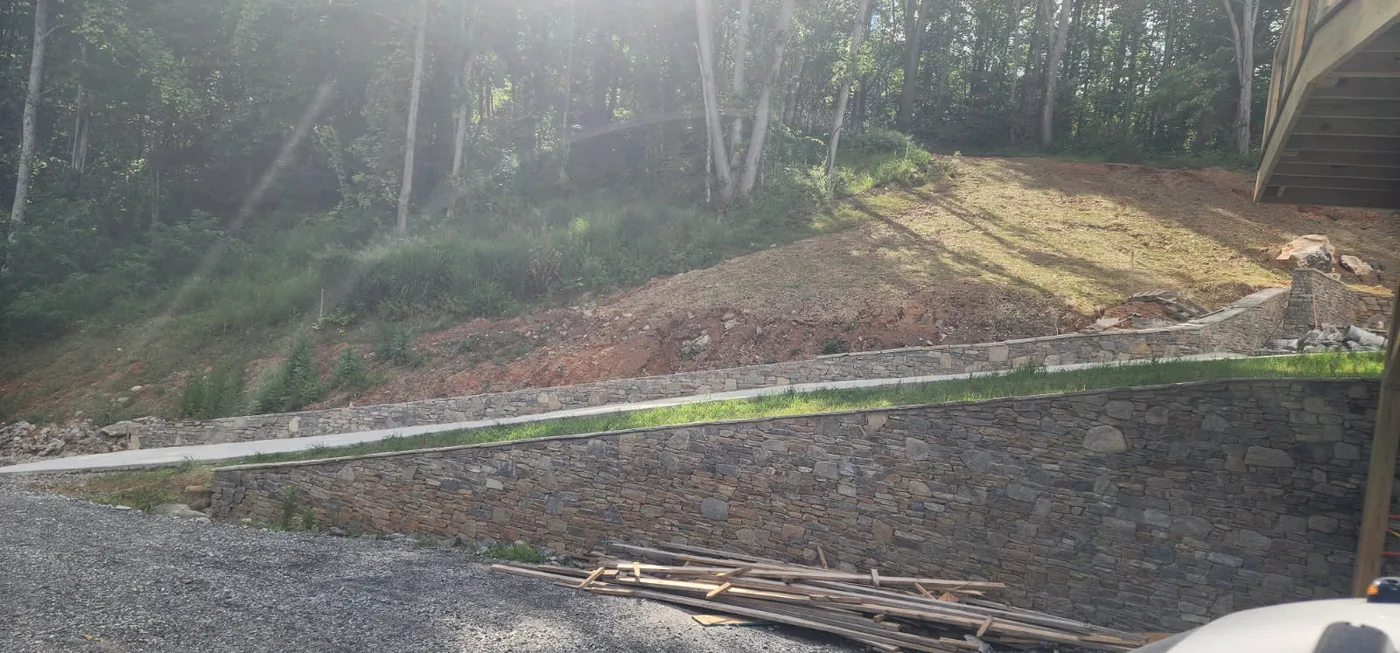
Consider a typical lot off Kanuga Road or up Howard Gap: the driveway cuts into a slope, the backyard falls away toward a creek branch, and the house sits on a bench that was graded decades ago. When a patio is added there, the runoff that used to sheet across the lawn now has to cross a hard surface. If the patio is pitched the wrong way, that water pools at the footer of the house. If it is pitched too steeply, it scours the mulch bed below. The sweet spot is a gentle grade that moves water to a defined collection point, then a pipe or swale that carries it past the disturbed area entirely. This is the kind of work where the design conversation matters more than the material selection, and it is why a hardscape quote in Henderson County should always include a drainage line item rather than treating it as an optional add-on.
Springs are the wildcard here. The clay layer that sits under many of these lots perches groundwater, and after a wet winter it can push up through a patio base. A French drain or a gravel-filled trench around the uphill perimeter is often the only defense. Contractors who build in Saluda, Flat Rock, and the Etowah valley see this constantly and price for it. Contractors who drive up from Greenville for the weekend often do not.
What hillside patios and walls actually cost here
Prices below reflect typical Henderson County scopes — materials, excavation, base prep, and drainage included. The county retaining wall cost table covers walls in finer detail.
| Scope | Typical range |
|---|---|
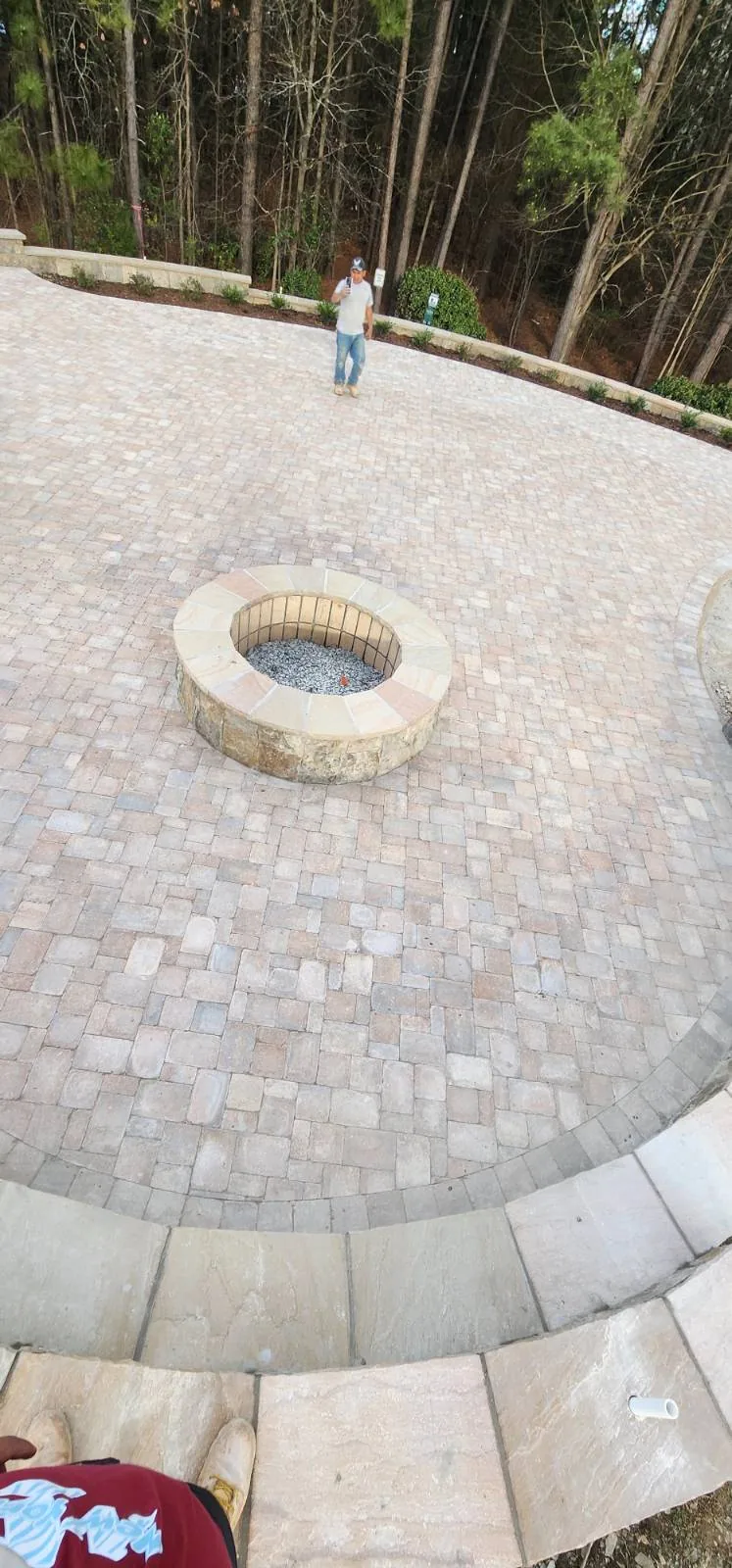
| Paver or flagstone patio, 300-500 sq ft, single grade | $8,000-$18,000 |
| Patio with steps, seat wall, or sloping-grade build | $18,000-$35,000 |
| Segmental block retaining wall, under 4 ft, under 40 linear ft | $4,500-$12,000 |
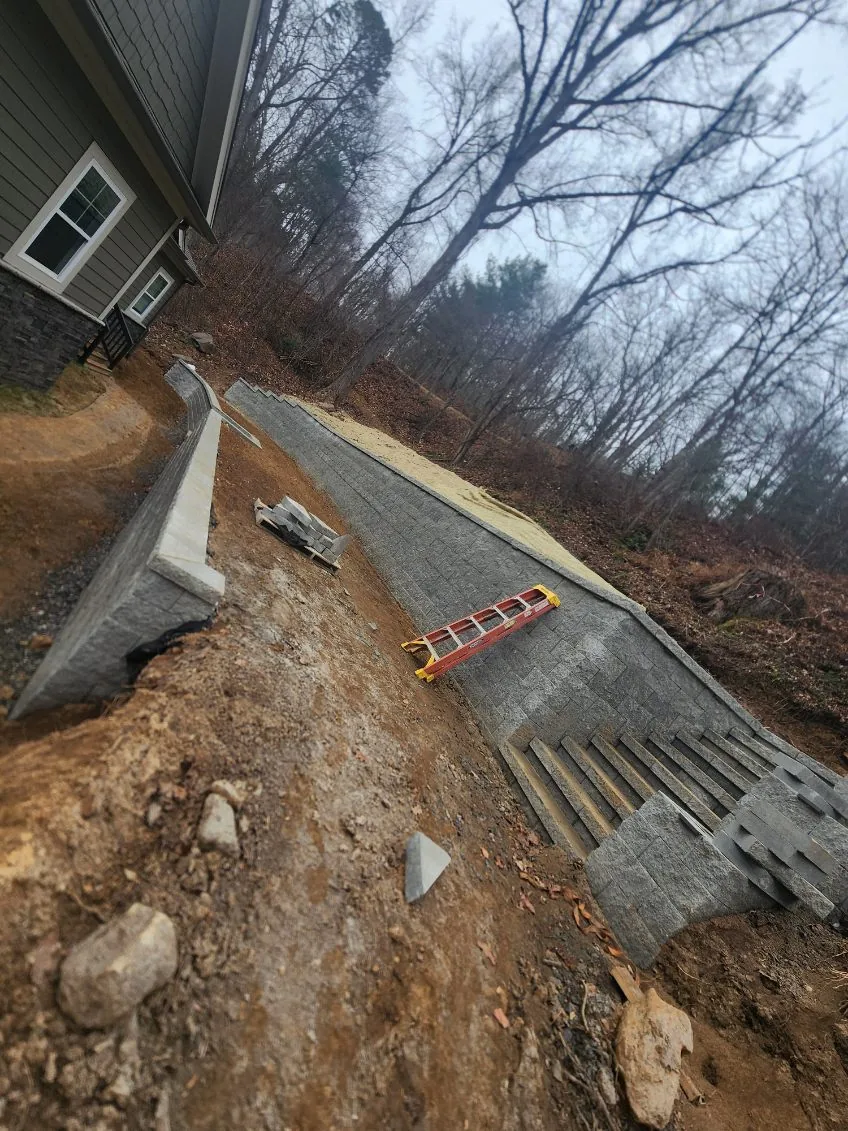
| Engineered wall over 4 ft or terraced multi-wall build | $16,000-$28,000+ |
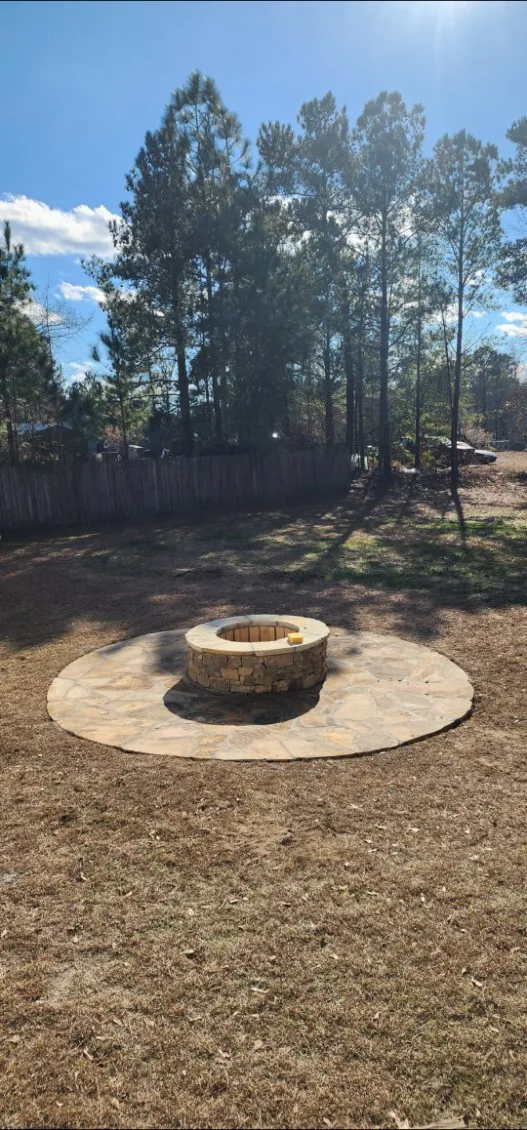
| Fire pit with seat wall and gas line | $4,000-$12,000 |
| Drainage, grading, and base correction (often bundled) | $2,500-$9,000 |
Anything above four feet of retained height usually needs an engineer's stamp, and North Carolina's general contractor licensing thresholds may pull the project under a licensed GC. Ask before you sign.
The spread within each row is real. A 400-square-foot patio on a gentle grade in a flat subdivision near Fletcher is a different job than the same square footage cut into a hillside above Laurel Park, where the crew may need to hand-carry material down a slope, build temporary stairs for access, or use a conveyor. Access alone can add thousands to a project that looks identical on a plan. Similarly, a wall that holds back two feet of soil is a landscaping feature; a wall that holds back six feet of saturated clay is a structure, and the engineering, geogrid, and drainage aggregate behind it change the price bracket entirely.
Homeowners often ask whether the drainage line item can be dropped to save money. The honest answer is that skipping it does not save money — it defers the cost into repairs two or three winters later, usually at a higher number because the failed work has to be removed first. Budgeting the drainage in from the start is almost always cheaper than retrofitting it.
Stone, block, or concrete: what fits these yards
The mountains supply the material palette. Fieldstone, Tennessee and North Carolina flagstone, and full-veneer local stone hold up to our freeze-thaw cycles and read as part of the landscape rather than on top of it. Segmental concrete block wins on engineered walls and gets a stone veneer if you want the look without the labor. Concrete pavers handle the wet clay subgrades better than poured slabs, which crack when the base moves. Timber walls, popular a generation ago around Flat Rock and Laurel Park, are mostly at the end of their service life and often get replaced rather than repaired.
The material choice usually shifts the budget 15 to 30 percent in either direction, so it is worth pricing two options before committing. The full hardscaping service overview breaks down each material's lifespan and maintenance profile.
Freeze-thaw is the great separator. Henderson County swings above and below freezing repeatedly through winter, and any material that holds water will spall or crack. Dense natural stone sheds water and lasts. Poured concrete without air entrainment or a proper base does not. That is why a poured slab that looked fine in Charlotte can crack within a season here, and why the local preference has settled on pavers, flagstone, and engineered block. If you want the poured look, ask the contractor how the mix is specified for freeze-thaw and how the base is compacted.
Matching the house matters too. A lot of Hendersonville housing stock is brick ranch, Craftsman bungalow, or mountain contemporary with siding and stone accents. A wall or patio that echoes the house's existing stone reads as original to the property. A shiny manufactured block that matches nothing on the elevation looks like an addition. Local masons and hardscapers keep samples of the common regional stone so the match can be checked against the house in daylight before ordering.
Storm history and the case for doing the drainage right
Henderson County has seen 16 federally declared disaster events over a 1978-2026 record, most of them flood and storm driven. Those events do not just damage roofs — they rip out undersized drainage, undercut wall footings, and turn a five-year-old patio into a settling field. The lots that survive are the ones where the installer thought about the 25-year storm, not the average Tuesday. If your property sits below a road cut, near a creek corridor, or at the base of a wooded ridge, treat drainage as the load-bearing part of the job.
Practical signs it is time to look hard at the water: mulch washing out after every heavy rain, a damp strip along the foundation after storms, standing water that lingers more than a day in the yard, or a visible crack that widens season to season in an existing patio or wall. Any one of those means the water is already winning somewhere. The fix is usually not a bigger pipe but a longer look at where the water originates and where it should be allowed to go. On many lots in the French Broad and Mud Creek corridors, the right answer is infiltrating some of it on-site rather than pushing it all downstream, which is also the approach encouraged by federal stormwater guidance from the U.S. Environmental Protection Agency.
Fire pits deserve a note here too. A gas fire pit with a buried line involves a permanent utility run, and the connection falls under the NC plumbing and heating licensing board. Using a licensed installer for the gas side — even when the stone work is done by the hardscape crew — keeps the project insurable and code-compliant, and it is the kind of detail that separates a build that lasts from one that gets flagged on resale.
Choosing the crew that builds it right
Three questions worth asking every bidder: how deep do you excavate for wall base on a slope this steep (the answer should reference the wall's height and the soil, not a number pulled from a brochure); who stamps the engineering on walls over four feet; and what happens to the water when you're done. Any crew that cannot sketch the drainage plan on the back of a business card is a crew that has not thought about it. Getting three quotes from experienced Hendersonville retaining wall contractors is the fastest way to see which one actually understands your lot.
Beyond the three questions, look for portfolio work you can actually visit. In a county this size, most reputable crews can point to a project within a short drive — a patio off Willow Road, a terraced wall near Etowah, a fire pit install up in the Laurel Park area. Driving past finished work and seeing how it has held up through a few winters tells you more than any brochure. Ask how long ago it was built and whether the homeowners have had any drainage issues since.
Equipment is another tell. Hillside work in this terrain needs a mini-excavator or a walk-behind for access, plate compactors for the base, and the ability to move material without tearing up the lawn you are trying to improve. A crew that shows up with a shovel and a wheelbarrow for a sloped build is a crew that will either cut corners or blow the schedule. None of this guarantees a good outcome, but together with clear answers on drainage and engineering, it narrows the field quickly.