What retaining wall work looks like in Fairview
Fairview sits on Buncombe County’s eastern slope rim, outside the Asheville city limits but entirely defined by the same mountain geometry. Homes here are built into former pasture and cut-and-fill lots that fall hard toward Catawba River tributaries. A typical call isn’t a wall around a flower bed — it’s a two-story house on a hillside where the downhill yard has started to move.
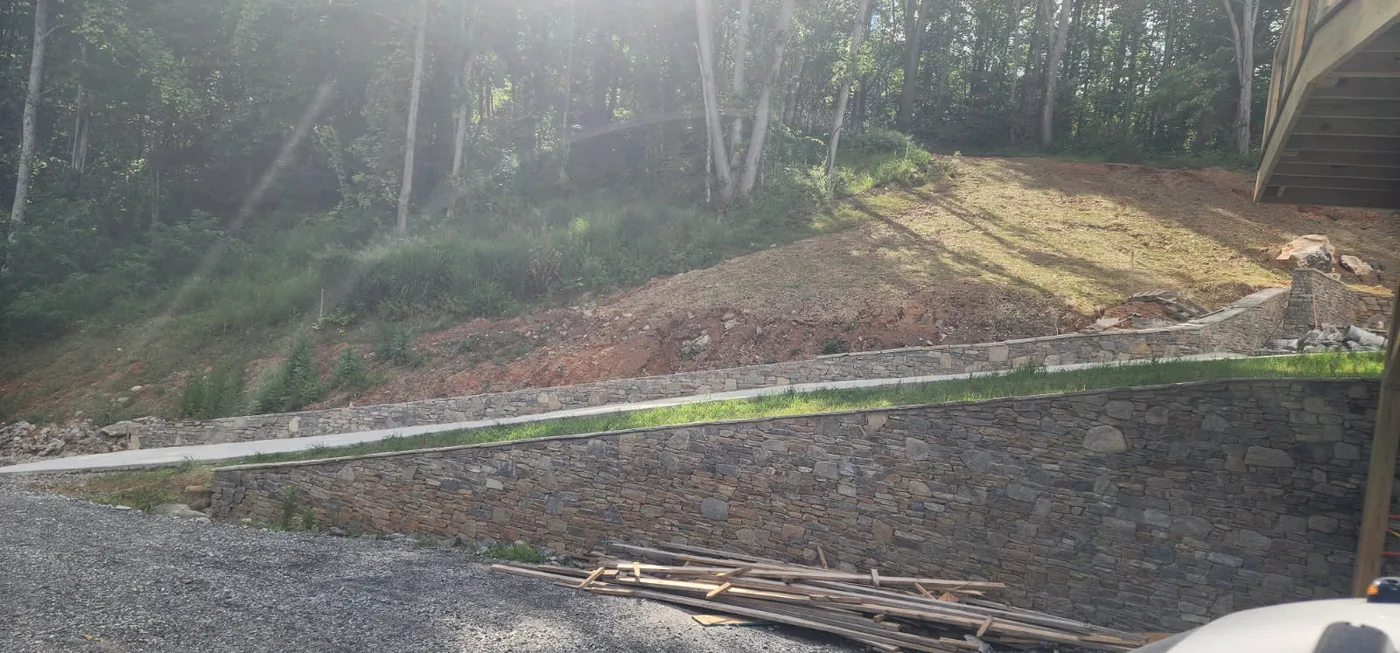
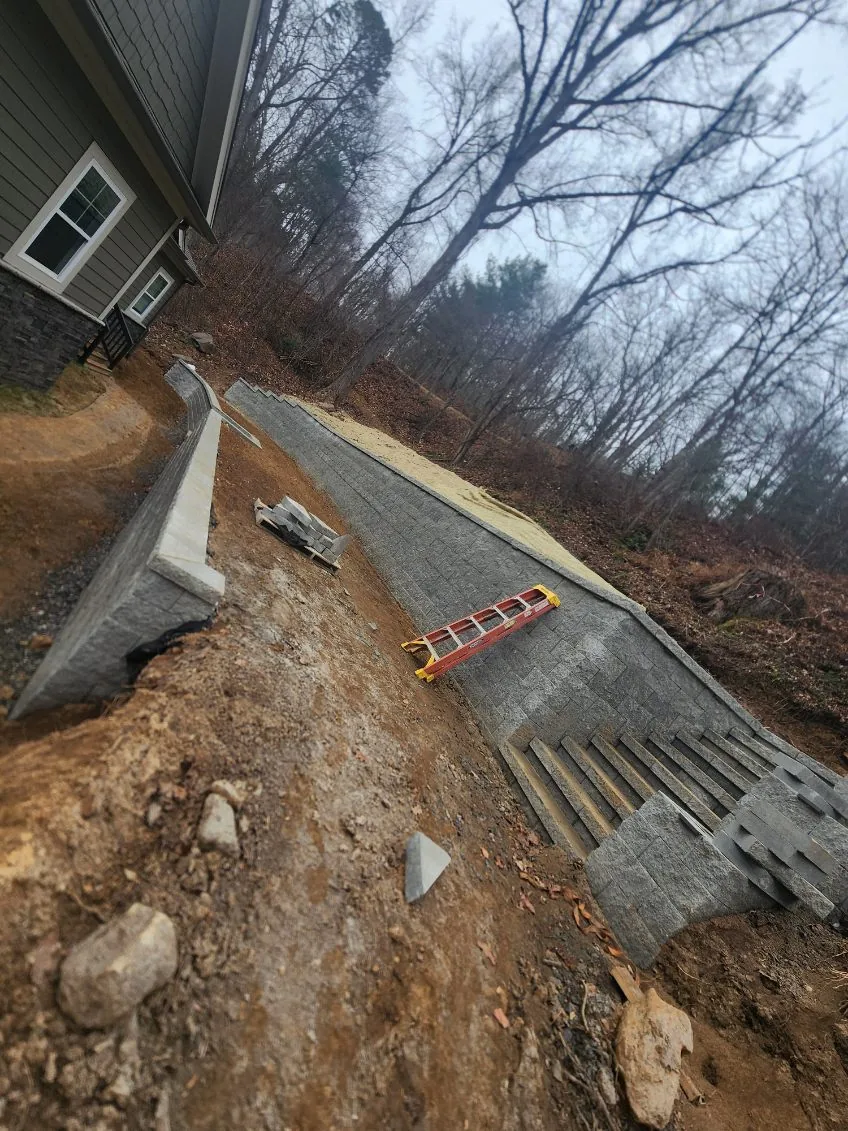
What you’ll see in Fairview: stacked stone walls from the 1970s leaning at the top, segmental block walls bowing after a wet winter, and new driveway cuts on North Fork Road that need tie-back or engineered reinforcement. The honest starting point for every job is the dirt — what water does when it comes off the ridge behind your house. We build to standards adopted by the North Carolina Licensing Board for General Contractors, which covers drainage and surcharge requirements — that matters more than how the face looks.
The terrain here is not uniform. The western side of Fairview, closer to the Swannanoa River gap, tends toward sandy loam over fractured granite — forgiving for gravity walls up to about four feet. Head east toward the Catawba River headwaters and you hit the red clay that shrinks and swells with the seasons, which changes everything about how deep you dig and how much drainage rock you bring in. A contractor who quotes the same wall for both soils isn’t listening to your ground.
The Fairview price picture
Costs cluster around wall height, soil type, and access. A Fairview wall built into clay loam with no water problem quotes very differently than the same wall on a seep line that needs a curtain drain. Below is our working range for common wall scopes; see the full retaining wall options and cost guide for a material-by-material comparison.
| Scope of Work | Typical Price Range (Fairview, NC) |
|---|---|
| Segment block wall, 3–4 ft high, gravity (small residential) | $6,000–$12,000 |
| Stone face over block, 4–6 ft high, reinforced with geogrid | $15,000–$28,000 |
| Engineered wall, 6–8 ft high on slope (tie-back or soil nail) | $30,000–$60,000 |
| Drainage retrofit only (existing wall, no rebuild) | $2,500–$6,500 |
| Repair / push-back on a leaning wall | $4,000–$12,000 |
Access in Fairview often means a 200-foot carry or a narrow county road that limits concrete trucks. Treat any low bid with suspicion if it doesn’t include a line item for delivery or equipment staging. On Green Mountain Road and similar ridges, we regularly hand-carry stone and block down stepped paths a skid steer can’t manage; that labor shows up in the price, and it should. The county’s steepest lots — those exceeding 20 percent grade — also require the contractor to think about how the wall ties into the driveway apron and whether the house foundation drain outlet can daylight on the downhill side of the new wall rather than dumping into the backfill.
Why Fairview walls fail — and what to do first
The federal disaster record for Buncombe County shows 19 declared events over the 1973-2026 record — a rainy-season pattern that tells the real story of wall failures here: they happen after prolonged wet, not after one dramatic storm. The ground upstream of your wall sat saturated for weeks, hydrostatic pressure built, and the wall that was fine for a decade started to lean. The National Weather Service climate data for the Asheville area shows wettest months clustering in late winter and early spring — exactly when the phone starts ringing about bowed block and cracked stone.
The drainage answer always precedes the structural answer. A proper wall build in this terrain starts with a gravel base, perforated pipe at the toe, and washed stone behind the wall — not just aesthetic facing. The backyard-is-a-hill guide explains the slope-reading process in detail, including how to spot seep lines before they become your wall’s failure point. We also look uphill — not just at the wall — because a failing swale or clogged French drain 30 feet above is often the real culprit, and fixing that first can save the cost of a rebuild. EPA stormwater management guidance for hillside construction reinforces what we see daily: surface water must be intercepted and conveyed before it reaches the wall face.
One Fairview pattern worth naming: many older walls here were built by the same person who cleared the lot, using stone from the excavation. Those walls have no drainage stone behind them, no geogrid, and often no footer below frost depth. They’re essentially decorative rock piles leaning against the hill. When they go, they don’t lean slowly — they push out at the base while the top stays put, the signature of a wall never tied back into a reinforced soil mass.
Repair versus rebuild in this market
Most walls past 20 years old in Fairview aren’t worth pushing back. The existing reinforcement — if any — was likely under-designed for what the hillside has taught the ground since. Cracks, leaning, efflorescence, and rusted rebar at the joints all point the same direction. Our honest bias is toward rebuild: a new wall built to International Code Council standards, with engineered geogrid where needed and a drainage system that isn’t an afterthought.
That said, repair makes sense when the wall is structurally sound, drainage was never installed (the easiest fix), or the damage is cosmetic facing. The repair explainer breaks down which failure modes hold up and which are an invitation to spend money twice. On walls in Fairview where the block is still interlocked and the lean is under two inches, installing a proper toe drain and relieving hydrostatic pressure can stop the movement permanently. But if the wall has rotated more than that, or you can see daylight through the joints after a dry spell, the soil behind it has already moved and no amount of drainage will put it back.
We also see a particular repair trap on older stone walls that give Fairview its rural character. Homeowners love the look — so do we — but a leaning, dry-stacked stone wall that was never mortar-set or reinforced can’t be pushed back safely. The stones shift during the operation and the wall ends up worse. The honest move: take it down, save the sound facing stones, and rebuild them over a reinforced block core that meets current code. The wall looks the same from the road, but it behaves like a modern structure instead of a historic liability.
Hiring a wall contractor in the Fairview area
Wall work sits under the general contracting license in North Carolina — not a specialty masonry license — so the check is about experience, not credentials on paper. The NC Licensing Board for General Contractors oversees the license structure that covers this scope of work. Ask candidates for references on walls over 4 feet high with engineered reinforcement, and ask whether they self-perform the stone work or sub it out. Ask how they handle tie-backs on slopes over 20 percent, and ask what their drainage spec is — if they can’t name pipe size and gravel type, they’re guessing.
Because Fairview is outside city limits but inside Buncombe County, permitting runs through the county office, and engineered drawings are required for any wall over specific height thresholds. A contractor who knows how to sequence the engineer’s stamp into the schedule saves you months. The county inspection process is straightforward but not fast — plan reviews take time, and the soil test that informs geogrid design has to happen before the footer is poured, not after. We also recommend asking how they handle the interface between your wall and your neighbor’s property line. In older Fairview neighborhoods where lots were subdivided from farms, drainage from one property often crosses another, and a new wall can unintentionally redirect water onto a neighbor’s driveway.
We serve Fairview, East Asheville, and the entire Catawba River side of the county — get a straight scope before you commit to a guess. Ask for a site visit during or just after a rain event so you can see where water actually flows, not where it looks like it should on a dry day. A contractor who shows up with knee boots and a shovel, rather than a tablet and a drone, is the one who has done this work on these slopes before.