What retaining wall problems look like in Leicester
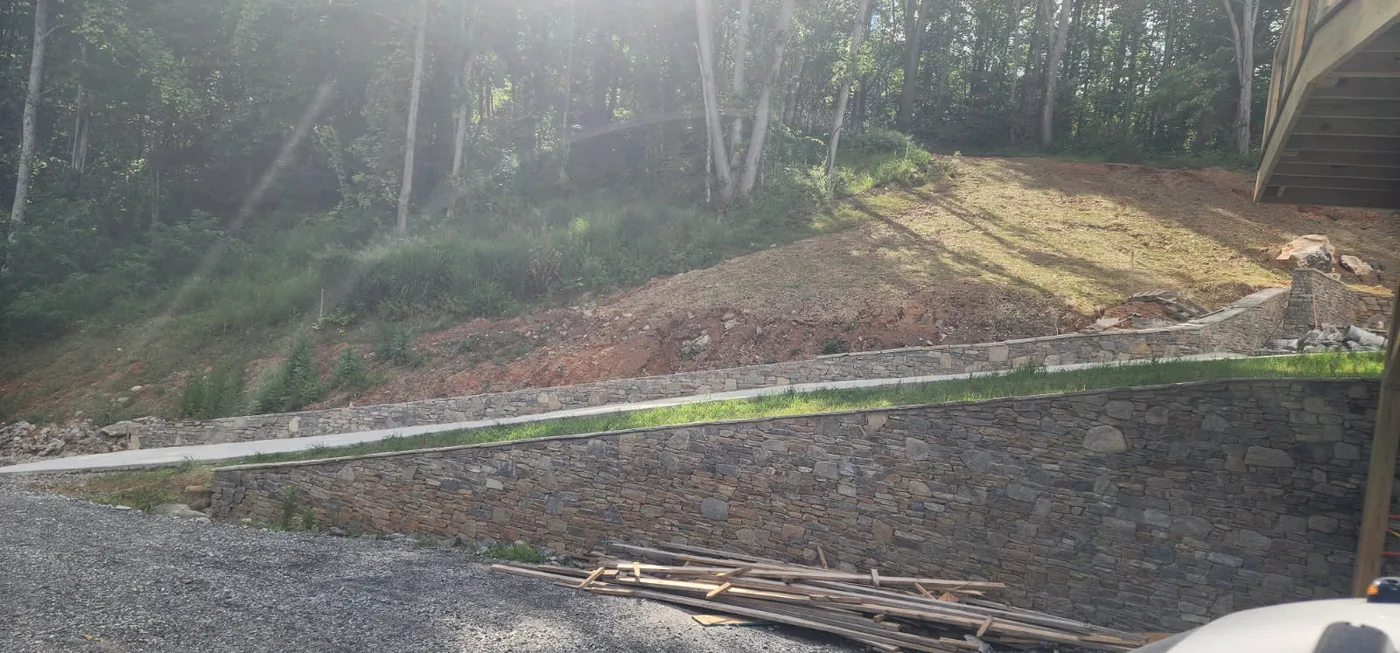
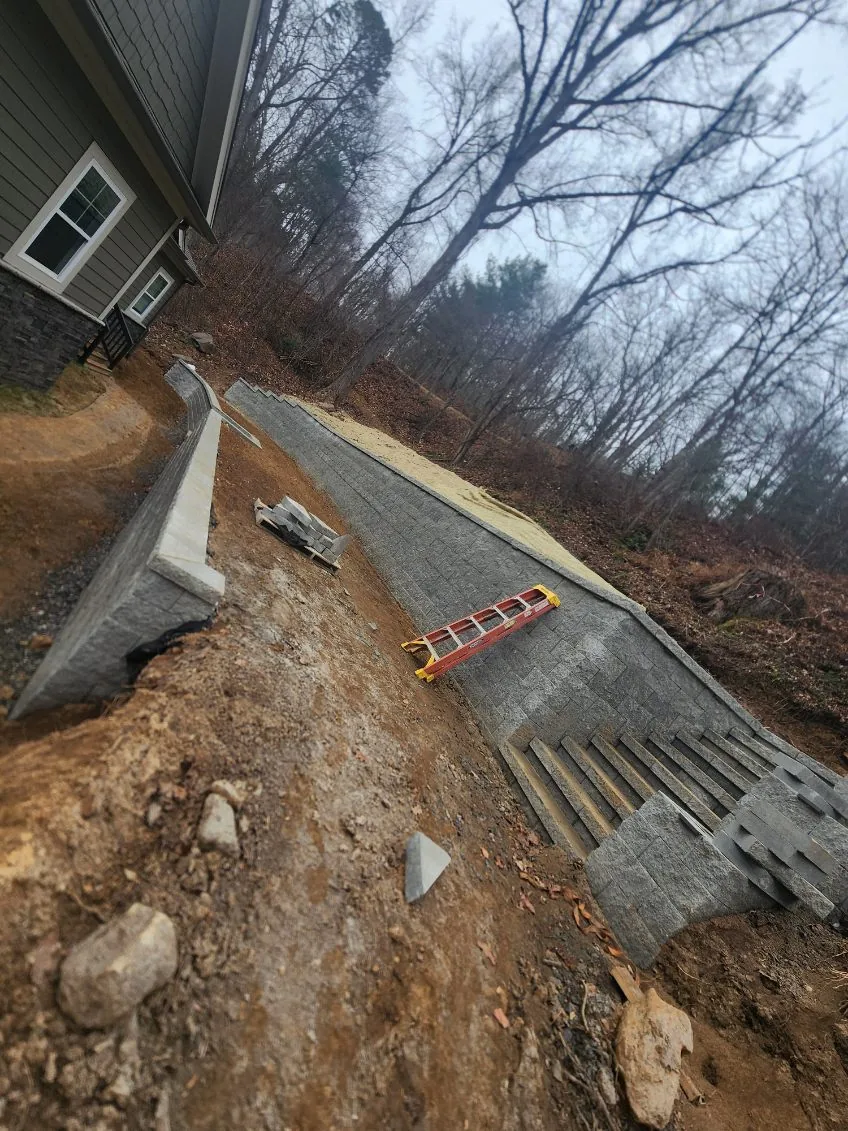
Leicester sits in the Sandy Mush valley with ridges climbing toward Newfound Mountain — some of the steepest residential terrain in Buncombe County. A stacked stone wall on a 1960s farmhouse off Old Leicester Highway is holding back fill that has been creeping for decades; a newer block wall beside a gravel drive cuts into a hillside that channels every thunderstorm toward its heel; a cabin near the creek needs a terrace wall just to make level ground usable. All three fail — for three different reasons. The house on Upper Glady Branch Road has a wall that leans a full three inches after a wet spring, while the one on Jimstown Road is bulging at the third course because the drainage pipe was never connected to daylight.
The tells worth acting on: a wall that leans more than an inch or two, bulges between the blocks or stones, cracks that run through the units themselves rather than the joints, and any wall where water is weeping through the face during a dry spell. Movement that accelerates after heavy rain is drainage; movement that shows up in winter is frost heave; movement that just grows is a wall working loose from its base. A lean that appears after a single storm event — like the July downpour that dropped three inches in an hour on the Sandy Mush watershed — is a drainage emergency, not a cosmetic one. The retaining wall guide covers the full anatomy of each failure type, including photos of what a washed-out footing looks like behind the face.
The Leicester price picture
Leicester lots price like the mountain county they sit in — see the full cost breakdown for the working table. The short version: gravity walls in the low thousands for a short garden terrace, segmental block walls from $45–$65 per square foot, and engineered walls on the steepest ridge lots running $70–$100 per square foot once geogrid, drainage stone, and excavation are counted. The line items that separate a real bid from a guess are excavation and disposal — Leicester's red clay is heavy, wet, and expensive to haul when it cannot stay on site. A wall along Old Haywood Road that is 60 feet long and four feet tall with full drainage will run you $14,000 to $16,000, while the same linear footage on a two-foot-tall garden border in the valley might land at $5,500. Delivery access matters dramatically: a crew hauling stone down a switchback drive off Newfound Road charges for that time, while a wall visible from the road on a flat lot saves on staging.
For the landowner comparing bids, the table below shows what different scopes realistically run for Leicester conditions.
| Scope | Typical Height | Price Range | What's Included |
|---|---|---|---|
| Timber or small gravity stone terrace | 2–3 ft | $4,500–$8,500 | Base gravel, compacted fill, basic drainage |
| Segmental block wall, mid-length | 3–5 ft | $8,500–$25,000 | Engineered base, perforated pipe, stone backfill |
| Engineered wall, steep ridge lot | 5–8 ft | $25,000–$55,000+ | Geogrid, deep excavation, full drainage, permit |
These bands reflect what we have seen across Buncombe County sites, not a fixed quote — the soil on the Newfound slopes versus the valley clay can double excavation cost on identical drawings. The Candler contractors page shows similar numbers for that neighboring community's terrain.
Water is the real enemy here
The federal disaster record explains most Leicester wall calls: 19 declared events touch this county (1973-2026), overwhelmingly storm and flood family. Every one of those events pushed water down these hollows and at walls that were built without proper drainage. In this valley, where Hominy Creek and its tributaries carve through the bottomland and hillside springs seep out of the clay for weeks after heavy rain, a wall with no drain pipe is a dam. The NC building code authority requires drainage behind any wall retaining more than a nominal height for good reason — hydrostatic pressure is what topples a wall, not the weight of the soil itself. Before anyone quotes you a taller wall, the answer to where the uphill water goes has to be solved first. That answer usually involves a perforated pipe routed to daylight or a dry well, not just a gravel backfill. The Candler contractors page covers the same drainage logic for the neighboring community with its own soil character.
Frost, clay, and the code that governs them
Leicester's winters push frost deeper into the ground than Asheville's city lots — the valley floor near the river runs colder than the urban heat island — and the clay here swells when wet and shrinks when dry, a combination that punishes shallow footings. A wall built on a one-foot footing in the loamy soil of the West Asheville side will heave on Leicester's red clay after the first hard freeze. The International Code Council standards that North Carolina adopts set footing depth and drainage rules precisely because of this behavior, and Buncombe County enforces those rules at permit inspection. A wall that sits on undisturbed soil below the frost line with a proper gravel base and a perforated drain line behind it will outlive one that skipped those steps by decades. The National Weather Service records for Buncombe County show the freeze-thaw cycles that make this a real consideration every winter, not just a theoretical one — typically 70 to 90 days below freezing yearly. When a February thaw follows a January deep freeze, the saturated clay expands and a wall without a proper footing rocks forward.
Hiring well in this market
Three Leicester-specific checks: ask whether the crew has built on your soil type — the red clay on the valley floor behaves differently from the decomposed granite on the upper ridges, and a crew that only knows city lots in Asheville will likely underbid the excavation; ask whether the bid includes drainage stone and a perforated pipe behind the wall — if it does not, it is an incomplete bid, not a cheaper one; and ask who pulls the permit. North Carolina's licensing rules via the state licensing board apply once a project crosses the contracting threshold — a real crew knows its number and its limits, and a homeowner hiring a handyman to build a four-foot wall on a hillside is taking on risk that shows up when the wall leans. On a steep lot off Newfound Road, a proper bid will include an excavator operator who knows how to bench into the slope without undermining the uphill side. When you are ready, the form on this page gets you a site visit from someone who will walk the slope with you and tell you which fix actually holds — including when the honest answer is that the wall needs to be shorter and the grade reworked. We also serve the Sandy Mush area and the ridge lines toward Marshall, so no part of the county is too remote for a practical site visit.