Where the water comes from, and where it has to go
Most retaining wall failures in Waynesville aren't wall failures. They're water failures. This is steep ground — ridges and coves dropping toward Richland Creek, Jonathan Creek, and the Pigeon River drainage — and on a graded lot, every square foot uphill of the wall is sending its rain somewhere. If that somewhere is the soil directly behind the wall, hydrostatic pressure builds until the wall tilts, bulges, or drops a section after a hard summer storm.
The fix order matters: find where the uphill water is coming from, intercept it, then route it around or under the wall to a daylight point downhill. A rebuilt wall without that work is a rebuilt wall that fails again. Haywood County has seen 19 federally declared disaster events across 1973-2026, and the overwhelming share of those are storm and flood family — which tells you what these slopes get hit with and why drainage, not stone, is the deciding line item.
On the typical Waynesville lot, that uphill water has three sources, and they behave differently. First is roof water: downspouts that dump at the top of the bank instead of daylighting below it, so every storm routes the whole roof through the wall's backfill. Second is surface sheet flow off a steep drive or a graded lawn, which arrives fast and concentrated on the exact line where the wall is weakest. Third is groundwater moving laterally through the hillside itself after days of rain — the kind that shows up as a wet line on the wall face long after the storm has passed, and the kind that no surface regrade will fix on its own.
The National Weather Service tracks the rainfall totals behind most of the calls we get; a single multi-inch event on saturated ground is often what tips a marginal wall over into a visible failure. But it's rarely one storm that kills a wall. It's a slope that was already holding more water than the wall was ever sized to resist, and then a wet week that pushed it past the line.
Where the water has to go is just as specific. On these graded lots, the daylight point — the spot downhill where the drain outlet actually exits to grade — is often across a neighbor's slope, down a shared bank, or into a roadside ditch with its own rules. That outlet has to be identified before the wall goes back in, because a footing drain that dead-ends in more soil just moves the pressure from one side of the wall to the other.
Reading a failing wall on a Waynesville lot
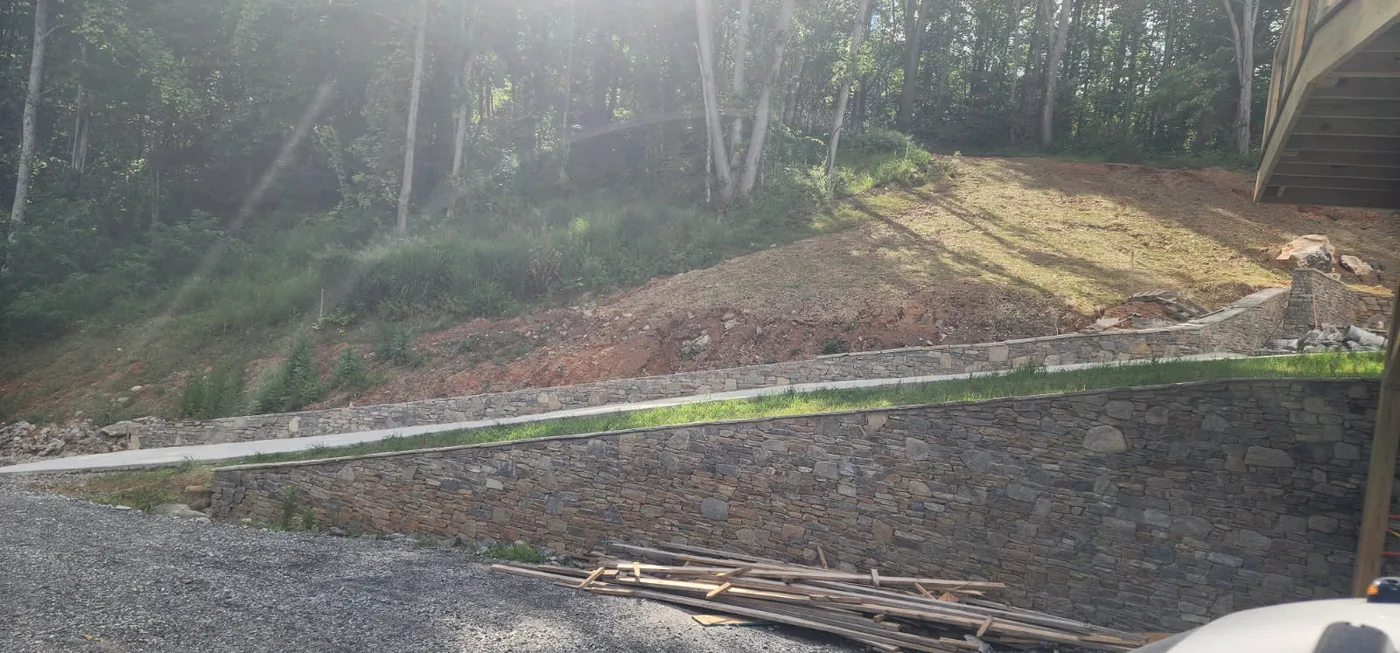
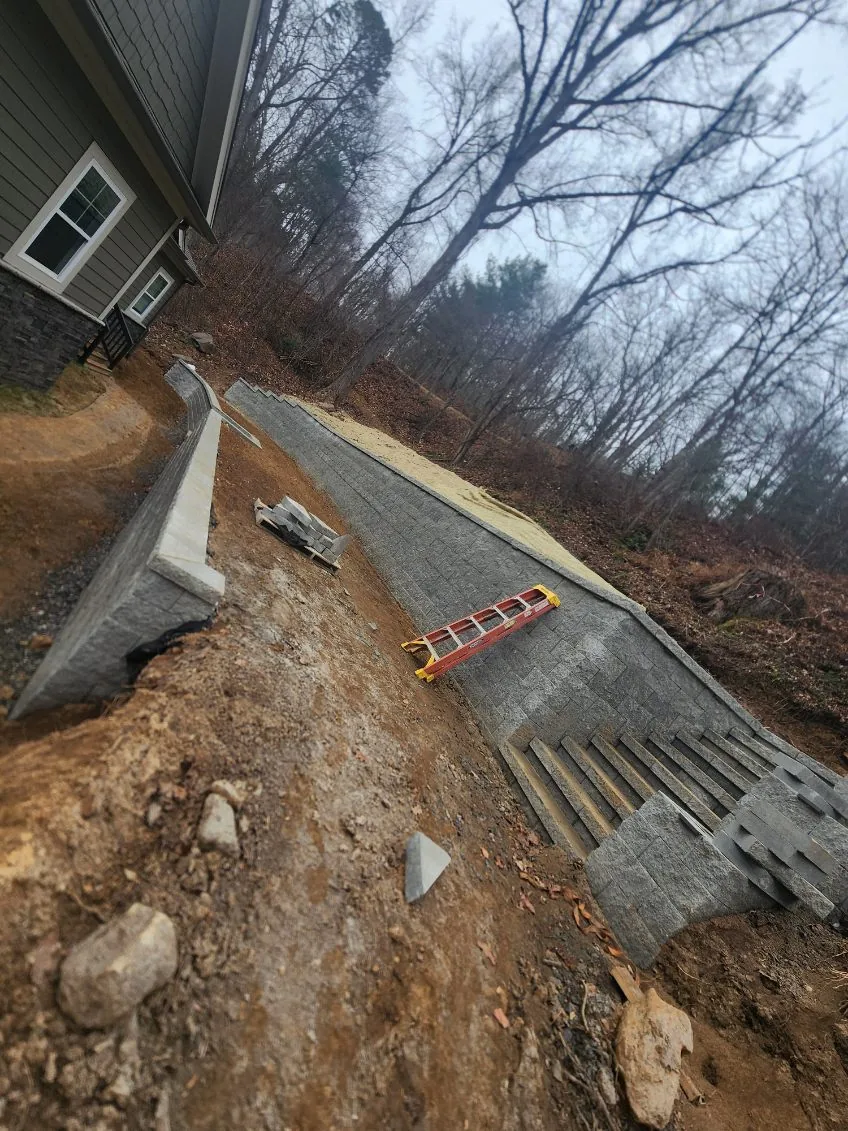
Segmental block walls lean. Timber walls rot and push. Dry-stacked stone settles into itself and holds longer than people expect, then lets go all at once. On a steep Waynesville lot you'll usually see one of four things: a visible batter (the top leaning away from the hill), horizontal cracking along a course, soil staining or a wet line on the face after rain, or a bulge with a vertical crack behind it.
Any wall over about four feet that carries a surcharge above it — a driveway, a parking pad, a structure — is doing structural work, not landscaping work. That distinction changes the scope, the engineering, and often the permitting. Movement that only appears after storms points to drainage; movement that keeps growing points to a wall that has lost its base or its tieback.
The materials here tell you what to expect before you dig. Older Waynesville properties often have dry-stacked fieldstone, which is a genuinely different animal from modern segmental block: it depends on its own weight and careful batter for stability, and when the base settles it usually goes in one or two courses rather than a slow lean. Timber walls — a common 1980s and 1990s hillside solution — rot at the soil line first, which is the part you can't see, so a timber wall that looks fine at the top can be little more than a shell sitting on a failed footing.
Block walls tell their own story through joints. A wall that's cracking horizontally along one course is usually fighting water at that level. A wall with a vertical crack and a bulge behind it has moved off its base. And a wall with staining that fades partway up the face is showing you exactly how high the water stands behind it during a hard rain — which is the number that should drive the drainage design.
Worth checking too: what's growing above the wall. Root systems from trees and hedges planted too close can pry at the cap or the upper courses, and irrigation that runs against the bank keeps the backfill wet all season. Those are manageable separately from the structural repair, but they belong in the same plan or the wall goes back into the same wet soil.
The Haywood County price picture
These are regional bands, not quotes — every wall is priced off its own height, length, access, and drainage plan. The Haywood County cost breakdown carries the working table. Steep-access jobs off Russ Avenue or up toward Maggie Valley routinely add machine-access and haul-off line items that flatter lots never show.
| Scope | Typical range |
|---|---|
| Minor repair — reset cap, repoint, patch a face section | $400–$1,800 |
| Drainage retrofit — footing drain, weep points, regrade behind wall | $1,500–$5,000 |
| Section rebuild — partial tear-out and re-lay, under 4 ft | $2,500–$8,000 |
| Full rebuild with drainage and engineered base, 4–6 ft | $8,000–$20,000 |
| Engineered wall over 6 ft or with surcharge (driveway/structure above) | $20,000+ |
If a bid doesn't separate the wall from the water, treat it as incomplete rather than cheap.
Access is the line item people don't expect. A wall that a mini-excavator can reach from a driveway prices very differently from one at the bottom of a bank where every block and every bucket of gravel gets moved by hand. On tight in-town lots, haul-off of old stone, block, and spoils can add real money because there's nowhere on site to lose the material. On larger lots off the main corridors, it can often be spread and reused.
Permitting and engineering scale with height and surcharge, not with cost per foot. A low landscape wall in a front yard is typically a straight repair. A wall holding a parking pad or a driveway above it, or anything over roughly four feet, is where plan review, an engineer's detail, and inspection enter the scope — and where a bid should show those as their own lines.
What changes the scope in this county
Three things show up on almost every Waynesville retaining wall job and change the number: access (can equipment reach the wall, or is it hand-work over a bank), the actual condition of the base (a wall that lost its footing is a rebuild, not a repair), and whether a structure or driveway sits above it. That last one pushes a job into structural territory where the NC Licensing Board for General Contractors thresholds apply and an engineer's detail is the right call.
Code treatment of retaining walls, drainage, and safety follows the state-adopted codes administered through the NC Office of State Fire Marshal. For anything over four feet or carrying a surcharge, expect a permit and a plan rather than a handshake.
The terrain itself is part of what pushes a job up or down in scope. A lot cut into a steep slope means more wall height, deeper drainage runs, and a longer haul to the daylight outlet. A lot with a naturally gradual grade can sometimes be fixed by regrading and a smaller, lower wall. Two walls the same linear feet can be completely different jobs in this county depending on how much hill they're holding back.
Then there's the question of what's happening uphill that you may not control. Roof drainage, a neighbor's regrade, or a shared driveway above the wall can dump water onto your slope no matter how well your own wall is built. Part of an honest scope is identifying whether the water source is yours, the shared grade's, or coming from above — because a repair that only handles your side of the water will fail again on the next big storm.
If you're still choosing who does the work, the Waynesville contractor guide covers the questions that actually separate crews. And for the broader repair picture — materials, methods, and when to rebuild versus repair — see retaining wall repair.
Hiring and sequencing on a hillside job
Ask three questions and the right crew separates quickly: How will you get water away from the wall once it's rebuilt? What's your base detail — how deep, what material, compacted how? And on a wall over four feet, who stamps the drawings? A crew that answers the water question first is fixing walls. A crew that answers with stone and labor first is selling walls.
Sequencing matters too. On a sloped Haywood County lot, the wall, the uphill grade, and the downhill outlet all get planned together — because fixing one without the others is how a wall comes back. The drainage goes in before the wall is finished, the uphill grade gets shaped to shed water away from the wall, and the outlet gets confirmed to actually reach grade. Skip any of those three and the repair is cosmetic.
A good scope also tells you what it isn't doing. If a crew can't say where the water was going before, where it goes after, and how the base was prepared, that's a sign they're selling stone rather than solving a slope. And on older Waynesville properties with dry-stacked or timber walls, be clear about whether the goal is restoring the original look or replacing it with block — the two produce very different finished walls and very different budgets.
Finally, plan around the season. These slopes stay wet through winter and spring, which is exactly when you don't want excavation open. Late summer into fall is often the practical window for a rebuild, and it's also when the ground is drier and the base can be prepped properly. A wall that moves during a wet stretch should still be looked at promptly — a temporary fix to stop movement is cheaper than letting a failed section take the rest of the wall with it.