Where the money actually goes on a Waynesville slope
A walkway quote for a flat lot in the valley and a walkway quote for a ridge lot off Sulphur Springs Road can differ by three times and still both be honest. The stone is rarely the swing item. What moves a Waynesville stone steps and walkways number is the ground underneath: how steep the grade is, how much soil has to be cut and hauled, whether a machine can reach the work zone, and whether water arriving from uphill has to be intercepted before the first tread is set.
On a typical Haywood County hillside lot, expect roughly a third of the price to be excavation and base preparation, a third to be the stone itself plus setting, and the remainder split between drainage, hauling, and finish details like lighting conduits or handrail anchors. A bid that quotes only stone and labor is almost always a bid that will grow once the trench opens.
Consider what that looks like on the ground. A lot on a graded bench above the valley floor might have a walkway run of forty feet with a foot of fall, and the cut is shallow enough that a mini-excavator can work the whole line. A lot off a switchback road like those climbing toward the Blue Ridge Parkway might have the same forty feet of run with six feet of vertical drop and a work zone three feet wide between a foundation and a property line. The second job has the same stone, the same labor rate, and a price that is two to three times higher because every bucket of spoil comes out by hand and every tread has to be cut and fit rather than laid.
Haywood County also has a housing stock that splits the work into two different flavors. In and around downtown Waynesville, near the historic core and the older streets off Main, walkways often tie into existing stone foundations, old brick piers, and mature landscaping, which means careful demolition and matching new work to masonry that has been there for generations. On the newer ridge and slope subdivisions spreading out toward Maggie Valley and the Crabtree area, the work is more often raw-grade construction where the entire stair run is new, the drainage has to be designed from scratch, and the access question is whether any machine can get there at all. Both are honest jobs. They just price differently.
What the line items look like priced out
The table below reflects realistic regional bands for Waynesville and the surrounding Haywood County terrain. Treat them as ranges, not quotes — your grade, access, and soil decide where in the band you land.
| Scope item | Typical price range | What drives it |
|---|---|---|
| Simple grade-level flagstone walkway | $3,200–$6,000 | Linear feet, base depth, stone thickness |
| Cut-stone steps, 3–5 risers, no landing | $2,400–$5,500 | Rise per step, tread width, stone type |
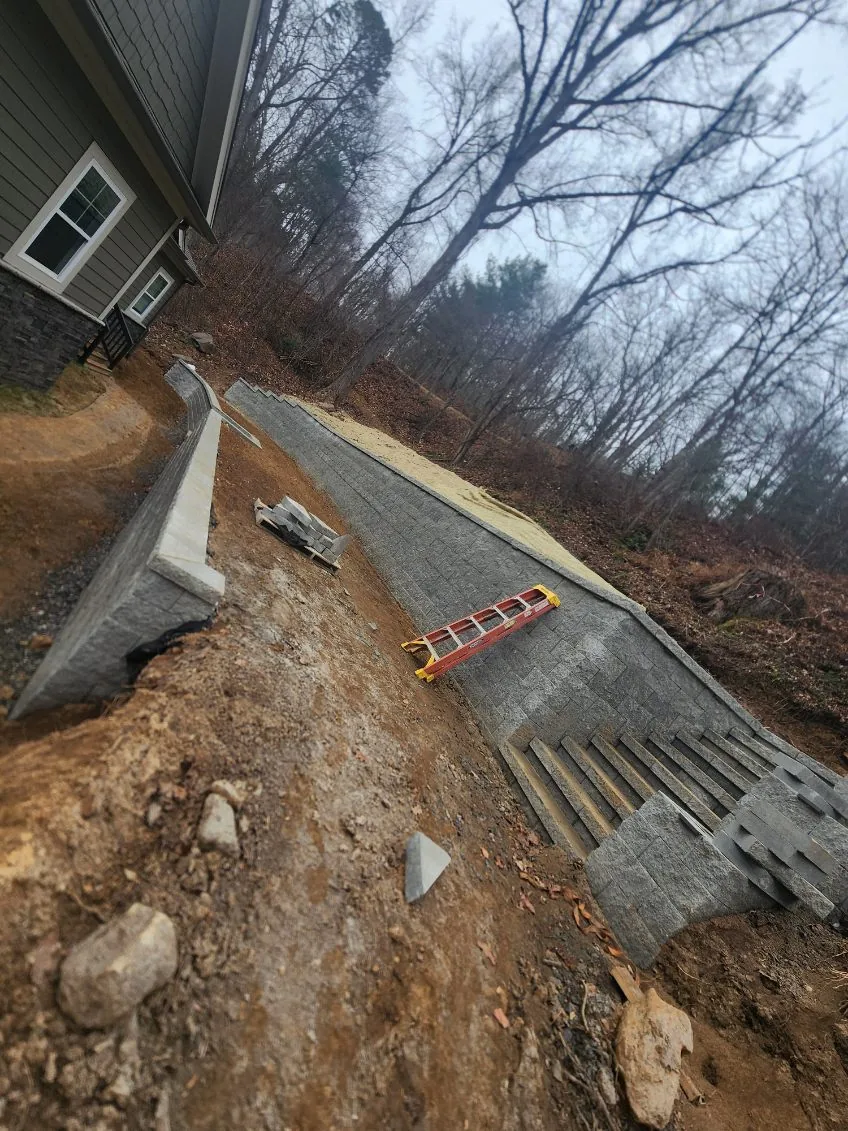
| Hillside stair run, 8–15 risers with landings | $6,500–$14,000 | Vertical gain, switchback count, hand excavation |
| Drainage correction (French drain, swale, downspout tie-in) | $1,200–$4,800 | Run length, outfall location, rock encountered |
| Retaining at stair base or landing | $2,800–$9,000 | Wall height, engineering threshold, backfill |
| Machine access surcharge (narrow or steep) | $600–$2,500 | Whether a mini-ex can reach, or it's all by hand |
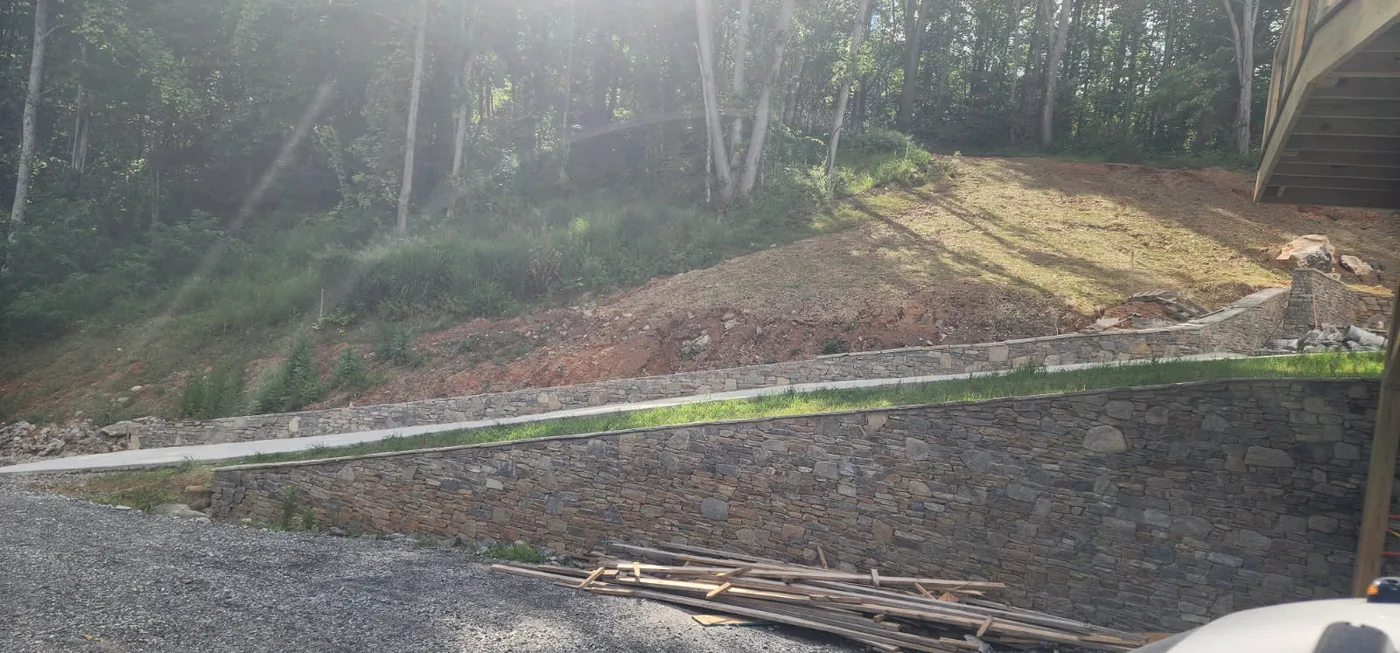
Where a stair run also needs a retaining wall — common on Waynesville's cut lots — the wall gets priced separately. See the Haywood County retaining wall cost breakdown for those line items, and the Waynesville retaining wall contractor guide for how to vet the crew doing both.
The line items that surprise homeowners most are the ones that are not stone at all. Haul-off is a real cost on a slope job: spoil has to leave the site, and on a tight ridge lot that may mean a conveyor, a crane, or a lot of wheelbarrow trips to a truck parked at the bottom of the drive. Drainage is the other one. A French drain running the length of a stair run, tied into a proper outfall, is a substantial scope item on its own, and skipping it to save money is the single most common reason a Waynesville walkway has to be rebuilt within a decade.
Grade, water, and the code questions that follow
Waynesville gets mountain rain, and the federal record bears that out: 19 declared events touch Haywood County across 1973-2026, overwhelmingly storm and flood family. Every one of those pushed water at steps and walkways that were built assuming less. That is why the first design question on any slope lot here is not what stone, but where the water goes when it leaves the tread. A stair run without a drainage plan is a stair run that will need rebuilding.
On the code side, walkway and step work is usually exempt from permitting, but once a project crosses into structural retaining, the state thresholds apply — the NC Licensing Board for General Contractors sets when a job requires a licensed general contractor, and the NC Department of Insurance Engineering and Codes division publishes the residential provisions that govern footing depth, frost protection, and stair geometry. If your project includes a wall over the state's height trigger, expect an engineer's letter to be part of the scope. For anything touching a drainage outfall or a regulated stream buffer, the EPA stormwater guidance is the reference the county will point to.
There is a reason these thresholds matter more here than in the flatland. Haywood County's freeze-thaw cycle is real and it runs deep enough that footing depth is not a formality. A stone step set on a shallow base will lift and rotate after a few winters, and a retaining wall built without proper drainage behind it will lean and eventually fail. The code provisions exist because the mountains punish shortcuts that would be forgivable in a milder climate. If your project touches a stream buffer, a drainage outfall, or a wall above the state's height trigger, the permitting and engineering conversation is not optional, and a contractor who waves it off is a contractor to walk away from.
Material choices that hold up on a mountain lot
Three stone families dominate this market, and each carries a different cost and maintenance profile. Regional fieldstone and Tennessee flagstone sit in the mid-band, weather well, and match the older masonry in Waynesville's historic core. Bluestone and thermal-finished sandstone sit higher, offer more consistent tread dimensions, and are the usual pick where a crisp modern edge is wanted. Cast concrete treads over a stone veneer land at the low end and are honest for utility stairs, less so for a front entry.
What matters more than the stone name is the base. A compacted, well-drained aggregate base with the right depth for our freeze-thaw cycle is what keeps a walkway flat after five winters. Skimp there and the most expensive stone on the lot will still rock, settle, and heave. That is also where the stone steps and walkways service overview starts every estimate.
There is also a sourcing question that separates local crews. Regional fieldstone and Tennessee flagstone are quarried within a reasonable haul, which keeps freight and lead times predictable and means a crew can usually match an existing wall or walkway on a repair job. Imported bluestone and sandstone travel farther, cost more per square foot, and are less likely to match anything already on the property. For a new build where everything is being installed at once, that mismatch does not matter. For a homeowner adding a new stair run to an existing historic walkway, it matters a great deal, and the honest answer may be that the older stone cannot be matched exactly.
Finish matters too. Thermal-finished treads are consistent and safe underfoot even when wet, which is why they show up on front entries and the steeper runs. Natural cleft flagstone is more forgiving visually and blends with older masonry, but it can be slicker in the rain and less uniform underfoot. On a Waynesville slope where a wet stair run is a genuine hazard, that safety difference is worth pricing into the decision rather than discovering after the first storm.
How to read the three bids you'll get
Most Waynesville homeowners collect three estimates and find them spread across a two-to-one range. That spread is rarely about markup. It is about what each bidder assumed. One bidder assumed machine access; another assumed hand-carving. One included drainage; two did not. One priced a base at four inches; another at twelve.
Ask every bidder to itemize excavation, base depth, drainage, and haul-off as separate lines. Ask whether the price includes any retaining that the grade requires. Ask what happens if rock is encountered during the cut — a real possibility on Haywood County lots, and a line item that should be defined before work starts, not after. The bid that answers those questions in writing is the one worth comparing the others against.
Two more questions are worth asking before you sign anything. First, who is doing the work — the person who walked your lot, or a crew you have never met? On a slope job with hand excavation and careful stone fitting, the skill of the people actually on the site is the whole ballgame. Second, what is the drainage outfall plan? If a bid does not have a specific answer for where the water leaves the stair run and where it goes after that, the drainage was not actually designed, and the price is incomplete. A bid that is twenty percent higher but answers both questions in writing is usually the cheaper bid over the life of the walkway.
It also helps to ask for photos of completed slope work, not just flat-lot walkways. A crew that has built stair runs on Haywood County slopes will have the pictures, and the details in those pictures — how the landings are set, how the drainage is concealed, how the stone ties into the grade — will tell you more than any price on a page.