What retaining walls in Candler are actually holding back
Candler sits on the western flank of Buncombe County, where Hominy Creek carves through slopes that rise fast toward the Pisgah National Forest boundary. A split-level on a ridgeline off Monte Vista Road needs a wall to hold back fill; a house near the creek on Smokey Park Highway needs one to keep the bank from slumping toward the water. Both get called a retaining wall. Both fail for entirely different reasons if built by someone who treats them the same.
The soil here is the star of the problem. Decomposed granite and red clay that swells when wet and shrinks when dry. A wall built without proper drainage behind it — gravel, a perforated pipe, and a way for water to get out — will be pushed over by hydrostatic pressure within a few seasons. The North Carolina Office of State Fire Marshal, which administers the state building code, treats drainage behind retaining walls as a structural requirement, not an option, precisely because wet soil weighs far more than dry soil.
Walk any Candler neighborhood after a hard spring rain and you will see the evidence: driveways with a slight ripple where the fill underneath gave way, and older walls with a telltale belly pushing into a side yard. The houses that fare best are the ones where the original builder understood that a wall here is not a decorative garden edge — it is a dam. In the Enka Village area, where lots step down toward the creek floodplain, the difference between a well-built wall and a decorative facade shows up in the first real storm.
The Candler price picture
Prices in Candler track the broader Buncombe County market — see the full county cost breakdown for the line-item table. The short version below gives you the range for the wall types you are most likely pricing, and it is honest about what drives the numbers up: height, access, and what is behind the wall.
| Scope | Typical price range (Candler/Buncombe) | What moves the number |
|---|---|---|
| Timber or railroad-tie wall, 2-3 ft | $25-$45 per sq ft | Cheap upfront, but rot-prone; a stopgap, not a fix. |
| Interlocking concrete block (segmentals), 3-4 ft | $45-$70 per sq ft | Gravel backfill, drainage pipe, and compaction are non-negotiables. |
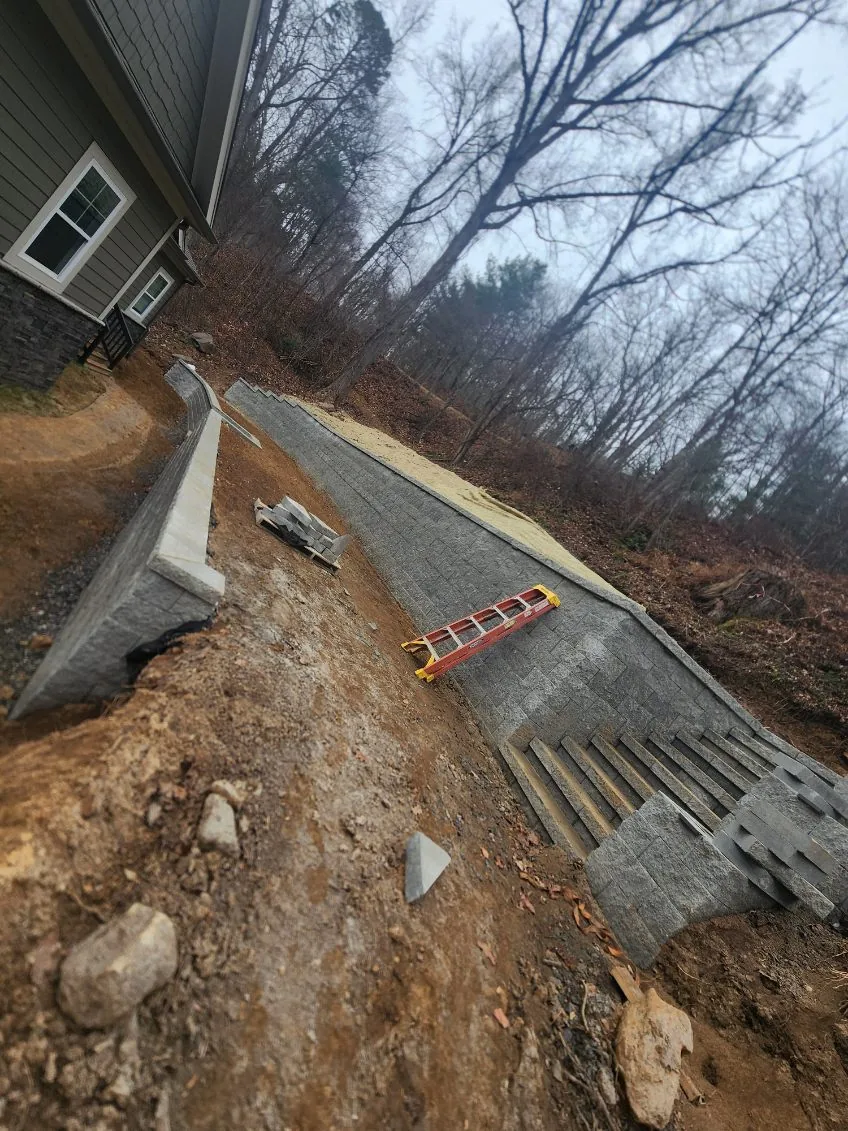
| Engineered segmental wall, 4-6 ft | $65-$85 per sq ft | Geogrid soil reinforcement layers add material and labor, not markup. |
| Structural concrete or natural stone, 3-5 ft | $70-$110 per sq ft | Formwork, rebar, and skilled labor for stone that matches the area's character. |
| Wall repair (bulge, lean, or failing drainage) | $120-$240 per linear ft | Usually involves tearing down and rebuilding the failed section — there is no cheap way to uncrumple a wall. |
Steep-lot jobs above the valley floor routinely require an engineer's stamped plan. That is a separate line item, typically $800-$2,000, and any bid that ignores it is incomplete, not cheaper — see our retaining walls overview for how scopes are supposed to be built. A two-foot wall along a flat driveway in the level part of Candler near the fire station is a different animal from a five-foot wall holding back a ridge line off Hominy Creek Road, and the price should reflect that reality.
Access matters more here than in flatter parts of the county. Many Candler lots were carved out of former orchard land or old farm parcels, and the only way to get equipment to the back of the property is a narrow gravel drive with a switchback. If your site requires hand-digging because a mini-excavator cannot reach the wall line, add 15-25 percent to the labor line for that inconvenience. Contractors who quote blind over the phone without walking the slope are either padding the number or planning to cut corners on compaction to make the math work.
Rain, frost, and the weather that tests every wall
The National Weather Service records for this part of Western North Carolina show why Candler walls fail less from earthquakes and more from rain events: 19 federal disaster declarations have touched Buncombe County (1973-2026), dominated by storms and flooding. Every significant rainfall event is a test of your wall's drainage — not its face, its back. And because Candler sits higher and cooler than downtown Asheville, winter freeze-thaw cycles are harsher here, which means the sub-base under your wall has to be compacted to spec, or frost heave will shift it in year three. The National Weather Service forecast office in Greenville-Spartanburg covers this region and regularly issues flood watches for the Hominy Creek watershed when slow-moving summer storms park over the mountains.
The International Code Council model codes, which North Carolina adopts and amends, require that any retaining wall over a certain height be designed by an engineer. Most residential walls around Candler that retain more than four feet of unbalanced fill fall into that category. If your contractor tells you they have never needed an engineer's stamp for a four-foot wall on this soil, they are either working illegally or under-building the project. The frost line here sits around 12-18 inches, but the bigger issue is the repeated freeze-thaw cycles that work moisture into hairline cracks and expand them season after season. A wall built with proper drainage and a compacted gravel base handles that cycle; one built with whatever dirt was on site will not.
It is also worth remembering that Candler's steep terrain means water moves fast. A wall at the bottom of a long driveway is collecting runoff from the entire slope above it, not just the soil directly behind it. The swale or gutter that feeds the wall's drainage system is part of the same project. If you are rebuilding a failed wall, trace where the water comes from before you pour a single footing — otherwise you are setting up the next wall for the same failure.
How to hire a wall builder, not a block stacker
Three checks that matter specifically in Buncombe County. First: ask if the crew has worked with clay-slope drainage and how they handle the water that comes off the ridge above your house — a wall in Candler is only as good as the swale that feeds it. Second: ask for the engineer's letter or stamped plans on any wall over four feet. North Carolina's licensing board governs who can pull permits for structural work, and that applies to retaining walls just like it does to decks and foundations. Third: ask how they sequence the backfill — proper compaction in lifts, not a single dump of wet clay, is the difference between a wall that settles and one that holds. A crew that cannot explain the difference between a 6-inch lift and a 2-foot lift is not a crew you want building a structure that holds back tons of earth above your house.
And if you already own a wall that is leaning, cracked, or has gaps opening at the joints, do not wait for it to fail dramatically — read our repair guide for what signs matter and what a proper repair scope looks like. A bulge that tilts more than an inch or two is a wall that is actively moving, and the fix is always cheaper before it lets go entirely. In Candler, where many homes sit below their own driveway or a neighbor's lot, a sudden wall failure can take out a car, a foundation, or worse. The U.S. Department of Housing and Urban Development has guidance on hillside construction that applies here regardless of whether you have a federally backed loan — the principles of drainage and soil retention are the same for every structure on a slope.
One more local note: get the bid in writing with a line item for drainage. If a contractor's proposal does not explicitly mention gravel backfill, a perforated drain pipe, and a daylight outlet or sump, ask why. In this county, that is not an upgrade — it is the difference between a wall that lasts decades and one that fails in a few years. The county cost breakdown shows the price difference between a full drainage scope and a stripped-down wall, and it is well worth the premium on a slope like most Candler lots.
Material choices that fit Candler's character
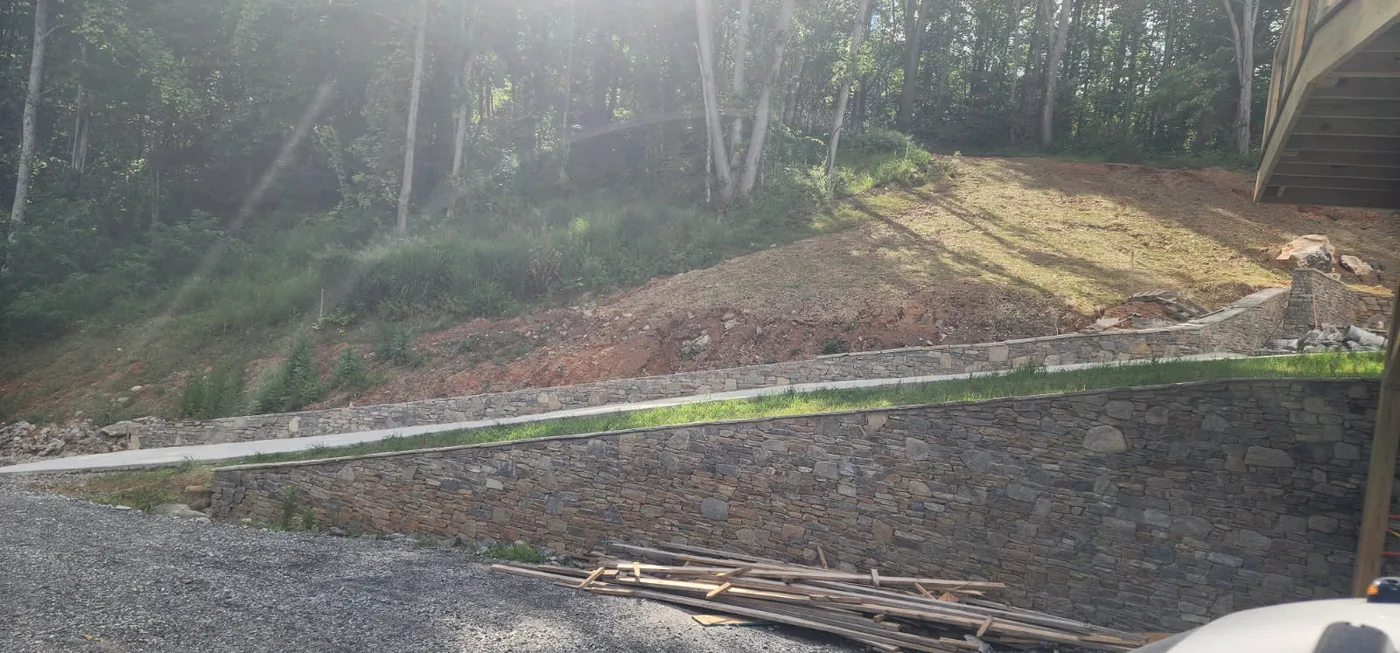
Candler is not downtown Asheville, and it is not a new subdivision in South Buncombe. The housing stock here is a mix of mid-century ranch homes, newer mountain craftsman builds, and the occasional farmhouse that predates the county's zoning. A retaining wall should look like it belongs on the property, not like it was dropped in from a catalog. Interlocking concrete blocks in earth tones blend with the landscape and are the most forgiving material for a first-time wall owner. Natural stone — the kind that matches the creek rock visible along Hominy Creek — costs more but gives a permanence that many Candler homeowners want when they are building for the long haul.
Timber walls have a place for very short, non-structural garden edges, but treating them as a retaining solution for a real slope is a mistake that Candler homeowners make once. The wet climate here rots even pressure-treated lumber within a decade, and when a timber wall fails, it tends to fail suddenly, releasing whatever is behind it. If you are looking at a property with a timber wall that is more than three feet high, budget for a replacement in the next few years. The retaining walls overview walks through the material trade-offs in more depth, including which blocks work with geogrid reinforcement and which are purely cosmetic.
For creek-front properties along Hominy Creek or the smaller tributaries that feed it, consider that the wall may need to handle not just soil pressure but occasional floodwater pushing from the other side. A properly engineered wall with weep holes and a robust drainage system can handle that; a wall built without thought to the water side cannot. The EPA's wetland and stream protection guidance is relevant if your project touches the creek buffer — Candler's stream buffers are regulated through Buncombe County, and you will need to know where your wall line sits relative to the water before you break ground.