What retaining wall work looks like in Weaverville
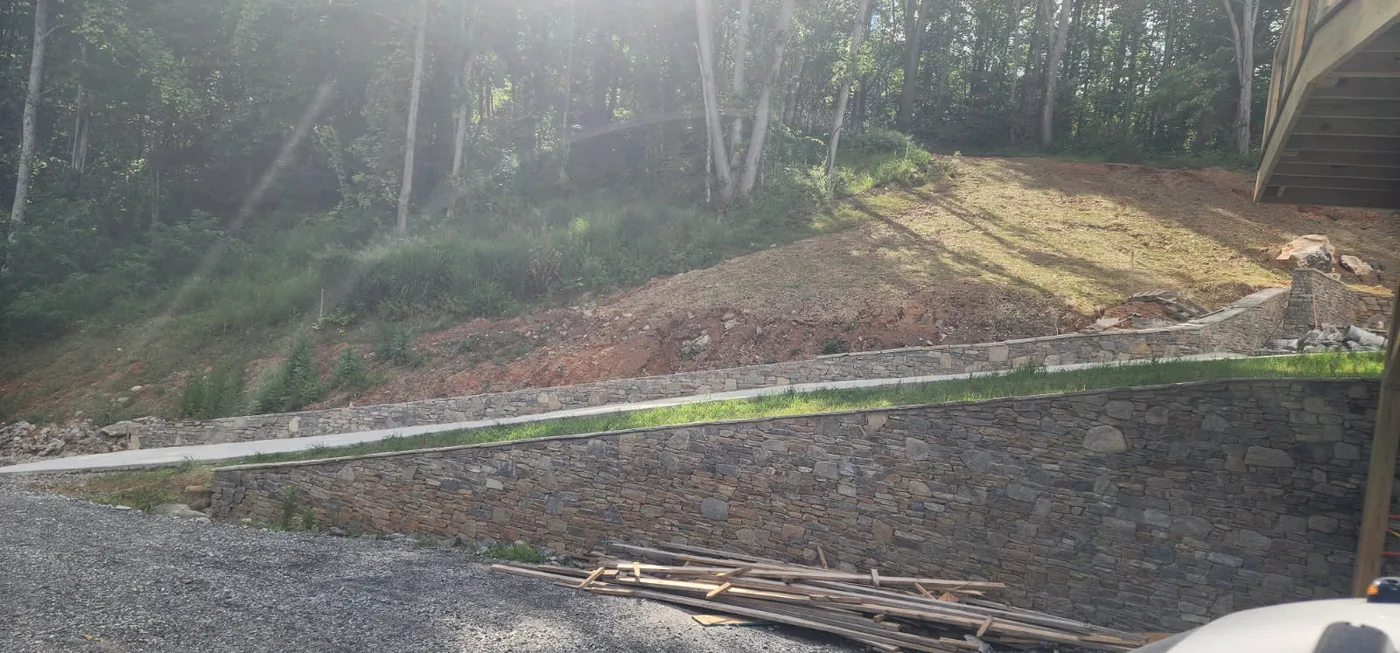
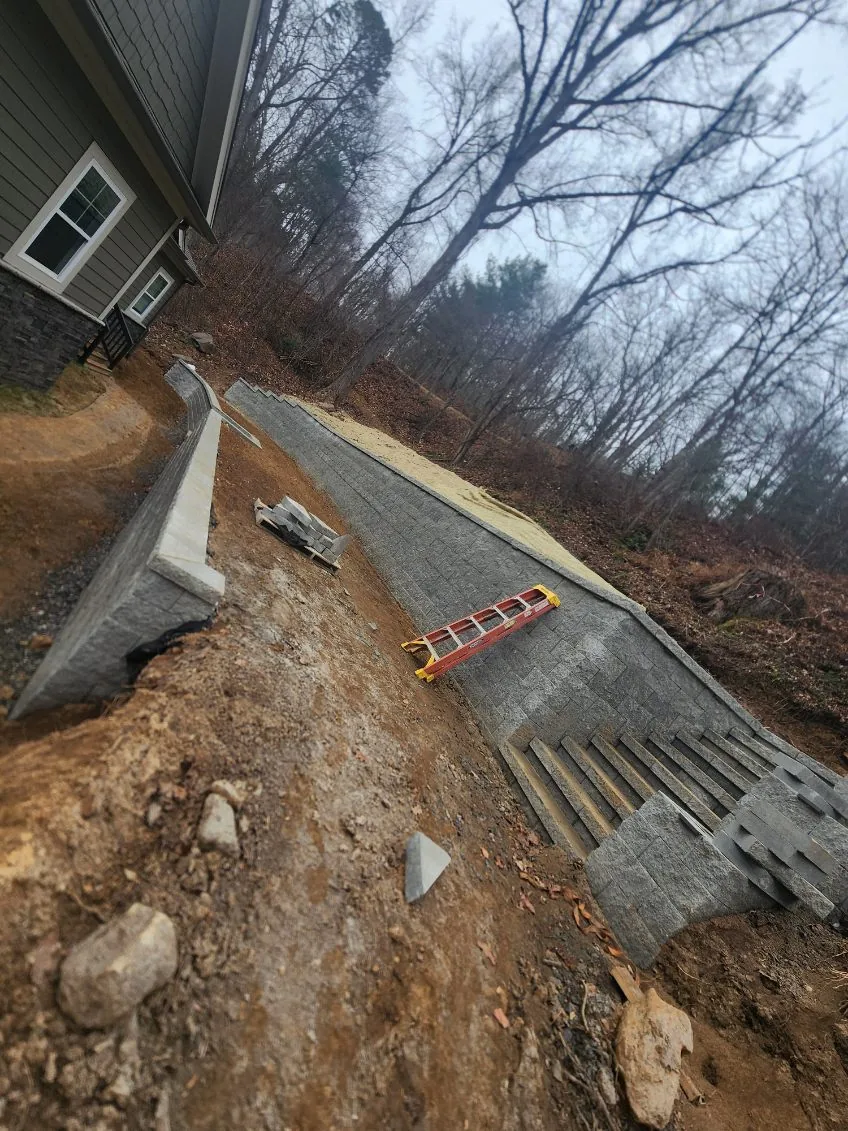
Weaverville sits in the valley between the Craggy and Pisgah ranges, where Buncombe County's steepest residential lots meet red clay that turns to grease when wet. A retaining wall here isn't decorative — it's the difference between a usable yard and a slope that migrates into your neighbor's driveway. The typical call: a 30-to-60-foot wall holding back a cut slope behind a house off Reems Creek Road, or a terraced series of walls on a new build off Flat Creek Road where the grade change exceeds what any single wall should handle. Further up toward Jupiter Road, the underlying weathered granite and schist can make excavation a pick-and-boom affair, not a shovel job, which is why you'll see contractors staging mini-excavators on those lots. In the flatter in-town sections near the historic depot, walls are shorter — 2 to 3 feet, often to define a raised garden bed or level a small city lot against the sidewalk — but they still fail when the local clay swells and pushes against an unbackfilled block face.
The honest starting point: segmented block (Allan Block or similar) for most residential work, weathered stone for the higher-end Montford-meets-country look, and poured concrete or cribwall when the engineer says the load is real. Weathered stone in Weaverville usually means locally sourced blue or brown stone that echoes the older farmhouse foundations along the French Broad River floodplain edges; it's more expensive not just for the material but because it demands a mason who can cut and fit each piece rather than stack a manufactured unit. Gravity walls carry the load with weight; geogrid-reinforced walls carry it with soil engagement. Which one your slope needs is a soils question, not a style question. Reading USGS topographic maps for Buncombe County shows where the steepest contours concentrate east of I-26 toward the Craggies, and that's where a two-story wall becomes a structural conversation, not a landscaping upgrade.
The Weaverville price picture
Steep lots price differently than flat ones. A wall behind a house that you can walk around with a loaded skid steer costs less per square foot than the same wall on a 35-degree slope above Dillingham Road where every block has to be hand-carried or boom-trucked into place. The table below reflects what walls actually cost in this corner of Buncombe County — always per square foot of wall face, installed, and always contingent on access and drainage scope. For the full working table with line-item detail, see the retaining wall cost breakdown. That page breaks out excavation, backfill aggregate, geogrid, drainage pipe, and the engineered footer — every number here assumes those are included, not optional extras. It also notes where you can save, like doing your own landscaping afterward or accepting a split-face block instead of a weathered stone veneer on a tall engineered wall.
| Wall type | Typical height | Price range (per sq ft) | Typical project total |
|---|---|---|---|
| Segmental block (gravity) | 2–4 ft | $45–$65 | $4,500–$9,000 |
| Segmental block (geogrid) | 4–6 ft | $65–$85 | $9,000–$18,000 |
| Natural stone (mortared) | 2–5 ft | $70–$95 | $8,000–$20,000 |
| Engineered concrete / cribwall | 6 ft+ | $95–$130 | $18,000–$40,000+ |
Every wall over 4 feet tall in North Carolina requires an engineer's stamp. That's not a suggestion — the NC Department of Insurance – Office of State Fire Marshal adopts the building codes that make engineered retaining walls a threshold reality. A contractor who quotes a 6-foot wall without engineering fees is either planning to build it wrong or planning to disappear. In Weaverville proper and the county's extraterritorial jurisdiction, the permit process also triggers a site-specific drainage review, and the county's soil maps matter. Buncombe County's web-GIS shows the flood zones along Reems Creek and the French Broad; if your property is anywhere near those, FEMA elevation certificates and floodplain permits multiply the paperwork even if the wall itself is only 3 feet tall. The price picture in Weaverville is honest, but it's never simple.
Drainage is the whole game
The federal disaster record explains most Weaverville wall failures: 19 declared events have touched Buncombe County (1973-2026), almost all storm and flood family. Each one saturated the clay behind walls that were built without proper aggregate, drain tile, or weep holes. The wall didn't fail — the water behind it did. When Tropical Storm Fred dropped over 10 inches of rain on parts of the county in August 2021, the creeks rose and the hillsides wept; the calls to local masonry shops afterward were not about creek damage but about hillside walls that had been holding for a decade suddenly bowing out because the soil behind them was fully saturated for days. That's the Weaverville reality: we're not rebuilding beach houses, we're re-grading mud slips.
Before anyone sells you a taller wall, the drainage question has to be answered: where does the uphill runoff go, what's the clay content of the soil behind the wall, and is there a footer drain that actually daylights somewhere useful? The International Code Council (ICC) standards for retaining wall drainage exist because water pressure — not soil weight — is what pushes walls over. A proper wall has 12 inches of washed stone behind it, a perforated drain line at the base, and a positive outlet. Anything less is a future repair bill. On sloped lots in Weaverville, that outlet is often the trickiest part — it has to run to daylight or a dry well, and if your wall is at the bottom of a slope with no downhill release, you're routing water through a pipe under your yard or into a catch basin. That adds linear-foot cost beyond the wall face itself, and it's the single most underestimated line item in the county. When you see a 2-foot retaining wall — the kind that doesn't legally need an engineer — failing, it's almost never because the blocks cracked; it's because the gravel behind it was skipped to save $300.
Hiring well in this market
Three Weaverville-specific checks: ask whether the crew has built on your slope angle (a 2:1 cut above Reems Creek is not the same as a terrace wall behind a flat lot in town); ask for the engineer's letter on any wall over 4 feet (North Carolina's general contracting licensing rules via the NC Licensing Board apply once the job crosses the threshold); and ask how they handle water — the answer separates wall builders from wall sellers. General contractors in NC must be licensed for projects over $30,000, so a mid-size Weaverville wall with driveway replacement can push into that territory; masons doing smaller work are unlicensed but still accountable to the county's permit desk. Ask to see a permit pull from Buncombe County for a similar job, not just a portfolio photo.
Also worth asking: what the wall is holding up. A failing wall that supports a driveway is an emergency; one that holds back a flower bed can wait a season. If your wall is leaning, bulging, or cracking, don't wait for it to decide for you. See the retaining wall guide for what to inspect first, and if you're just east of us in Woodfin, the Woodfin page covers that specific slope territory. In Weaverville, the municipal code requires a permit for any wall over 3 feet in the front yard or 4 feet in the back, even if the state's engineering threshold is higher; your contractor should know the town's zoning map — the historic district near the downtown has stricter visual standards, and the county ETJ areas have different setbacks than the town's. Hiring well here means hiring someone who has already navigated the Reems Creek road widening or the floodplain overlay zone, not someone learning your street for the first time.
Soil and site prep specific to Buncombe County
Bringing a Weaverville site to the wall-building stage often costs as much as the wall itself, and that's a line item most national websites never mention. The county's upland soils — typically the Evard, Fannin, and Tusquitee series — are deep, well-drained loams over clay subsoils on the slopes, but the bottomlands along Reems Creek and the French Broad shift to the Braddock and Buncombe series: silty clay loams with slow permeability that hold water like a ceramic bowl. When you cut into a hillside off Elk Mountain Scenic Highway, you expose that clay cap, and it will never drain naturally. A proper installation removes the failed soil, places structural fill in lifts, and compacts it — a process that's invisible in the final photo but determines whether your wall survives the next 1973-2026 hurricane season. The county's elevation range — from about 1,900 feet at the river to over 4,000 feet at the crest of the Craggies — also means freeze-thaw cycles are real: water gets behind a coping stone, freezes, expands, and pops the cap off in February. Ask a local contractor how many seasonal maintenance visits they do in March; it's a revealing answer.
Beyond the soil, access is the hidden variable in Weaverville pricing. Many of the ridge lots off Cane Creek Road have switchback driveways that a concrete truck can't negotiate, meaning the pumper has to park at the bottom and push mix up a 200-foot hose run, or the mason hand-mixes on site — both add labor hours and cost. For block walls, a pallet of Allan Block weighs about 2,400 pounds, and if the skid steer can't reach the wall line, you're hand-balling each 70-pound unit down a slope. Realistic bids include a line item for 'material handling' that ranges from nothing (easy access) to $2 per block (rough terrain). The best way to flush this out is to walk the site with the contractor, showing them where the truck can park and where the wall is actually going. The U.S. Department of Housing and Urban Development (HUD) publication on sloped-lot construction, 'Steep Slope Construction', is a practical read for homeowners — it spells out the soil compaction and drainage sequencing that a good local bid already assumes.