Why materials decide this town's steps
Clyde is a Haywood County town where the housing runs from century-old mill-era cottages near the old rail corridor out to newer builds on graded lots climbing toward the Waynesville side. Those two ends of the stock want different stone. Brick bungalows that already have a low stoop read best in fieldstone and river rock — irregular, mortar-set, scaled to a porch that was never tall enough for three full treads. Newer builds on cut-and-fill pads usually need something structural first: block cores, poured footings, then a veneer. Timber often enters as the honest answer on the sides of a walk where grade changes are gentle and the budget is not.
That materials question is our lead question on every estimate, because the wrong stone for the grade is what produces loose treads two winters later. The stone steps and walkways service page walks through the assemblies we build, but the short version for Clyde is this: match the tread to the rise, and match the finish to the house.
Walk the older blocks off Carolina Avenue or near the former paper mill housing and you will see what fifty years of frost heave does to a poorly bedded stone. The treads that survive are the ones with a deep, drained base and joints that were packed, not smeared. That is the lesson we bring to every new build on a graded pad above the valley floor.
The grades that shape every Haywood County quote
Almost nothing in this county is flat. Clyde sits in the Pigeon River valley, and the moment a yard leaves the bottomland it starts climbing. A walk that loses two feet over twenty runs can be dry-laid in an afternoon; the same walk losing four feet needs steps with real risers, a landing, and probably a handrail. Add the county's wet-history reality and the price picture moves again.
The storm and flood record here is not a marketing hook, it is a design input: 19 federal disaster declarations touch this county across 1973-2026, overwhelmingly water-family events. That matters for steps because water is what undermines a footer, floats a paver, and heaves a mortared joint. The National Weather Service's rainfall frequency data for western North Carolina (NWS) is the number we actually use when sizing a drain behind a stoop, and it's the same number the state's code intends you to respect.
Homes that sit above the Little Pigeon or Crabtree bottoms deal with a water table that rises fast after a mountain storm. Even on a slope, water is moving downhill through your soil toward the house, and steps are the first thing it hits. A French drain behind the top riser, daylighted to a lower point, is not an upsell here — it is the difference between a stair that lasts twenty years and one that rocks in five.
Scope versus price, line by line
The table below reflects what these assemblies cost in this region when done with real base prep rather than set on topsoil. Treat any bid far under the low end as a scope that skipped something.
| Scope | Typical range |
|---|---|
| Two to three fieldstone treads, low stoop, dry-laid base | $2,900-$4,800 |
| Mortared stone stoop with poured footing and drainage behind | $4,500-$8,000 |
| Walkway, roughly 30-40 linear feet, flagstone or pavers on compacted base | $3,800-$7,500 |
| Grade-change stair run, four to six risers with landing | $5,500-$11,500 |
| Block core, stone veneer, and code-compliant handrail anchoring | $6,000-$12,000 |
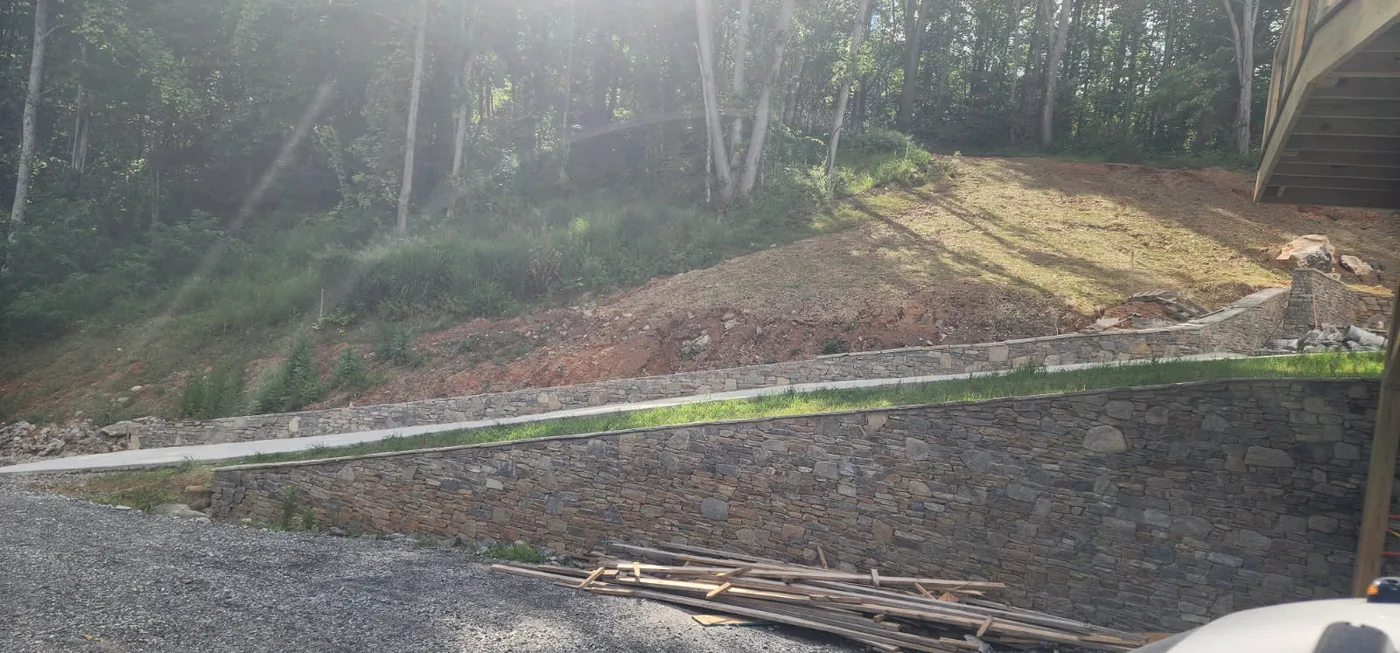
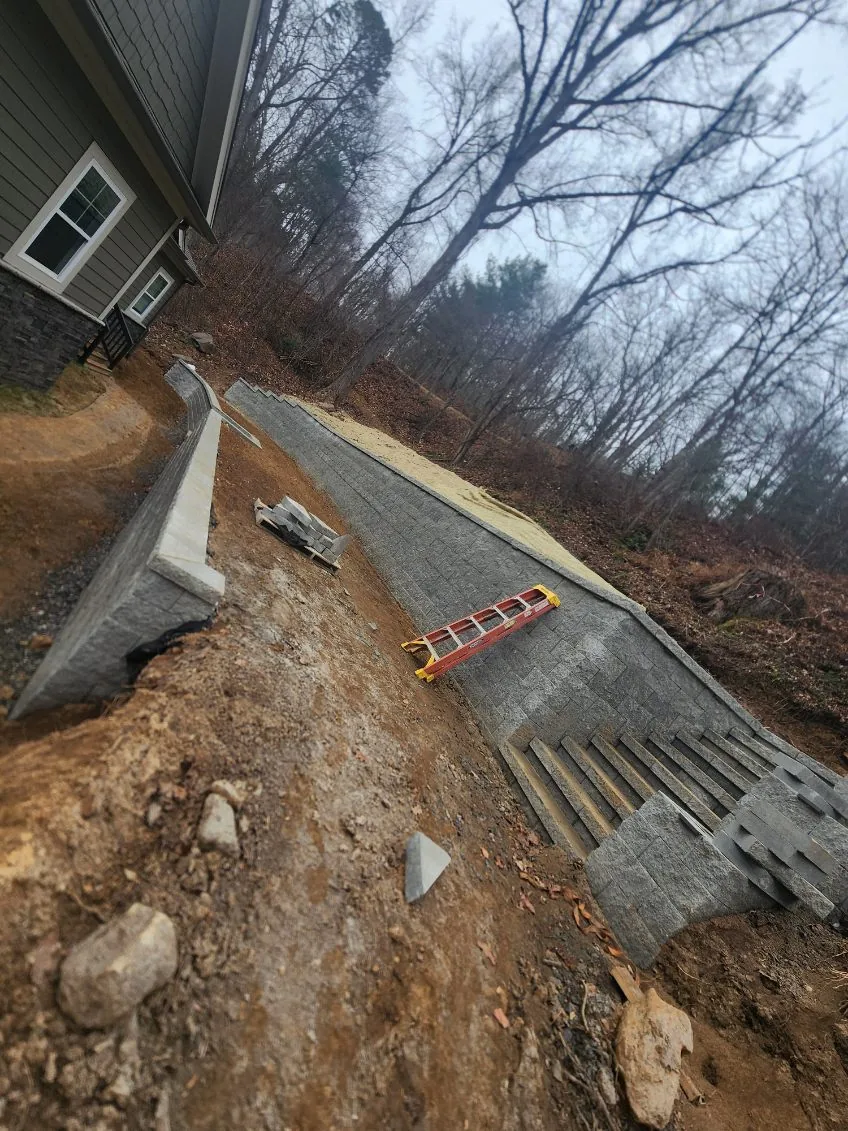
Where a stair run doubles as a grade break, it is often cheaper and more durable to solve both with one structure — that is retaining work wearing a step's clothing. The Haywood County retaining wall cost breakdown is the right next read if your project is really a wall with treads cut into it.
Two details move the number more than stone choice: how deep the footer runs and how far the drain behind the stoop travels to a legal daylight. A short drain run to a ditch costs a fraction of a line that has to cross a driveway or run a hundred feet downhill. Ask for both line items separately so you can see what you are actually buying.
Footings, rails, and what the code expects
North Carolina treats exterior stairways and their guards as structural elements, not decoration. Once a run reaches a certain height, footings have to bear below frost, treads need consistent riser dimensions, and guards have to resist a real lateral load. The NC Department of Insurance Engineering and Codes division is where that language lives, and the International Code Council publishes the model text the state adapts. Handrails anchored into stone veneer are a frequent failure point precisely because the anchor was sized for a porch rail, not a stair guard.
Licensing matters on the bigger end of these jobs. The NC Licensing Board for General Contractors sets the threshold at which a project needs a licensed general contractor, and mixed scopes — stone stairs plus a retaining structure plus drainage — cross it faster than homeowners expect. Confirm who is actually pulling the work before anyone breaks ground.
Riser height consistency is the quiet code issue on these slopes. A flight that varies by an inch and a half trip-loads the ankle, and inspectors flag it. We set every riser off a laser, not off the stone, because fieldstone is never uniform and the eye will follow the tread if you let it.
Choosing a builder without guessing
Ask every bidder three things: where the water goes when it leaves the top of your steps, how deep they set the footer, and whether they build the base to be walked on before any stone goes down. The third answer tells you the most. Stone laid on a properly compacted, properly drained base will hold; stone laid on a bed over clay will not, no matter how good it looks in June.
Then ask for the assembly, not a material name. Fieldstone, boulder, block, and timber all have places where they are the correct answer in Clyde, and places where they are not. Local crews who have set stone on these grades can tell you which is which in a ten-minute walk of the yard — the Clyde retaining and hardscape contractors page is where to start if you'd rather not cold-call.
Ask to see a job that has been through at least two winters, on a grade like yours. Ask whether the footer was poured or just dry-stacked rubble. Ask who hauls the spoils off site, because on a tight slope that haul can add real money to a bid that looked cheapest on paper. The crew that answers all three without flinching is the one to hire.