Why Fairview lots build differently than Asheville lots
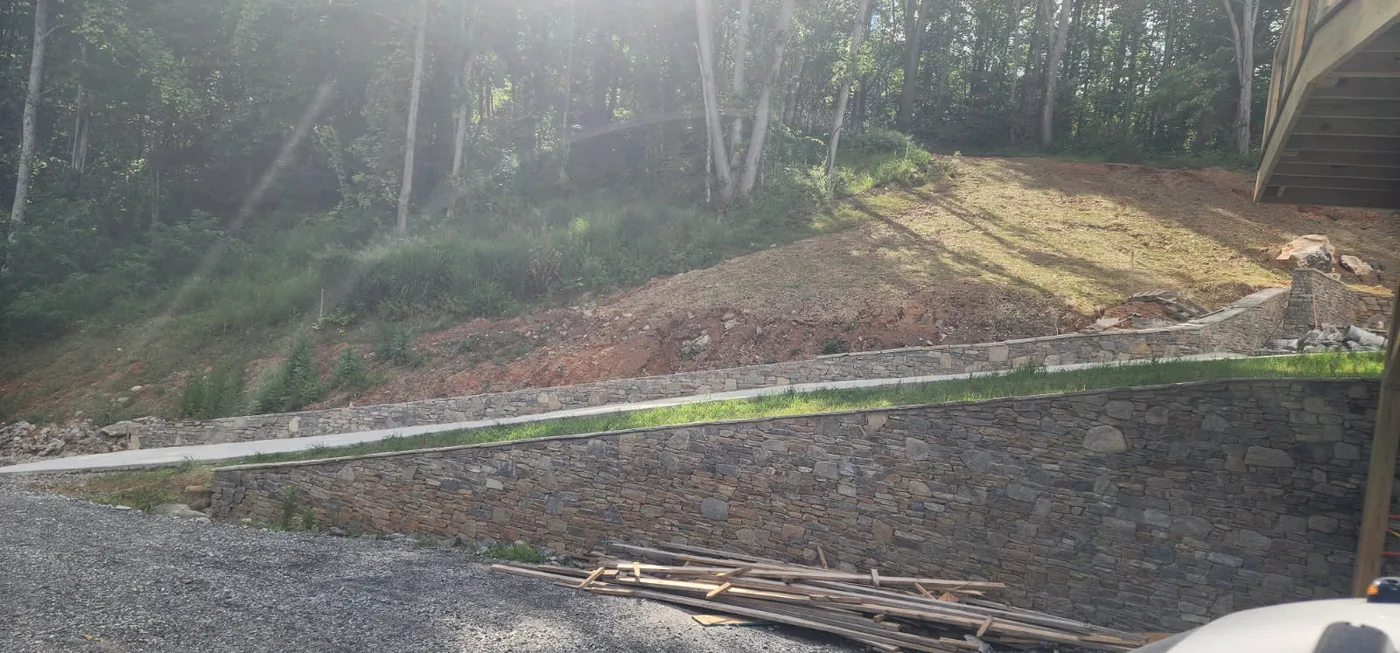
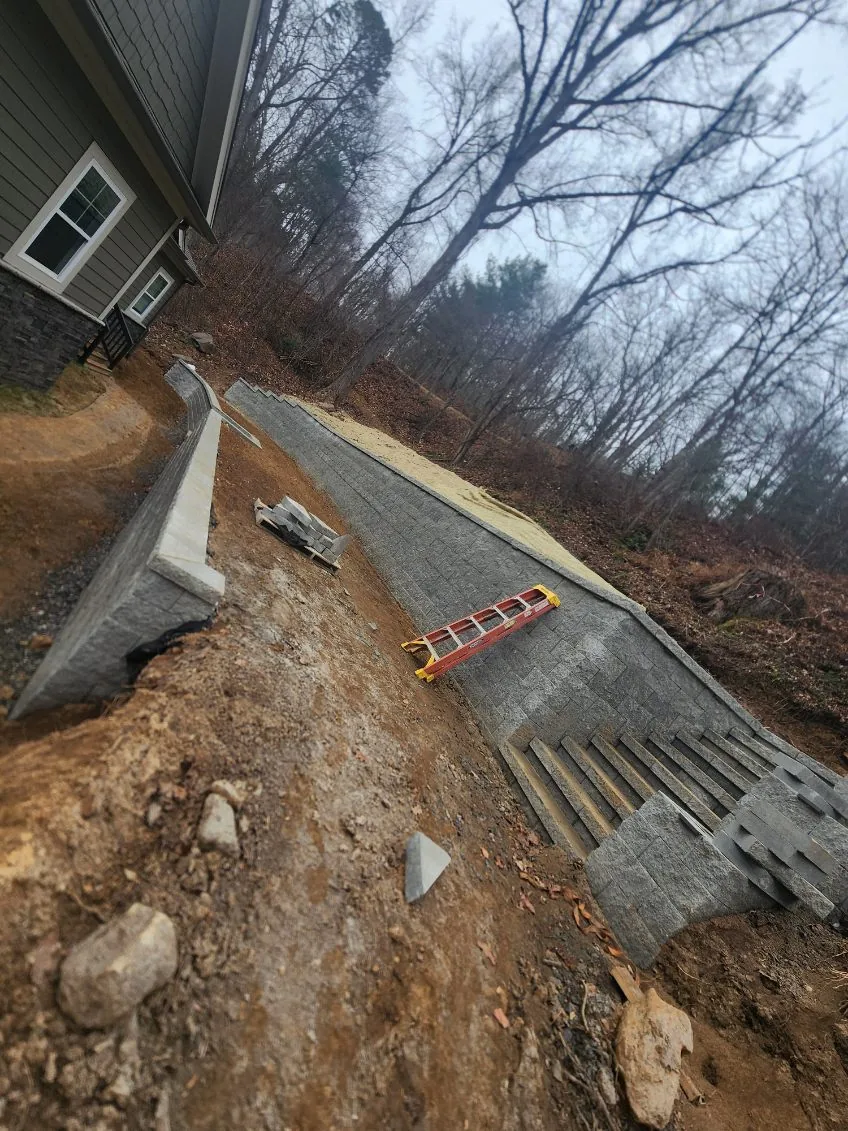
Drive out past the county line and the lots change shape. Fairview properties tend to be wider, steeper, and farther from the road than anything inside the Asheville city limits, which means the walk from driveway to front door is often a genuine grade change, not a decorative path. On a lot like that, a stone walkway is really a small retaining structure wearing a walkway's clothes. Every step is holding back soil, and every landing has to shed water instead of pooling it against the house.
Fairview's ground is a mix of weathered clay, decomposed granite, and rock that shows up about a shovel deep in more places than homeowners expect. Clay holds water against a step tread and heaves in winter; rock stops a builder who planned on digging holes. The crews that do well out here plan the drainage before the first stone gets set, because redoing a failed flight of steps costs more than the original build.
Talk to longtime Fairview residents and you hear the same story in different forms. A walkway that looked fine for two seasons suddenly has a lip on it after a wet spring. A retaining timber wall creeps downhill a quarter inch a year until a step no longer meets the landing. That is not a stone problem. That is a base and drainage problem that finally showed up as a stone problem. On flatter in-town Asheville lots you can sometimes get away with a shallower base and a simpler outfall, because the ground under the path is not trying to slide toward a creek at the bottom of a long grade. In Fairview, it usually is.
Housing stock out here reflects the terrain too. Older homes tend to sit on the more buildable pockets, with additions, outbuildings, and parking cut into the slope over decades. Newer builds often perch higher and push the walkway problem downhill, which is why so many Fairview projects start with a muddy path that floods every storm and end with a proper stone stair, a retaining run, and a buried drain that finally gives the water somewhere to go.
What stone steps and walkways actually cost here
Pricing on steep lots tracks three things: how many steps, how much retaining, and how much dirt has to move. A short flagstone path on near-level ground is the cheap end of this trade; a full flight of stone steps climbing a Fairview hillside with buried drainage and a landing is the expensive end. The ranges below reflect typical Buncombe County work. See the retaining wall cost breakdown for Buncombe County for the wall-specific line items that often ride along with a stair build.
| Scope | Typical range | What drives it |
|---|---|---|
| Flagstone walkway, near-level, under 60 ft | $3,200–$6,500 | Tread count, stone type, base prep |
| Stone steps, 4–8 risers, modest grade | $4,500–$9,000 | Rise, width, landing, drainage |
| Hillside stair with retaining and switchback | $8,000–$14,000+ | Total rise, wall footings, soil removal |
| Drainage retrofit under existing walkway | $1,800–$5,500 | French drain length, outfall location |
Any quote that doesn't mention drainage on a Fairview slope should be treated as incomplete, not cheap. A bid that is thousands below the others usually means the base, the outfall, or the retaining was left out of the scope, and that cost lands on the homeowner two or three years later when the steps start moving. Ask each bidder to walk you through the base depth, the drain routing, and where the water exits the property. If those answers are vague, the price is not really lower.
Three other line items show up on Fairview jobs more than most homeowners expect. Hauling is one, because removing excavated clay and rock from a steep lot takes equipment and time. Access is another, because a staircase that has to be built entirely by hand-carry, bucket by bucket, costs more in labor than one a mini-excavator can reach. Rebuilding an existing landing or stoop is the third, and it is often worth doing while the crew and the equipment are already on site rather than paying a full mobilization again next year.
Water is the real design brief
Ask anyone who has watched runoff cross a Fairview driveway after a storm. The federal disaster record for this county is dominated by storm and flood family events, 19 declared events across a span of 1973-2026, and every one of them pushed water at stonework built on the assumption that a normal year would stay normal. The National Weather Service keeps the local precipitation record, and the trend line is not gentle.
That's why a good stone stair job includes, at minimum, a compacted gravel base, a slight pitch to every tread so water runs off instead of sitting, and an outfall plan for whatever the drainage system collects. The International Code Council residential provisions treat exterior stair geometry like rise, run, and handrail height as safety requirements for a reason, and those rules apply whether the stair is interior or exterior. A stone stair that fails code geometry is a trip hazard with good looks.
In practice, water moves across a Fairview lot in sheets after a heavy storm, gathering speed on the long grades and cutting wherever the ground is softest. A tread that is dead level traps that water until it finds a joint, and once it finds a joint it starts lifting stone. A tread pitched even a few degrees toward the downhill edge sheds that water and keeps the base intact. The outfall matters just as much: a French drain that ends ten feet from the foundation has not solved anything, it has just moved the problem. The good outfalls daylight at a lower point on the property, well away from the house, the driveway, and any neighbor's grade.
For homeowners on a slope, the honest advice is to fix the water before dressing the path. A stone walkway over a wet, heaving base will fail no matter how it looks on the day it is finished. A stone walkway over a drained, compacted base will hold its lines for years, and the same stones cost about the same either way. Our stone steps and walkways service page covers the full scope of what we build, drainage included.
Stone choices that hold up on a slope
Not every stone belongs on a Fairview hillside. Flagstone is the classic choice for walkways and landings because it can be cut and fit to an irregular path; it works well when the base is properly compacted and the joints are tight. Fieldstone and stacked stone show up on retaining and step faces where mass matters more than precision. Bluestone and slate look excellent but cost more and demand more careful setting, which pushes labor up on a steep site where every stone has to be carried in by hand.
The honest tradeoff: a cheaper stone that's set correctly on a proper base will outperform an expensive stone set on a bad base every time. Ask what's under the stone before you ask what the stone is. A good crew will tell you the base depth, the compaction method, and how the joints are being filled, because those are the details that decide whether the steps are still level in ten years.
Locally sourced stone is worth asking about on Fairview jobs, partly for the look and partly because haul distance is real cost. Stone that is regional and reasonably close to Buncombe County can land cheaper than stone trucked in from several states away, and it often matches the existing walls and outcrops already on the property. If a homeowner has a pile of fieldstone from an old wall or a cleared garden bed, a good crew can often work some of it into the design, which cuts material cost and keeps the site's character intact. That is one of the small advantages of building with stone: unlike a poured slab or a manufactured paver, stone accepts what the land already has.
Using local trades the right way
North Carolina's licensing threshold for general contractors matters on projects that cross into structural retaining work, and the NC Licensing Board for General Contractors is the place to verify a license before you sign. Many stone and hardscape jobs fall under the threshold and don't require a licensed GC, but a wall over a certain height or a stair with significant retaining may pull the project into scope. A contractor who knows the line and can explain it clearly is usually the one who also knows how to build a step that won't move in five years.
For larger projects, check whether your scope needs a Buncombe County permit before work starts. Our retaining wall contractors in Fairview NC page covers how to vet a crew for slope work specifically, and that vetting matters more out here than it does on a flat lot, because a mistake on a slope is expensive to undo. Ask to see work the crew has done on comparable terrain, ask what happens if a step settles in the first year, and get the drainage scope in writing. Those three questions separate the crews who build for the long haul from the ones who build for the photo.