Why Henderson County lots pick a material before they pick a contractor
Drive from downtown Hendersonville out toward Flat Rock or up toward Jump Off Rock and you pass the whole argument in one trip: nineteenth-century fieldstone terraces holding up farmhouse yards, boulder walls fronting mid-century ranches off Kanuga Road, split-face block behind newer builds on cut lots, and timber walls quietly rotting behind homes built in the 1980s boom. In this county the material usually gets decided by three things that have nothing to do with taste — how much wall you need, how much water is coming at it, and who is paying.
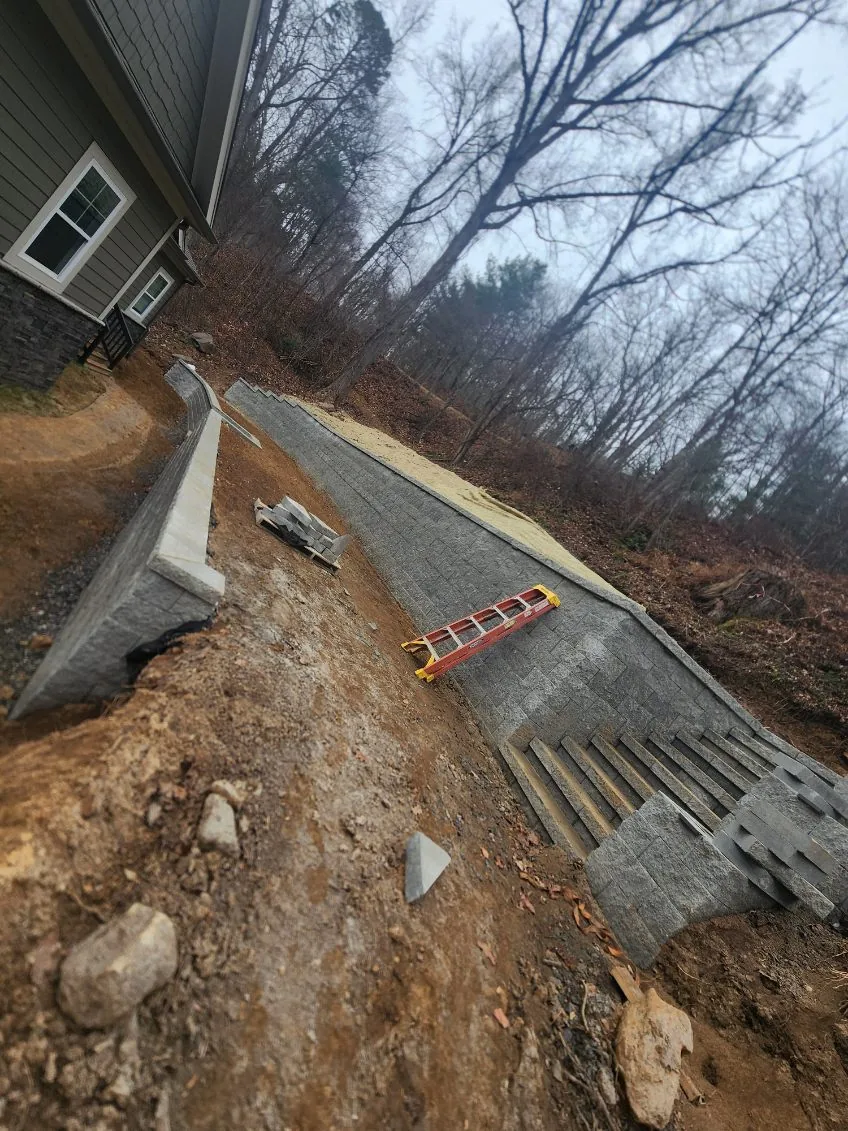
Fieldstone is what the old walls here were built from, gathered off the same acres they hold up. It is beautiful, it drains itself, and rebuilding one is slow, expensive, hand-laid work. Boulder walls went up fast on hillside lots in the 1960s and 70s and many are still fine, but they lean when water gets behind them. Segmental block is the modern workhorse: engineered, stackable, and the only material most builders will put on a tall wall without a fight. Timber is the budget answer — fine behind a garden, doomed as a structural wall, because it rots from the inside out at the soil line.
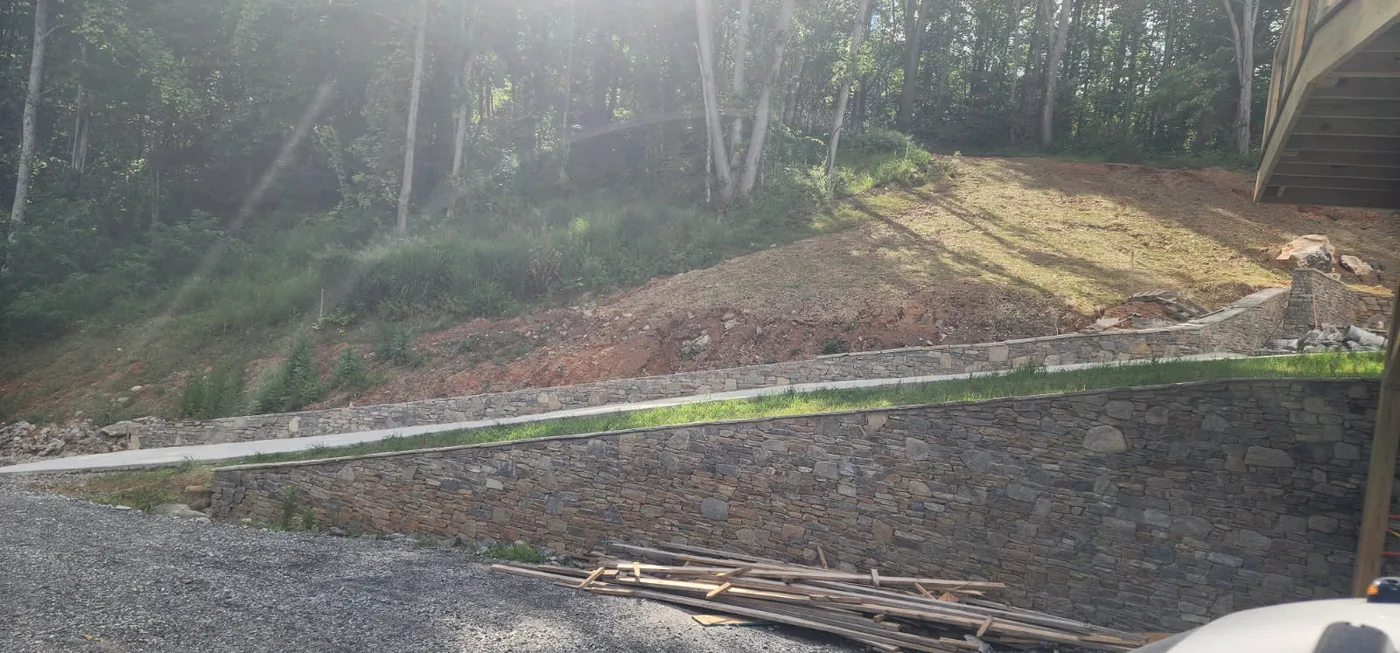
What makes Henderson County different from a flatland county is how often the wall is also a driveway edge. Half the homes between Kanuga Road and the Flat Rock ridge sit on pads cut into the slope, and that cut created a wall whether the original builder thought about it or not. Driveway-side walls on these lots get loaded from above by the car and from behind by groundwater, and that combination is what pushes a lot of four-foot walls into engineering territory. A wall on a flat Greenville lot is landscaping; the same wall on a Hendersonville slope is a structure holding back a hill that wants to come down.
Material also tracks the housing stock. The older farmhouses and 1950s ranches around Flat Rock and Laurel Park tend to have fieldstone terraces that can be matched and re-pointed in kind. The 1990s and 2000s subdivisions off Highway 64 and up Howard Gap Road were built on graded cut lots with tall block walls at the rear property line, and those are the calls that usually come in as rebuilds rather than new construction. Knowing which era your house belongs to tells you more about what the wall needs than any photo of the finished face.
What walls actually cost in Henderson County
Prices here track wall height, access, and how much of the job is dirt versus material. A wall under three feet on flat, open ground is landscaping. A wall over four feet, or any wall holding up a slope near a house or driveway, starts to be engineering — and the NC Licensing Board for General Contractors threshold applies once the project crosses into structural work. Most residential projects in this county run $4,500 to $28,000, and the honest national frame from the EPA is that retaining structures exist to manage water first and hold dirt second — which is why drainage line items show up on every real bid here.
| Scope | Typical range |
|---|---|
| Timber wall, under 3 ft, garden use | $30-$50 per sq ft |
| Segmental block, 3-4 ft, residential | $40-$70 per sq ft |
| Engineered block, over 4 ft, permits + engineering | $65-$110 per sq ft |
| Fieldstone or boulder, hand-laid | $50-$120 per sq ft |
| Drainage, footing, and backfill correction | $1,500-$6,000 |
| Full rebuild of a failed wall, haul-off included | $8,000-$30,000 |
For a line-by-line breakdown specific to this county, see the Henderson County retaining wall cost page.
Two cost realities are specific to this county. First, access. A lot of these hillside properties have no room for a machine behind the house, which means stone and block move by wheelbarrow and the labor line climbs. A wall that would be a two-day machine job on a flat lot can be a week of hand work on a Laurel Park terrace. Second, haul-off. A rebuild on a failed boulder wall usually means trucking out the old rock before any new block goes in, and that disposal cost sits outside the per-square-foot number people compare on.
It is also worth separating the wall budget from the yard budget. A common mistake on these lots is spending the whole number on a taller face and then leaving nothing for the drainage, footing, and backfill correction that actually decide whether the wall survives the first wet winter. If a bid is dramatically cheaper than the others, look at what it left out before you look at what it included.
The water behind the wall is the real job
Hendersonville sits in one of the wettest corners of the state, and the federal record backs it up: 16 declared disaster events touch this county across 1978-2026, almost all storm and flood family. That history matters because a retaining wall is judged by what happens after three days of rain, not on the day it is finished. Every wall needs drainage behind it — gravel, filter fabric, a perforated drain, and a path for the water to leave. A wall built without that path will lean, crack, or fail, no matter what it is made of. The National Weather Service tracks the rainfall patterns that keep this county's soils saturated, and any contractor bidding here should be talking about them before talking about block.
Henderson County soils make this worse than the rainfall alone would suggest. The clay-heavy ground common on these slopes does not absorb water quickly, so a soaked hillside pushes hard against the back of a wall and holds that pressure long after the storm has passed. That is the mechanism behind most of the leaning walls you see up off Kanuga Road and behind the older homes near downtown: not a bad wall, a wall with nowhere to drain. A carved swale, a buried drain running to daylight downhill, or a properly graded backfill zone is what gives the water a direction that is not straight through the block.
The retaining wall construction guide covers the sequencing — excavation, footing, drainage, backfill, facing — that separates a wall that lasts from a wall that gets redone. If a wall is already leaning or cracking, retaining wall repair is usually less than a rebuild but only if the drainage is fixed at the same time. Patching a face without addressing water is paying twice.
Surface water is the other half of the story. Roof downspouts, driveway runoff, and uphill yard drainage all get funneled somewhere, and on a sloped lot they often get funneled directly at the back of the nearest wall. A contractor who walks the uphill side of the property before bidding is doing the job right. If nobody asks where the water above your lot goes, that is a sign the bid is cosmetic.
How code and permits work in this county
Henderson County and the City of Hendersonville both require permits for retaining walls over certain heights, and the thresholds and inspection requirements are set by the state — the NC Department of Insurance Engineering and Codes division publishes the residential code that governs footing depth, drainage, and wall design. The practical version: short garden walls usually need nothing, walls over four feet typically need a permit and a design, and walls near a slope or structure often need an engineer's stamp. The International Code Council is where those standards originate, and a contractor who can point you to the specific code section is usually the one who will build to it.
In practice, the walls that get people in trouble here are the ones nobody classified as structural. A three-foot wall at the bottom of a steep bank is holding far more soil than a three-foot wall on level ground, and the load it carries depends on the slope above it, not its own height. That is why a wall can be short and still need a design. If the ground behind it rises, treat the height of the wall as a poor guide to how much engineering it needs.
Permit timing matters on a project schedule too. Inspections on footing and drainage have to happen at stages that are buried once the wall goes up, so a build that skips the paperwork often skips the inspection and loses the ability to prove the drainage was done right. On a resale, an unpermitted structural wall near a house pad is a real problem, and the cost to make it right later is almost always more than doing it correctly the first time.
Choosing a crew on these hillsides
Ask three questions before hiring. First, who does the engineering on walls over four feet — the answer should be a licensed engineer, not the foreman. Second, how is water handled behind the wall — if the answer is gravel and a pipe, keep talking; if it is "it'll drain," stop. Third, what is the wall doing — holding a slope, holding a driveway, or holding a house pad — because those are three different builds even at the same height. The wall construction page walks through the scope questions a good bid should answer.
Beyond those three, ask for recent local work you can drive past and judge on your own. A wall that has been through several wet seasons up here tells you more than any brochure. On a sloped Henderson County lot, the telling details are things you can see from the street: whether the wall is straight after a few winters, whether there is a clean drain outlet at the low end, and whether the ground behind it still slopes away from the wall instead of settling into a trench against it. A crew that has built a lot of walls in this terrain will have an answer for each one, and probably a few examples nearby they are happy to point you toward.