Why the four-foot line decides your Clyde waterfall budget
Most waterfall builds in Clyde fail or succeed on one measurement: the height of the retaining wall holding the upper pool. Haywood County's terrain off the Pigeon River corridor pushes almost every project into a slope, and once that wall reaches 4 feet — measured from the bottom of the footing to the top of the wall — North Carolina treats it as a structure, not landscaping. That triggers an engineered design, a permit, and inspection sequence that a sub-4-foot wall never sees. The NC Licensing Board for General Contractors counts retaining walls among the improvements that can push a project into general-contractor territory, so the threshold is not just local paperwork: it changes who can legally build it. Plan the waterfall around a 3-foot wall and you save four figures; plan it at 5 feet and you pay for engineering you cannot skip.
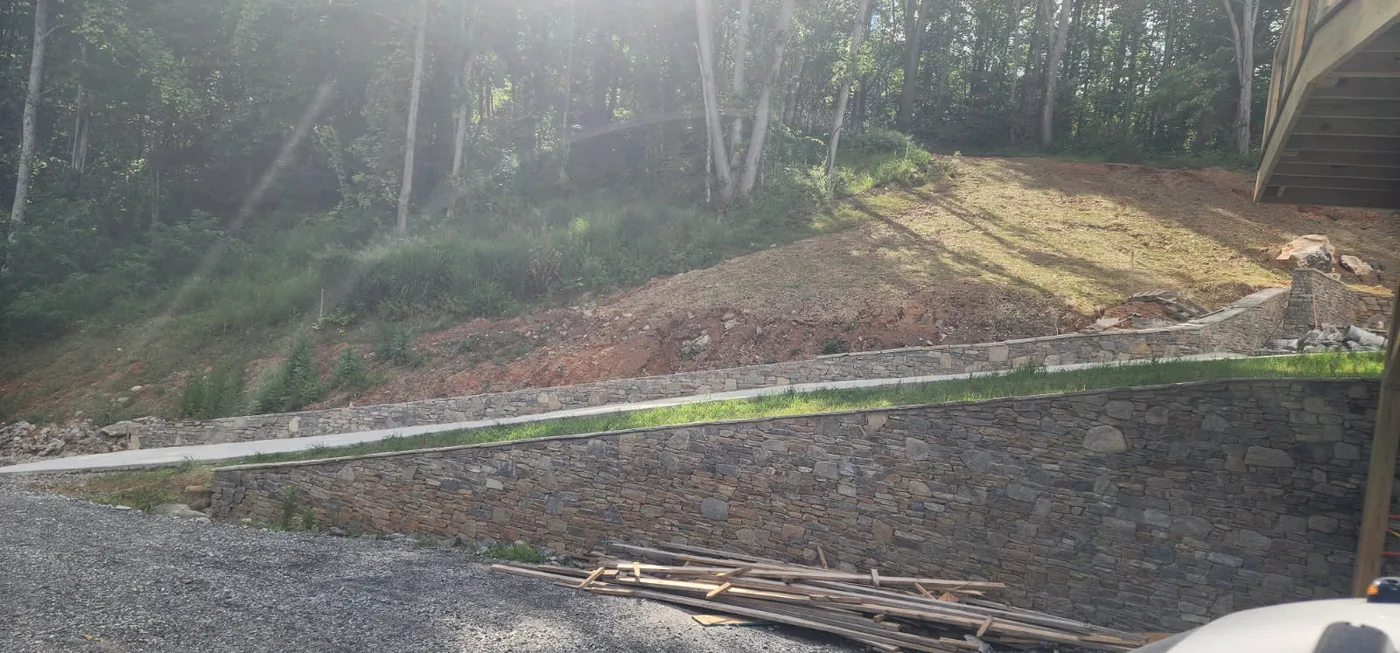
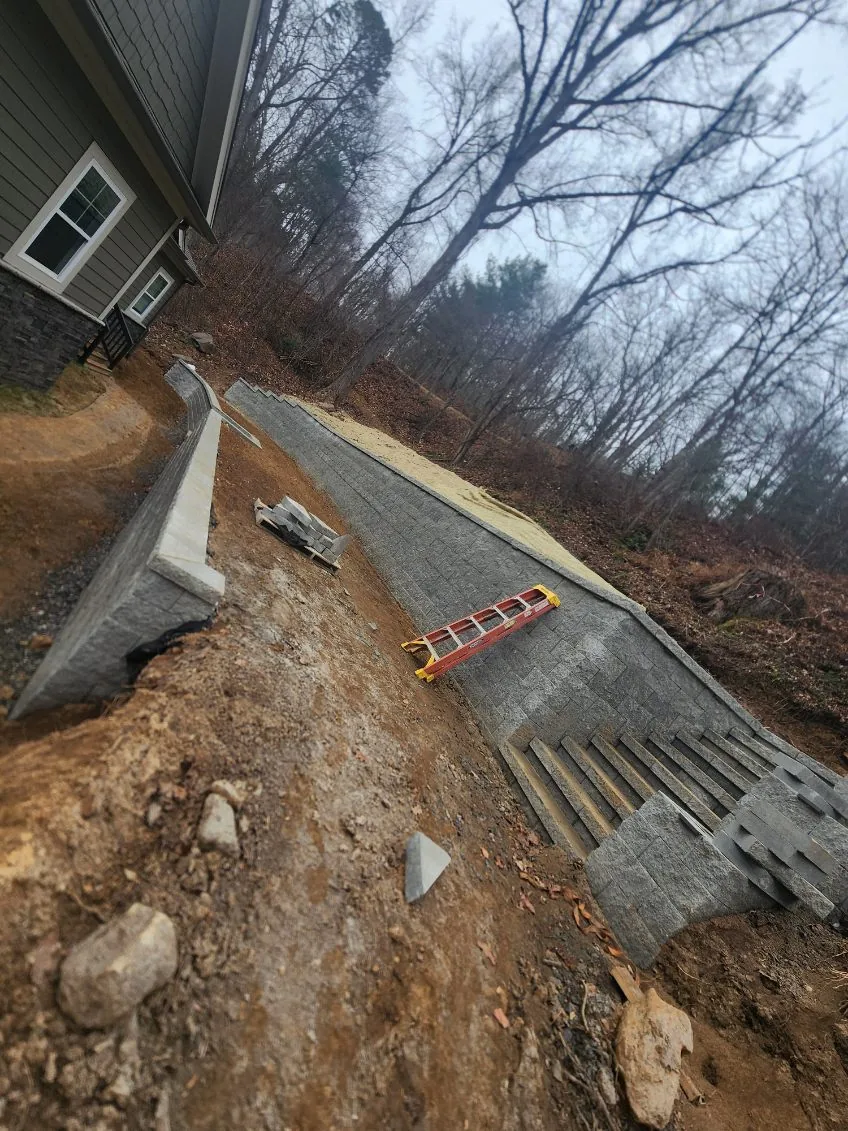
The reason the threshold bites harder in Clyde than it would in a flat Piedmont town is the way lots here are cut. A driveway off a ridge road often drops 15 or 20 feet from the road edge to the house pad, and the natural place for a pond basin is the one bench of flat ground the builder left behind. That bench is usually held by a wall, and that wall is usually already close to four feet because the cut was made decades ago when the house went in. Homeowners rarely come to us asking for a tall wall. They come asking for a waterfall, and the waterfall lands on top of a wall that was already at the line.
That is also why the honest first conversation in Clyde is not about stone or pump brands, it is about what is already on the slope. If the existing wall is under four feet and in good shape, a waterfall can often sit on it with little more than a face veneer and a reinforced cap. If it is at or over four feet, or if it is dry-stacked and leaning, the project changes category before it changes design. Measure the wall from the bottom of the footing, not from the dirt you can see, because the buried portion is what the code counts and what a plan reviewer will ask about.
What stone waterfall and pond work costs here
Clyde sits in a county where the ground drops fast and the stone is often native, which holds material costs down and labor and machine time up. Ranges below are typical for Haywood County work; steep access off a mountainside driveway or a spring-fed water source can push the upper end. Use the scope table as a starting point, then walk the site.
| Scope | Typical price range |
|---|---|
| Boulder accent waterfall (single drop, under 3 ft lift) | $4,200 – $8,500 |
| Pondless waterfall (2–3 drops, hidden basin) | $8,000 – $16,000 |
| Pond with liner, pump, and stone edging | $9,500 – $22,000 |
| Retaining wall tied into waterfall, under 4 ft | $45 – $85 / sq ft face |
| Retaining wall 4 ft and taller (engineered, permitted) | $95 – $160 / sq ft face, plus $1,200 – $4,500 design and review |
| Pump, plumbing, and electrical rough-in | $1,800 – $6,500 |
Pairing the build with a standalone slope fix is common here — the Haywood County retaining wall cost breakdown covers the wall-only scopes so you can separate line items.
Two local variables move those numbers more than anything else. The first is machine access. A lot with a gentle gravel drive off a county road lets a mini excavator and a stone truck reach the basin, and that is the cheap version. A lot where the only path is a switchback foot trail above a septic field means every boulder and every yard of gravel goes in by hand or on a track machine that has to be walked in carefully. That difference alone can swing a project by several thousand dollars, and it is the first thing a bidder should look at, not the last.
The second is the stone itself. Haywood County and the surrounding mountains produce a lot of the material used in these builds, so a waterfall faced in native fieldstone or regional boulders usually costs less in material and more in handling than a trucked-in quarried product with a uniform look. If you want a specific color or a squared, uniform face, expect to pay for freight and for the labor to sort and fit it. Mixed native stone with some larger boulders for the drops is the value path, and it also tends to look like it belongs on a Clyde slope rather than on a commercial water feature.
Water, storms, and why Clyde ponds need a drain plan first
Haywood County has seen 19 federal disaster declarations spanning 1973-2026, and the dominant family is storm and flood. That history is not abstract when you are putting a liner pond on a downhill lot: an overflow path is the difference between a pond and a mudslide into your neighbor's yard. The NC Building Code Council code set treats grading and drainage as a first-class requirement for structures, and a waterfall basin is a structure once it holds water. Before any pump is sized, answer where the overflow goes, how the uphill runoff is intercepted, and what happens in a 100-year rain. The pond and waterfall buildout specifics live on the stone waterfalls and ponds page, but the drainage layering is the part that varies by Clyde lot.
Mountain storms here tend to arrive as short, intense bursts rather than all-day soaking rain, and that matters to the design. A basin that has a proper freeboard above the normal water line can take a burst without losing its edge. A basin built to the rim has nowhere to put the extra water, so it finds the weakest point in the liner or pushes over the stone and starts cutting a channel. An overflow that daylights to a defined, armored outfall keeps that water moving in a path you chose instead of one the storm chose.
Uphill runoff is the other half. On a lot that climbs away from the house, water that crosses the waterfall terrace on its way down is carrying soil and leaf litter, and it will fill a basin over a season if it is not intercepted above the feature. A simple swale or a shallow interceptor trench above the waterfall, tied into the same outfall, is one of the least expensive parts of the job and one of the first things we look for. Settlement and grading around the basin edge also matter: a liner pond that was backfilled against fresh fill can shift in the first wet season, so the stone collar and edge treatment get built to move slightly rather than crack.
Permits, trades, and who signs off
Three separate authorities can be involved and the sequence matters. The NC Licensing Board for General Contractors sets the dollar and scope thresholds for who may contract the work. The NC State Board of Examiners of Plumbing, Heating and Fire Sprinkler Contractors governs plumbing and irrigation connections if the waterfall ties into a pressurized water supply or a pump system with a potable cross-connection risk. Electrical for the pump is its own licensed trade. The International Code Council publishes the model codes North Carolina adopts, which local inspection follows on engineered walls. Ask each contractor which license covers their scope before you sign.
The practical order on a permitted build is engineering first, then the permit application with the stamped drawings, then construction, then inspection before the basin is filled and the liner is buried. That last point trips people up. If the inspection needs to see footing depth or drainage detailing, and the stone and liner are already in, the inspector cannot verify what is covered. Building in the order the permit requires is not bureaucratic delay; it is the difference between a pass and a rebuild.
Waynesville is the county seat and the building department that reviews most of this work sits in Haywood County, so the review process and the inspection calendar are the same one the town contractors deal with all year. Low-slope and hillside lots throughout the county run into the same questions, which means local reviewers have seen waterfall and pond projects before and will ask specific things about drainage and wall height rather than treating it as an unusual request. Bring the wall height measurement, the drainage plan, and the trade license information to the counter and the review is usually straightforward.
Reading a Clyde waterfall bid like a local
A complete bid for a stone waterfall in Clyde names four things: the wall height and whether it crosses the 4-foot line, the liner and underlayment spec, the pump curve and its electrical circuit, and the overflow and drainage path. A bid missing any one of those is not a cheaper bid; it is a bid with the expensive part left out. Bids that fold the retaining wall into the waterfall line without separating the engineered portion are the ones most likely to grow after the first inspection. For a wall-only scope, the Clyde retaining wall contractor page breaks out how those bids are structured. If your site also has a slope above the waterfall, plan the two structures together so the drainage is solved once, not twice.
One more thing worth asking about is the pump and its housing. A pump that sits exposed at the edge of a basin on a Clyde slope will be easier to service and easier to hear from the patio. A pump set in a buried vault is quieter and cleaner but needs a drain so the vault does not fill. Neither is wrong, but the bid should say which one you are getting, because the vault version adds excavation and a lid and the surface version adds noise and a little more winter exposure. On a cold mountain site, a pump that can be pulled and stored for the hardest weeks is a real advantage, so ask how the plumbing disconnects.
Finally, ask who returns when the feature is running and something is off. A waterfall is a working system, and the first month after startup is when you find out whether the flow is even, whether the liner edge is holding, and whether the overflow actually carries water in a storm. A contractor who builds in Clyde and services in Clyde can come back on a short drive. A crew that came in from out of the county for the install may not, and that is a cost that does not show up in the bid line items.