What Buncombe County retaining wall projects really run
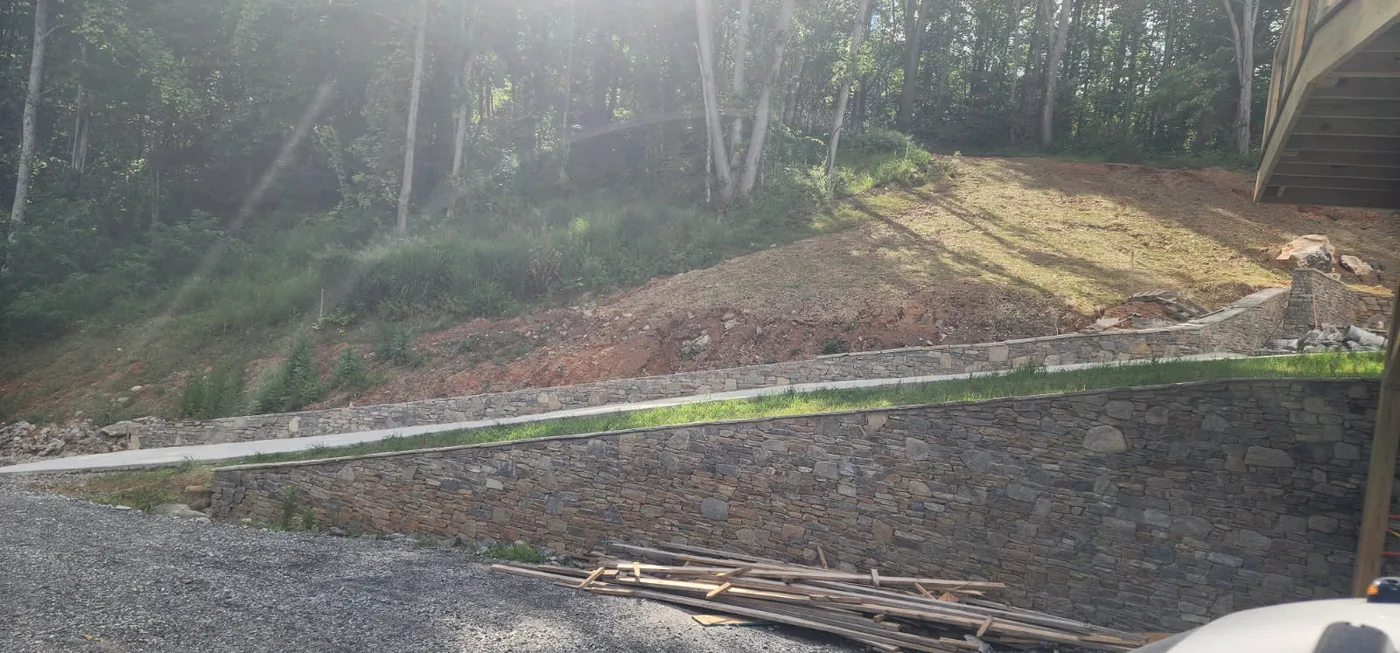
Quotes for retaining walls in the Asheville area do not look like the national averages you see on DIY sites. We build on mountain lots where stone is local, labor is skilled, and the ground has opinions. Between the steep ridge lots above Haw Creek, the terraced backyards in Montford, and the long driveway walls from Weaverville to Fairview, the price range is wide and the middle of it reflects our terrain.
| Scope of work | Typical Buncombe range | What drives it |
|---|---|---|
| Small garden wall, natural stone (under 20 ft, 2 ft high) | $2,200 – $4,800 | stone type, access, footing depth |
| Standard driveway wall, block or manufactured stone (20–40 ft, 3–4 ft high) | $5,500 – $12,000 | height, curve, drainage aggregate behind |
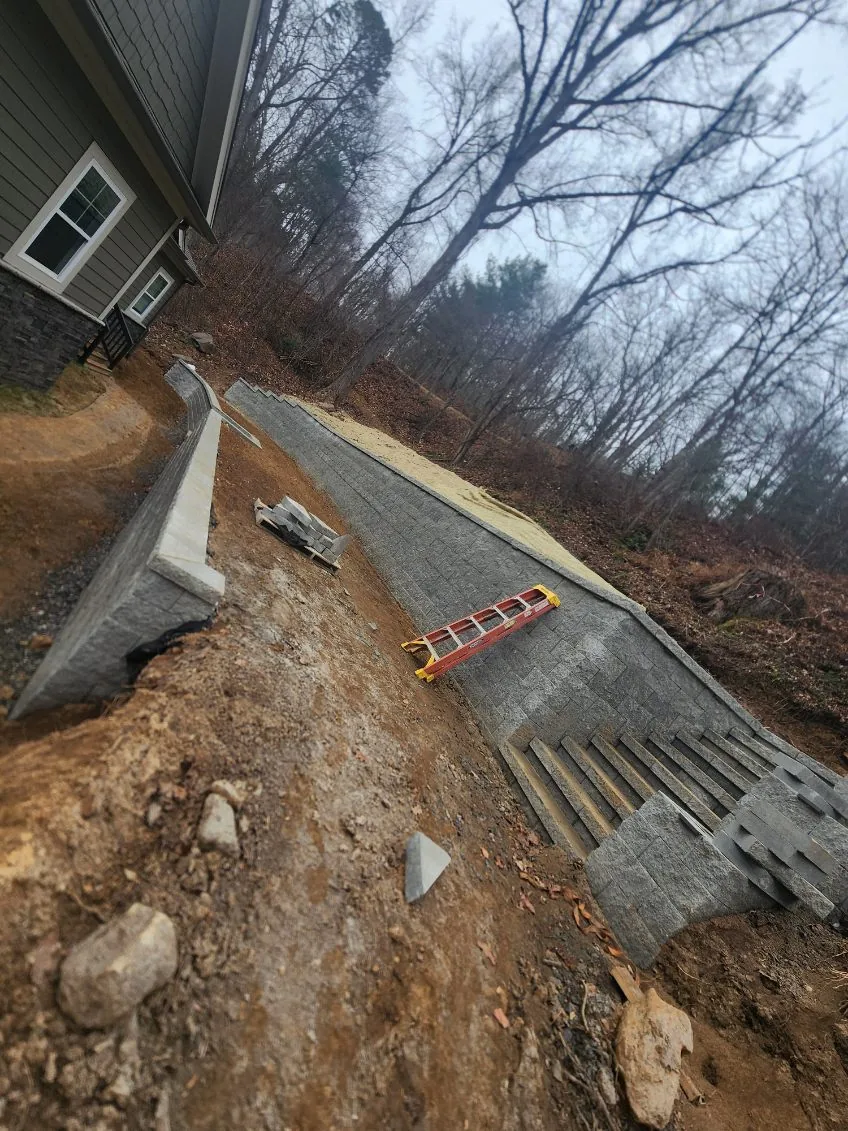
| Tall engineered wall (over 4 ft high, any material) | $12,000 – $30,000+ | geogrid reinforcement, engineered design, excavation |
| Full hillside terrace system (multiple tiers) | $18,000 – $50,000+ | total face area, access on slope, drainage complexity |
Those are honest working ranges, not quotes. A crew that gives you a firm number over the phone without seeing how the water runs on your lot is guessing with your money.
Why slope and water call the shots here
Buncombe County's elevation climbs from around 2,000 feet at the French Broad River to over 5,000 feet on the ridge lines. In between is a patchwork of red clay, weathered rock, and filled land that only a stop a drill bit can read accurately. Most failed walls in this county did not fall down because of bad stone; they leaned over because the builder skipped the drainage stone and the perforated pipe that move water away from the back of the wall.
Where does that water come from? The National Weather Service records show this county is no stranger to heavy rain events (NWS rainfall data for the southern Appalachians routinely shows 3-5 inch single-day totals during summer storms), and the federal disaster record confirms it: 19 federally declared disaster events have touched Buncombe County (1973-2026), most of them tied to flooding and severe storms. That history is why any structural wall here gets a drainage story before it gets a stone face.
We see the practical result every season: a retaining wall built without a proper gravel column and a drain line at its base is a plan to push water into your own backyard. The right order is always water first, wall second. Our guide to retaining wall costs explains what the drainage package adds to a project.
Wall design and the NC code reality
If you are in Buncombe County and thinking about a retaining wall that holds back more than four feet of dirt — or that sits near a structure, driveway, or property line — you have crossed into the territory where the NC Building Code expects a stamped design from a licensed structural engineer. The International Code Council's IRC code framework that North Carolina adopts has specific geotechnical requirements for retaining walls over that height. County inspections are routine for engineered walls; they want to see the reinforcing steel tied the way the drawing says and the drainage fabric lapped where the spec calls for it.
Contractors doing the work are almost always licensed under North Carolina's general contracting board (NC Licensing Board for General Contractors) once a project crosses $40,000 — a threshold that is easy to trip with site work, materials, and labor combined. If a contractor suggests skipping the permit on a wall over four feet tall, treat that as a red flag. The county's inspectors have seen exactly what happens to a wall that was backfilled before the clay (or the designer) objected.
Honest ground rules: walls under four feet, not supporting a structure, and set back from slopes and property lines — those are usually straightforward to do without a full engineered plan. Anything taller, or on a slope like most of this county, gets the engineering. That is not a hassle; it is the difference between a wall that looks good in photos and one that outlives your mortgage.
What makes bids come in so different
Get three quotes for an Asheville retaining wall and you might see a $4,000 spread on the same project. Some of that is honest difference. Most of it is how each bidder answers these three questions:
- Where does the water go? A bid with an undersized or missing gravel drainage blanket is a low bid that fails early. Ask every bidder to walk you through their drainage spec, not just their stone palette.
- What is the wall holding up? A 3-foot wall holding a flower bed is a garden feature. The same height retaining a gravel driveway or the foundation of a guest house is a structural element. Bids that treat them the same are not protecting you.
- How do you get material in? A crew that can get a mini-excavator and a pallet of stone close to the wall site will quote far less labor than one that has to wheelbarrow every stone 100 feet down a slope. Access is a price driver that has nothing to do with the stone you choose.
Want to see what a quality contractor walks you through before they bid? Our overview of retaining wall systems covers the options from treated timber to split-faced block to full natural stone. And for anyone just southwest of Asheville, the specific retaining wall landscape in Candler is worth a read — the soils there are their own story.
Natural stone or manufactured — a practical price note
Buncombe sits in the heart of Appalachian stone country, and the native options — Cherokee slate, moss rock, and the blue-gray gneiss that comes out of local quarries — are stunning. If the budget allows and the look matters, natural stone is the honest choice. But here is the trade secret: the raw material cost of local natural stone in Buncombe County can be comparable to high-end manufactured block, because the manufactured blocks are essentially never made here. They ship in from a regional plant, which adds freight. What truly changes your price is labor — natural stone is slower to set, every piece is different, and the masons take longer. Plan on $15-$30 per square foot for the face of the wall, which typically runs a third higher for dry-stacked or mortared natural stone than for modular block.
Whatever the material, the part you cannot see matters more than the part you can. The drainage aggregate behind the wall, the compacted fill, the footer that reaches below frost line — those are the components that stop a wall from becoming a retaining pile of rubble after a wet season. If your budget is tight between two bids, do not cut the drainage. Skip the fancy cap stone instead; a wall that sheds water will look good a decade from now when the cheaper wall has bowed.
Keeping your own price honest in this market
Three moves protect you when you are hiring in the Asheville area:
- Walk the site with every bidder. Do not send photos and ask for a quote. Point out where the water comes off your roof and where your neighbor's lot drains toward your property line. A good contractor will look at that first.
- Put the underground work in writing. Make sure the bid itemizes the gravel backfill, the perforated drain pipe, and the geotextile fabric (if specified). If those are bundled into a lump sum, ask for the cubic yardage so you can sanity-check it.
- Compare against this region's math. If a bid lands far outside the table above, make them walk you through it. Sometimes there is a real reason — the rock on your lot means everything is chisel work — and the explanation tells you as much as the number does. See the national cost breakdown for a sanity check, but rely on local bids for the final call.
If you are starting from scratch on what wall type suits your slope, our retaining wall guide is a place to begin. And if you are in the Candler area looking for a crew that knows those specific soils, we wrote about the Candler retaining wall picture too. Every slope is different; the questions you ask should not be.