What Madison County homeowners actually pay
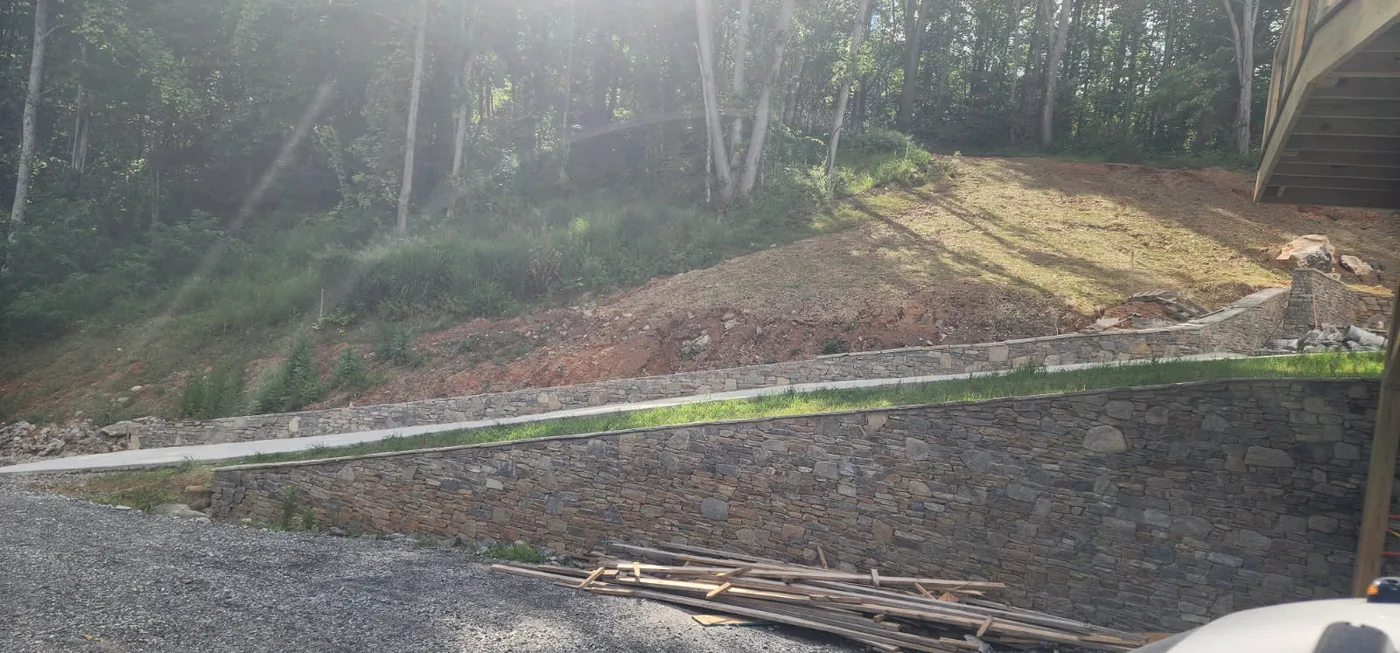
Madison County retaining wall projects don't price like national averages. The terrain between Mars Hill, Marshall, and Hot Springs is carved by the French Broad and its tributaries – homes sit on side slopes, ridge lines, and old creek terraces. That means walls here are often taller, longer, and need deeper footings than in the Piedmont. Most residential work in the county seat and unincorporated areas follows a similar pattern: the wall is holding back a driveway, a building pad, or a terraced garden on ground that falls away faster than a flat lot ever would. Here's a realistic range for common scopes seen across Madison County, from the flatter bottoms near the river to the steep pitches up toward the county line at Snowbird Mountain:
| Scope of work | Typical Madison range | What drives it |
|---|---|---|
| Timber or railroad-tie wall (retaining, 3–4 ft) | $3,500 – $7,500 | height, length, straight vs. curved, access |
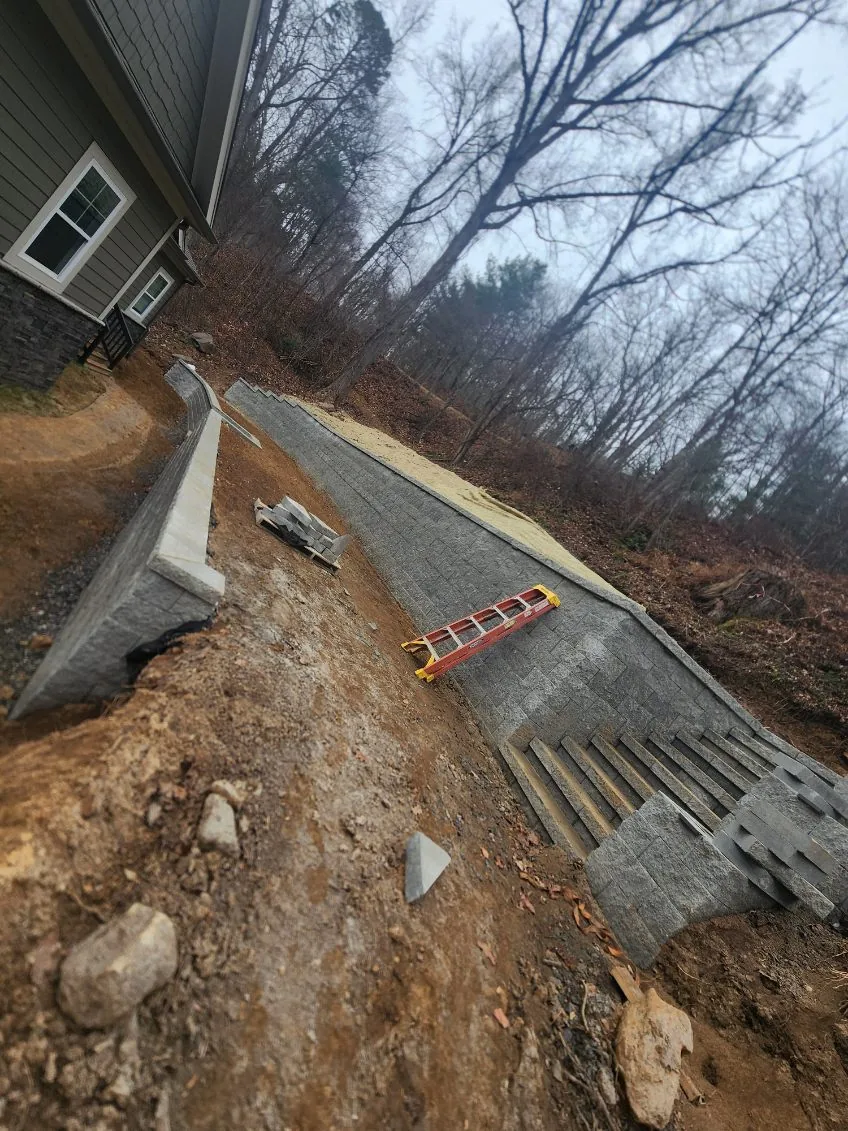
| Segmental concrete block wall (4–6 ft) | $5,500 – $12,000 | height, soil conditions, engineered footer, drainage |
| Natural stone or boulder wall | $8,000 – $20,000+ | stone type, labor intensity, dry-stack vs. mortared |
| Engineered retaining wall (over 6 ft, steep lot) | $15,000 – $30,000+ | geotechnical engineering, geogrid, tie-back, drainage |
Those are working ranges, not fixed bids. A contractor who quotes before seeing how water moves on your lot is guessing with your money. On a ridge-top lot near Wolf Laurel, drainage might be straightforward, but on a hollow-side property in the Big Laurel area, the same block wall can require twice the excavation and a pumped daylight line.
Why slope and soil change everything here
Most retaining wall failures in this county trace to water and shallow soil. Madison sits in the Blue Ridge, where the National Weather Service records frequent heavy rain events – the area has seen repeated storm and flood declarations over the years (see 21 federal declarations since 1978-2026). That history shows up as saturated hillsides, frost heave, and walls that lean after a wet winter. The county's steep hollows are often filled with colluvium – loose rock and soil that slid downslope over millennia – and that material does not behave like a compacted clay fill. It holds water in pockets, shifts when loaded, and can push a wall forward years after installation if it wasn't founded properly.
The practical consequence: in this county, a retaining wall quote that doesn't include drainage – gravel backfill, perforated pipe, and daylighting – is a quote for building twice. Always pair the wall with a water plan; see our guide to sloped backyards for what that adds. A wall on a homesite carved into a hillside near Marshall is not just holding back soil from one angle; it is often the boundary between the living space and an uphill drainage path that fills during every thunderstorm.
When engineering and permits are required
Any retaining wall over 4 feet in height – measured from the bottom of the footing to the top of the wall – typically requires a building permit in North Carolina under the International Code Council model codes, which the state adopts. The NC Building Code, enforced locally, mandates engineered plans stamped by a structural engineer for walls above 4 feet. Madison County enforces the state code, and the county's steep terrain often means a wall that is 3 feet on the downhill side might be 6 feet on the uphill side if it steps with the grade – a detail that forces a permit even when the visible face looks short. A wall that retains a surcharge (like a driveway) may need engineering even under 4 feet. If a contractor suggests skipping permits, that tells you what their structural sense is too.
Contractors doing structural work on retaining walls fall under the state's general contractor licensing thresholds, per the NC Licensing Board for General Contractors. Most residential walls land under the $30,000 threshold, but if your project is part of a larger grading job that crosses that line, or if you are building a tall wall with tie-backs, the contractor must be licensed. Always ask for proof of licensure. In Madison County specifically, where high elevation sites are often unstable fill from past logging or farming, an unlicensed contractor is a gamble no homeowner should take with thousands of dollars of soil on the line.
How to keep your retaining wall cost honest
Three moves protect your budget in Madison County:
- Get the drainage story first. Ask every bidder what the water is doing above and below the wall. The right order is water, then wall – and on a mountainside, the water is coming from somewhere you may not see from the deck.
- Price per square foot of wall face, not per linear foot. Height doubles price quickly – a 6-foot wall costs more than twice a 3-foot wall of the same length because of engineering, footing, and fill. On a Hot Springs slope with shallow rock, the footing may require hand-digging into weathered gneiss, which adds labor that no linear-foot estimate captures.
- Compare against the county range above. If a bid is far outside it, make them explain why – steep access, poor soil, or high stone cost are real reasons – and how they explain it tells you their competence.
Curious how other wall types price? See our retaining wall type guide or the full cost breakdown for the regional picture. Concrete block prices have climbed with fuel surcharges on delivery trucks, and a boulder wall near a remote ridge road might require a skid steer to shuttle stone 200 feet from the drop point – a cost that disappears on an open flat lot but shows up in your bid here.
Local realities: frost, fill, and what to expect
Frost depth in Madison County runs to about 18 inches – not as deep as New England, but deeper than most of the Piedmont, and it moves differently on exposed slopes. North-facing hillsides in the county, especially above 3,000 feet near the Tennessee line, stay frozen longer and thaw from the surface down, which can create a slip plane under a shallow footing. That means footings for masonry or concrete walls need to go below frost line in exposed locations. The U.S. Department of Housing and Urban Development provides guidance on frost-protected foundations that applies here, even though we're not in a deep-freeze zone. Fill soils are common in this county, especially where old homesites were leveled – and fill compacts slowly, which is why a wall built on fill today may shift years later if the fill wasn't properly compacted in lifts. On old farmsteads between Mars Hill and White Rock, the "level" area beside the barn is often uncompacted fill from the 1930s, and it will settle under the weight of a new wall unless excavated and re-compacted.
Another local factor: access. Many Madison driveways are steep, narrow, and winding, cut into hillsides that slide in wet years. If a concrete truck can't reach your wall, the crew mixes on-site or uses a pump – and that adds $500–$2,000 to the job depending on distance and slope. Ask your bidder how they plan to haul materials before you assume a flat delivery fee. A block delivery that costs $150 on a flat Asheville lot can run $600 plus a trans-load charge on a one-lane switchback above the French Broad. Time of year also matters – the county's red clay turns to slick grease after a spring rain, and a crew that can't get a loaded dump truck up a wet slope will charge for the weather risk in the busy season.